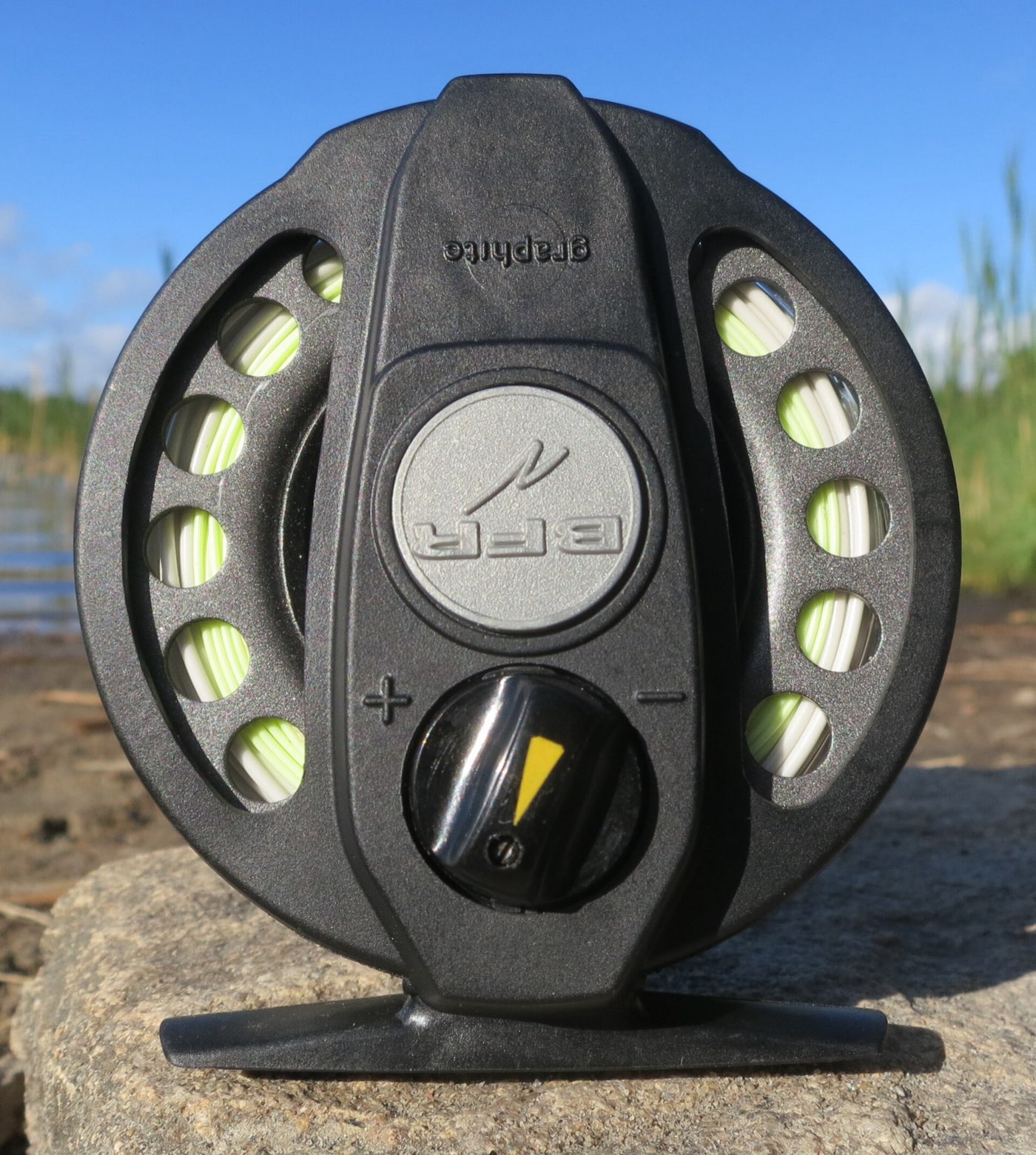
The Redington Behemoth 5/6 ($159.99, verified at farbank.com in September 2026) is the reel to put behind a 9-foot 5-weight trout rod when the budget stops near $160 and the priority is backing capacity and drag adjustment, not refinement. It weighs 5.7 oz, holds 125 yards of 20 lb backing, and runs an adjustable carbon fiber drag stack inside a die-cast frame. Buy it if you want the most drag and the deepest spool in a sub-$160 field and don't mind a drag Redington never calls sealed. Skip it if you dunk reels often and want a sealed drag you never have to think about: the Orvis Clearwater gives you one for $10 to $30 less, and the Waterworks-Lamson Liquid S for the same $159.99.
Spec sheet
- Model: Behemoth 5/6, one of five freshwater and saltwater sizes in the line, from 4/5 up to 11/12
- Weight: 5.7 oz
- Backing capacity: 125 yds of 20 lb backing
- Frame: die-cast construction, which Redington's own copy calls "unmachinable"
- Spool: interlocking large-arbor design, deep V-spool profile
- Drag: adjustable carbon fiber drag stack, sold as "super-heavy duty" by Redington
- Diameter: not published on the current product page
- Retrieve: converts between left-hand and right-hand with no tools
- Handle: twin molded, soft-touch ergonomic handle knobs
- Case: nylon reel case included
- Colors: Black, Gunmetal, O.D. Green, all $159.99
- Warranty: lifetime, backed by Far Bank (Redington's parent company, which also owns Sage and RIO)
Die-cast frame: what the "unmachinable" line actually means
Redington's product copy calls the Behemoth's construction "unique, un-machinable, die-cast." That phrase is a manufacturing distinction, not a marketing flourish. A machined reel starts as a solid bar of aluminum and gets cut down on a lathe, which is slow and expensive but produces a dense, consistent piece of metal. Die-casting instead forces molten aluminum alloy into a mold under pressure, which is fast and cheap and lets Redington sell a five-ounce large-arbor reel with a carbon fiber drag for under $160. It also produces a shape, in this case the interlocking spool and drag housing, that a machinist working from bar stock could not cut economically. That is the "unmachinable" part.
The tradeoff shows up under a hard, direct impact rather than under normal fishing loads. Cast aluminum alloys used in reels this price run more porous than the bar stock used in a machined frame, so a corner-first drop onto a boat ramp, a rock, or a tailgate is more likely to chip or crack the flange on a die-cast reel than it is to dent a machined one. Normal drag pressure, even a hard-pulling smallmouth or a fresh stocker digging for the far bank, is well within what a die-cast frame handles for years. It is a sharp edge strike, not cumulative fishing wear, that is the actual failure mode here.
Redington Behemoth drag: carbon fiber, adjustable, and not sealed
The drag is the reason to buy this reel over something cheaper. Redington's copy calls it a "super-heavy duty carbon fiber drag package" and claims it is "the most powerful drag in its class," a manufacturer claim worth treating as a claim rather than an independent measurement, since Redington doesn't publish a peak drag figure in pounds on the product page.
What is verifiable by reading the spec copy closely: nowhere does Redington use the word "sealed" for the Behemoth's drag. Compare that to the Orvis Clearwater, which Orvis specifically markets as having an "improved Carbon-to-stainless, sealed disc drag" that "resists corrosion," or the Waterworks-Lamson Liquid S, built around what Lamson calls a sealed conical drag. The Behemoth's carbon fiber stack sits in an adjustable housing without that sealing claim.
For a wading trout angler, that distinction matters more than the peak drag number. A reel that goes underwater, dipped scooping a fish into a net, dunked crossing a thigh-deep run, or simply held below the surface while you re-rig, lets grit and fine stream sediment work into an open drag stack. The failure mode is a gritty startup rather than total drag loss: the drag sticks slightly before it releases, then surges, which is exactly the moment a light tippet on a good fish can't absorb the jolt. Rinsing the reel in clean water and letting the drag knob cycle a few times after a dunking reduces this, but it's maintenance an owner has to remember, not something the reel handles on its own the way a sealed drag does.
Backing capacity and the large-arbor spool
The 5/6 holds 125 yards of 20 lb backing, which on a WF5 line is enough for any Mid-Atlantic trout stream and most smallmouth water without crowding the spool. The interlocking large-arbor spool and deep V-spool profile are built to pick up line fast on a fish that turns and runs at you, and a wider arbor reduces the tight coiling a long day of nymphing can put into fluorocarbon tippet stored on a small-diameter reel. For comparison, the Redington Crosswater IV 4/5/6 holds a WF6 line plus 100 yards of 20 lb backing in a lighter 5.0 oz reel, a real difference if you fish a lot of moving water where a hooked fish can strip line into the backing on the first run. The Behemoth's own limit here is the die-cast spool rim: dropped on a rock, a cast spool dents where a machined one scuffs, and a dented rim rubs the frame and drags on every retrieve.
Weight and balance on a 9-foot 5-weight rod
At 5.7 oz, the Behemoth sits on the heavier end for a 5/6 reel. A typical 9-foot 5-weight graphite blank weighs around 3 to 3.5 oz on its own, so a 5.7 oz reel shifts the outfit's balance point back toward the butt and the angler's hand. Some anglers prefer that: a butt-heavy outfit reduces wrist fatigue on a long day of high-sticking nymphs, since the rod doesn't want to tip forward when you hold it out over a run. Others find it makes the rod feel less lively on a dry fly cast, where a lighter reel like the Crosswater's 5.0 oz keeps the balance point closer to center. Neither is wrong. It depends on whether the rod spends more of the day held out at an angle (nymphing) or moving through a full casting stroke (dries).
Warranty and service: lifetime coverage from a large parent company
The Behemoth carries a lifetime warranty against defects in materials and workmanship, backed by Far Bank, the parent company that also owns Sage and RIO. That is a meaningful step up from the Crosswater's 1-year warranty on the same shelf. What it does not include is field service: at this price point, there's no user-rebuildable drag stack the way there is on a machined reel built for anglers to strip down and grease themselves. If the carbon fiber drag stack fails outside of normal wear, the practical path is a warranty exchange through Far Bank rather than a repair kit and an afternoon at the bench. For a reel meant to be inexpensive insurance behind a first serious trout rod, that's a reasonable trade.
Compared with
| Reel | Price | Frame | Drag | What separates it |
|---|---|---|---|---|
| Redington Behemoth 5/6 | $159.99 | Die-cast, large-arbor | Adjustable carbon fiber, not stated sealed | Reviewed here, most backing capacity and drag adjustment at this price, lifetime warranty |
| Waterworks-Lamson Liquid S -5+ | $159.99 (verified 2026-09-07) | Pressure-cast | Sealed conical drag | Same price as the Behemoth, but the drag is sealed against grit after a dunking |
| Redington Crosswater IV 4/5/6 | $79.99 | Durable composite/polymer | Carbon disc drag, not stated sealed | Half the price and lighter at 5.0 oz, but a 1-year warranty and less drag capacity for a big fish |
| Orvis Clearwater (II through IV) | $129 to $149 | Die-cast, powder-coat finish | Sealed carbon-to-stainless disc drag | Sealed drag at a lower price than the Liquid S, though the II size tops out at 5wt |
Verdict
Buy if: you want the most backing capacity and the strongest adjustable drag on a 9-foot 5-weight rod for under $160, and you're willing to rinse the reel and cycle the drag knob after it goes underwater.
Skip if: you dunk reels often enough that a sealed drag matters more than backing capacity, in which case the Orvis Clearwater ($129 to $149) or the Waterworks-Lamson Liquid S ($159.99) is the better fit for the same size rod.
Questions people ask
Is the Redington Behemoth drag sealed?
No. Redington's product copy describes an adjustable carbon fiber drag stack but never uses the word "sealed," unlike the Orvis Clearwater's sealed carbon-to-stainless disc drag or the Waterworks-Lamson Liquid S's sealed conical drag. Grit can work into the Behemoth's drag after a dunking, so rinse it and cycle the drag knob to clear it.
Redington Crosswater vs Behemoth: what does the extra $80 buy?
The Behemoth costs $159.99 against the Crosswater IV's $79.99, and the difference is frame material, drag capacity, and warranty length. The Behemoth's die-cast frame and larger carbon fiber drag stack are built for bigger fish and more backing, and it carries a lifetime warranty against the Crosswater's 1-year coverage. The Crosswater's composite frame is lighter at 5.0 oz and fine for stream trout and panfish where drag rarely matters.
What size Behemoth fits a 9-foot 5-weight rod?
The 5/6 size. Redington sizes the Behemoth line by weight range, and 5/6 is the smallest freshwater size, built for 5 and 6 weight rods. It holds 125 yards of 20 lb backing behind a 5-weight line, enough for typical Mid-Atlantic trout and smallmouth water.
Is the Redington Behemoth a good cheap large arbor reel for bigger fish?
For anything larger than stream trout and modest smallmouth, the drag capacity that makes the Behemoth a strong value at 5/6 also means anglers size up: the 7/8 and 9/10 versions target salmon, steelhead, and bigger warmwater species with the same die-cast construction and unsealed carbon fiber drag, so the same maintenance habit after a dunking still applies.
Related reading
- Orvis Recon 9-foot 5-weight review for a rod this reel balances well on.
- Best 5-weight fly rods for Mid-Atlantic trout for other rods sized to the Behemoth 5/6.
- RIO Gold WF5 fly line review for the line most anglers spool onto a reel this size.
- Euro nymphing: the complete guide for the high-stick technique where a large-arbor reel's fast pickup matters most.
- Savage River, Maryland fly fishing guide for freestone wading water where a dunked reel is a matter of when, not if.
Updated September 30, 2026.