Euro Nymphing: a complete guide to the technique that beats indicator fishing
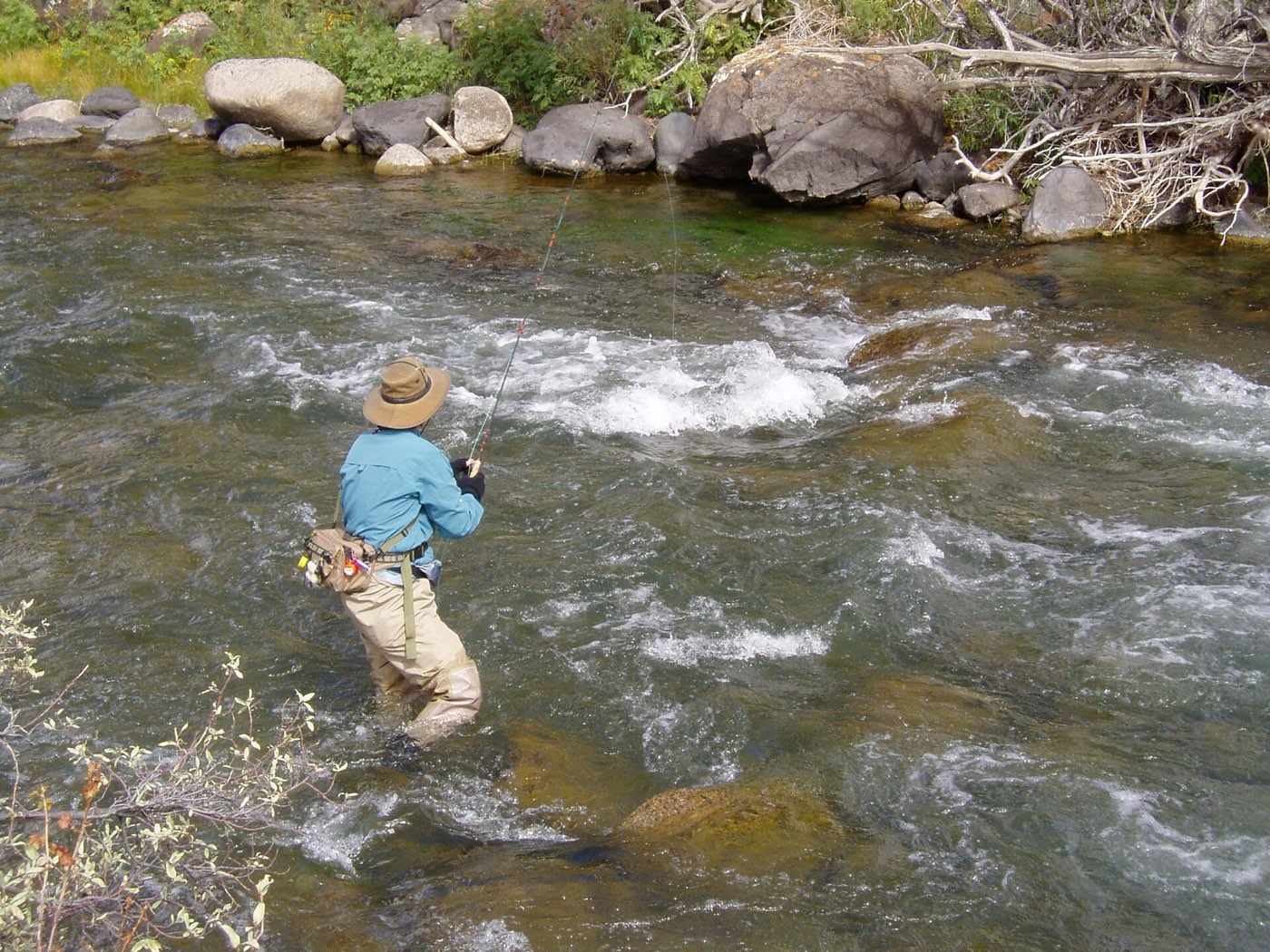
Euro nymphing is tight-line nymphing without an indicator. The angler holds the rod high, keeps a sighter (colored monofilament) in view, fishes two or three weighted nymphs on a long leader, and detects strikes through line tension instead of a bobber. The technique came out of European competitive fly fishing, won the World Championships repeatedly through the 1990s and 2000s, and replaced indicator nymphing as the dominant tactic on competitive Eastern trout water by the mid-2010s.
This is the pillar guide. It covers the history, the rig, the cast, the drift, the strike detection, the four regional sub-styles (Czech, Polish, French, Spanish), the gear, the common mistakes, and when to use something else. Bookmark it; the spokes link back here.
TL;DR
Long, soft rod (10-11 ft, 2-4 wt). Floating monofilament running line. Long mono leader with a colored sighter section. Two or three weighted nymphs on tippet rings. Cast upstream and across, lead the flies through the seam at line-tension contact, watch the sighter for any change. Strike on every tick. Out-fishes indicator nymphing in pocket water and runs under 4 feet deep.
Where Euro nymphing came from
Euro nymphing didn't appear from nowhere. The technique evolved from four parallel European traditions, each driven by competition rules that prohibited strike indicators and external weight on the leader.
Czech nymphing (1980s). Czech anglers competing in the World Championships developed short-line, deep-drift nymphing using heavy nymphs on a short leader. The rod stayed high; the line stayed off the water; strikes registered through the leader and the sighter. This was the foundation.
Polish nymphing (late 1980s). Polish national team angler Wladyslaw "Vladi" Trzebunia formally introduced European tight-line nymphing at the 1989 World Fly Fishing Championship. Polish style added longer drifts and refined the leader-sighter system. Vladi's Polish team dominated the early competition era.
French nymphing (1990s-2000s). French anglers extended the leader length and added a curlique-style sighter that reads strike movement more sensitively at long distance. French nymphing became the standard for fishing larger water at greater range.
Spanish nymphing (2000s). Spanish anglers refined the perdigon — a slim, heavily-weighted, hard-coated nymph that sinks faster than any traditional dressed pattern. Spanish style emphasized fast, deep penetration into the column and ultra-thin profile to defeat educated trout.
Modern Euro nymphing (post-2005). Around 2005, US competition anglers (Lance Egan, George Daniel, others) consolidated the European traditions and rebranded the result "Euro nymphing." The current dominant style draws from all four regional traditions and adapts to specific water types.
The deeper history reaches further back. English angler G.E.M. Skues developed tight-line nymphing in the late 1800s — discovering that rising trout that refused dry flies often took nymphs fished in the surface film. Frederick Halford, the dry-fly purist, persuaded the Fly Fishers Club of London to ban nymphing. Skues's technique survived in obscurity until the European competition circuit picked it back up 80 years later.
Why Euro nymphing works
4 reasons it out-fishes indicator nymphing on most water:
Direct line contact. The rod tip leads the flies through the drift. The angler feels weight changes, ticks, and pauses through the rod hand — strike detection happens 10x faster than watching a bobber drift downstream.
No indicator drag. A bobber on the surface drags differently than the flies sub-surface. The drag is subtle but consistent; over a 20-foot drift, an indicator rig presents an unnatural drift more often than not. Euro rigs eliminate that drag entirely.
Precise depth control. The angler controls where the flies fish in the column by adjusting rod height and leader length. Want the flies six inches off bottom? Lower the rod. Want them mid-column? Lift. Indicator rigs commit to a single depth per drift.
No surface disturbance. An indicator plops onto the water and gives fish a visible target. A Euro leader enters the water at a narrow angle — the only thing on the surface is a few inches of tippet. This matters most on close bank seams, where an indicator spooks fish before the flies arrive.
Where Euro nymphing under-performs:
- Water deeper than 4 feet. The technique loses contact at depth. Indicator rigs or sinking lines beat it.
- Long-distance presentations (40+ ft). Euro rigs work best at 15-30 ft. Beyond that, the angler can't maintain tension without spook-inducing rod movement.
- Active surface feeding. When trout are eating duns or spinners, fish dries.
- Wind over 15 mph. The high rod position is a kite in wind.
What you need (gear)
| Component | Spec | Why this matters |
|---|---|---|
| Rod | 10 ft to 11 ft, 2-4 wt | The long rod controls line height over the water; soft action protects light tippet |
| Reel | Standard click-pawl or basic disc | Reel choice barely matters in Euro — line stays in your hand |
| Line | Floating monofilament running line OR Euro nymph fly line | Specialty Euro lines exist; cheap mono running line works fine for the budget rig |
| Leader | 10-15 ft monofilament | Built tapered from 0.020" butt section down to 4X-5X tippet |
| Sighter | Colored monofilament section, 12-24 inches | The visual element you watch — pink/yellow/red two-tone is standard |
| Tippet rings | 2 mm | Allow tippet replacement without re-tying the leader |
| Tippet | Fluorocarbon, 4X-6X | Fluoro sinks; Euro nymphing wants the tippet in the column with the flies |
| Flies | 2-3 weighted nymphs | Tungsten beadhead anchor fly at the point (#10-14) + lighter dropper 18-24 inches above (#14-18 nymph or soft hackle) |
A dedicated Euro rod is not a prerequisite. A standard 9 ft rod like the Orvis Recon 9ft 5wt works — you give up some reach and leader control, but the technique translates, and you can decide later whether the specialty rod earns its place. Hook choice matters as much as bead size: a Pheasant Tail tied on a Hanak H400 BL Jig Hook sinks at roughly twice the rate of the same pattern on a standard nymph hook.
The Euro nymph leader
A standard French-style Euro leader, written tip-to-butt:
Fly line / running line connection
↓
0.020" monofilament butt section          (3 ft)
↓
0.018" monofilament                        (3 ft)
↓
0.015" monofilament                        (2 ft)
↓
0.013" monofilament                        (2 ft)
↓
SIGHTER — 12-24" colored monofilament      (~1.5 ft)
↓
Tippet ring (2mm)
↓
Fluorocarbon tippet, 4X-5X                 (variable, 3-6 ft to point fly)
↓
Tippet ring or surgeon's knot (dropper tag)
↓
Dropper tippet, 4X-6X                      (~12 inches)
↓
Dropper fly (lighter weight)
↓
Continued tippet
↓
Point fly (heaviest weight)
The angler watches the sighter. It enters the surface at the angle where the leader sinks; any change in angle, color visibility, or movement signals a strike.
Build the leader yourself or buy one. Commercial Euro leaders (RIO, Hanak, Umpqua) run $12-18 and skip the learning curve of tapering a connection that turns over correctly — a reasonable trade for a first season on the technique.
The technique, step by step
Step 1: Position
Stand at a 45-degree angle to your target seam, upstream side. Don't wade through the seam you're about to fish. Face downstream and across.
Common mistake at this step: Wading directly upstream into a productive seam. Trout in the lie spook before the rig hits the water. Approach from the side.
Step 2: Cast
Standard tuck cast: rod loads on a slow back stroke, accelerates on the forward stroke, and stops sharply with the rod tip pointing high. The flies flip forward and tuck into the water on the leader's recoil. Aim for a target 6-10 ft upstream of the lie you're fishing.
Common mistake at this step: False casting. Euro nymphing rigs tangle on false casts. Pick up, single back stroke, forward, present. If you need more distance, take a step.
Step 3: Lead the drift
As the flies sink, raise the rod tip to remove slack from the sighter. Maintain a slight downward angle from rod tip to sighter. Lead the flies downstream by tracking the rod tip parallel to the current — the sighter should drift just slightly behind a vertical line dropped from the rod tip.
Common mistake at this step: Letting the sighter trail too far behind the rod tip. Trail = slack = missed strikes. Or keeping the sighter dead vertical — vertical = the flies are dragging upstream, which trout reject.
Step 4: Watch the sighter
The sighter is your strike indicator. Any change reads as a strike:
- Sudden pause in drift
- Slight upstream tick
- Color of sighter visibly compresses or extends
- Sighter dives below surface
Common mistake at this step: Watching the flies instead of the sighter. By the time you see the take through the water, the fish has spit the fly.
Step 5: Set on every tick
Strike-set is upward, not back over the shoulder. Sharp 6-12 inch lift of the rod. If it's a fish, you're connected; if it's bottom, you free up the rig with minimal tangle.
Common mistake at this step: Big indicator-style sets. Euro sets are short and sharp. Big sets break tippet on rocks and snap small fish off.
Step 6: Cover the lie
A productive seam takes 3-5 drifts. Same lane, slightly different lengths each time. If three drifts produce no take, move to the next seam. Most fish are hooked within 15 ft of the angler — moving your feet matters more than casting distance.
Common mistake at this step: Standing in one spot for 15 minutes. Euro nymphing rewards mobility — work upstream covering pocket water, four to six drifts per lie.
Common mistakes (extended list)
Mistake 1: Sighter sag
What it looks like: The sighter belly droops below horizontal between the rod tip and the water entry point. Why it happens: Rod tip too low, or the angler isn't tracking with the current. The fix: Raise the rod tip. Sighter should be taut — not pulling the flies upstream, but with no slack.
Mistake 2: Fishing too deep
What it looks like: Constant snags. Tippet breaks every fourth drift. Why it happens: Wrong fly weight for the depth you're fishing. The fix: Lighter beads. Or shorter tippet to the point fly. Or both.
Mistake 3: Fishing too shallow
What it looks like: No takes on a productive-looking seam. Why it happens: Beads not heavy enough to reach feeding zone. The fix: Step up bead size. Tungsten 3.0-3.5mm for medium runs; 3.5-4.0mm for fast or deep runs.
Mistake 4: Tippet too heavy
What it looks like: No takes on a fishery you know holds fish. Why it happens: Trout see the tippet, refuse the fly. The fix: Drop one X-rating. Most Eastern Euro nymphing happens on 5X-6X.
Mistake 5: Setting on bottom contact
What it looks like: False sets on every other drift. Why it happens: Confusing bottom ticks for strikes. The fix: Set anyway. Bottom contact and strikes feel similar at first; with practice, the angler distinguishes them. Set rate goes down as the hand learns the difference. Until then, set on every change.
When this technique works
| Condition | Why | What to expect |
|---|---|---|
| Pocket water, 1-3 ft deep | Variable current; flies tumble naturally | Best water type for Euro |
| Riffles | Trout hold tight to seams; tight line beats indicator | Multiple takes per productive run |
| Cold water (40-55°F) | Trout sluggish, won't move for surface flies | Sub-surface is the only game |
| Pressured catch-and-release water | Fish refuse indicator rigs they've seen 100x | Euro rigs read as natural debris |
| Off-hatch periods | When nothing is rising, sub-surface produces | Day-saver technique |
When to fish something else
| Situation | Better technique |
|---|---|
| Water deeper than 4 ft | Indicator rig or full-sink line |
| Active dry-fly hatch | Match the hatch on a dry |
| Wind over 15 mph | Drop to indicator rig, or fish streamers |
| Spring runoff (high-water visibility under 6") | Streamer fishing |
| Distance presentations (40+ ft) | Standard nymph rig with indicator |
| Very slow pools (flies won't lead the drift convincingly) | Indicator rig or dry-dropper |
| Short-range pocket water without Euro gear | High-stick nymphing — faster, no specialized gear needed |
The four regional sub-styles
Czech nymphing
Defining trait: Short line. Fishing within a rod's-length of the angler. Heavy nymphs, vertical drift, very fast water. When to use: Boulder pocket water in fast, deep runs. The angler is essentially fishing a vertical shaft of water.
Polish nymphing
Defining trait: Slightly longer leader than Czech, with a more horizontal drift. Two flies typically; the upper fly imitates an emerger. When to use: Medium-fast water with mixed seam structure.
French nymphing
Defining trait: Long leader (15-20 ft), curlique sighter for sensitivity at distance. Fishing 25-40 ft downstream of the angler. When to use: Larger river water where fish hold beyond Czech-style range.
Spanish nymphing
Defining trait: Perdigon-style flies (slim, hard-coated, ultra-fast sinking) on a long leader. Emphasis on the fly profile to defeat selective trout in clear water. When to use: Tailwaters and clear-water fisheries with educated fish.
Modern Euro nymphing pulls from all four. American competition anglers tend to fish a French-influenced length with Spanish-style flies in clear water and Polish-style two-fly rigs in faster runs.
Drills to practice
Sighter visibility drill. Set a target on the bank. Cast, drift, hold the sighter at four positions: rod tip 90°, rod tip 60°, rod tip 30°, rod tip 0°. Notice when the sighter loses sensitivity. That's your operating range.
Strike-or-snag distinction. On known productive water, set on every change in the sighter for 30 minutes. Track strikes vs. bottom contacts. The hand learns the difference within an hour of focused practice.
Bead-size calibration. Bring three nymphs in 2.5mm, 3.0mm, and 3.5mm beads. Fish each in the same run for 15 minutes. The bead that produces takes is the right one for that depth.
The leadership drill. Practice keeping the sighter exactly 6 inches behind a vertical line dropped from the rod tip. Most strike misses are caused by sighter trail outside that window.
Patterns that pair with this technique
- Mop Fly — heavy point fly for deep runs
- Walt's Worm — natural-imitation point fly for limestone water
- Perdigon Nymph — Spanish-style ultra-fast-sinking dropper
- Frenchie Nymph — Lance Egan's high-confidence Euro pattern
- Green Weenie — bright trigger dropper
Where to fish this technique
- Gunpowder Falls Maryland — pocket water; ideal Euro terrain
- Savage River Maryland — boulder pocket water below the dam
- North Branch Potomac — cold tailwater rewards short-line Czech-style
Further reading
- Dynamic Nymphing by George Daniel — the most thorough single book on modern Euro
- Nymph Fishing by George Daniel — the prequel; foundation work
- Tactics, Tips & Tricks for Tight Line and Euro Nymphing by Lance Egan — competition angler perspective
- Troutbitten — Domenick Swentosky's running corpus on tight-line technique
*Last updated: 2026-04-28. *
Sources cited: Hatch Magazine — Building a simple Euro-style tight line nymphing leader, Troutbitten — The Nine Essential Skills for Tight Line and Euro Nymphing, Wet Fly Swing — Beginners Guide to Nymphing, Simpson Fly Fishing — Euro Nymphing: an Old American Technique, The Sovereign Piscator — How European Nymphing is Different from Traditional Tight Line Nymphing.
