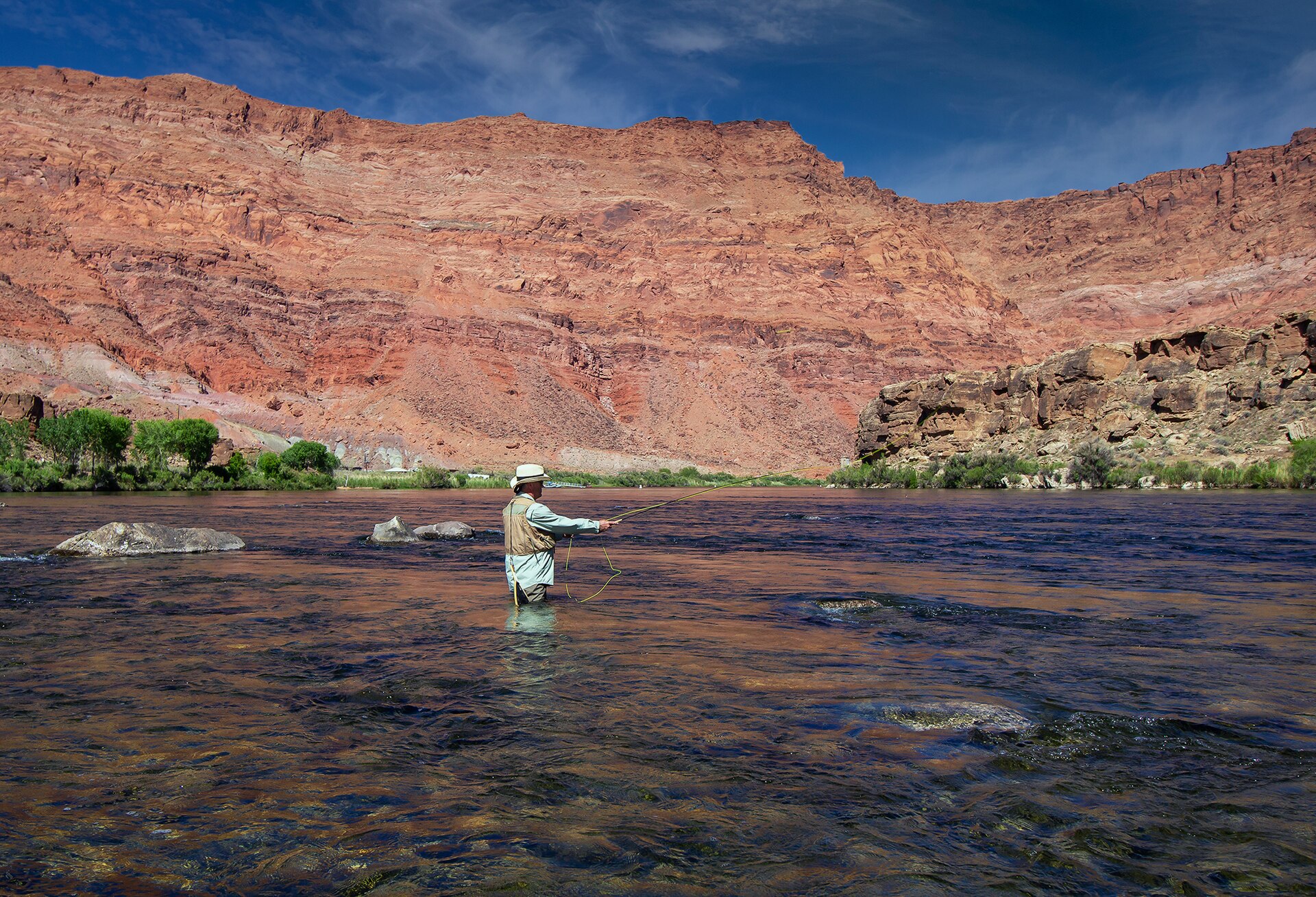
Quick reference
| Field | Value |
|---|---|
| State / region | Arizona, northern Arizona below Glen Canyon Dam near Page |
| Species | Rainbow trout (dominant), brown trout |
| Best months | March–May and October–November; the tailwater fishes year-round |
| Water type | Tailwater |
| Difficulty | Intermediate to advanced — technical indicator nymphing with small flies on big, clear water |
| Wading | Possible on sand and gravel bars at lower flows; strong mid-channel current limits it, and most water beyond the walk-in reach is boat access |
Why fish here
Lee's Ferry is the cold, clear tailwater immediately below Glen Canyon Dam, running through Glen Canyon National Recreation Area to the Grand Canyon boundary, and it is widely regarded as Arizona's most celebrated fly-fishing destination. The draws are concrete: stable flows and temperatures that never depend on snowpack or runoff timing, high densities of wild rainbow trout, and roughly 15 miles of big-river water split between walk-in fishing near the ramp and long boat-access runs beneath redrock canyon walls.
The fish justify the trip on their own. Average trout often run in the 14–18 inch class with chances at larger fish, and they respond to refined indicator nymphing with midges, scuds, worms, and small streamers — a fishery that rewards technical presentation and careful reading of current seams rather than brute coverage. This is one of the Southwest's premier technical nymph fisheries, and it fishes like it.
The other advantage is the calendar. Year-round midge activity plus seasonal terrestrials — cicadas in late spring, hoppers through summer, Tricos in late summer — mean there is almost always a productive program for anglers willing to adapt depth, weight, and drift. Winter is a pure midge game; summer adds foam dries against the banks.
The river, section by section
Walk-in area — Paria Riffle to Lees Ferry Boat Ramp
Access: The Lees Ferry Boat Ramp and adjacent parking off Lees Ferry Road within Glen Canyon NRA; the Paria Riffle at the Paria River confluence marks the downstream walk-in boundary. Character: Broad, slow-to-moderate gradient big river — long runs, cobble and gravel bars, defined seams along banks and mid-river shelves. Structure reads as large, extended runs with soft edges rather than tight pocket water. Species mix: Primarily rainbow trout, managed as a tailwater trout fishery. Crowding: The highest concentration of anglers on the river, especially weekends and the pleasant spring and fall windows. Arrive early to secure parking in the upper lot. Notable hatches: Year-round midges, strongest late morning to early afternoon; spring BWOs; cicadas, hoppers, and Tricos from late spring through early fall.
This is the only substantial water at Lee's Ferry that requires no boat, and it fishes well enough that plenty of anglers never leave it. Wading is workable from sand and gravel bars at lower flows but limited by depth and strong mid-channel current — fish from shore or hop bars rather than pushing deep. Indicator nymphing and dry-dropper rigs cover most of it effectively.
Mid-river boat section — Lees Ferry Boat Ramp to Cathedral Wash
Access: Jet boat, drift boat, or raft launched at the Lees Ferry Boat Ramp, running upstream to named bars and runs. Most anglers and guides concentrate on the first several miles above the ramp, where trout are densest. Character: Classic big-tailwater structure — long deep runs, broad mid-river shelves, current seams along cliff faces and islands, strong but predictable currents. Riffles are subtle and tied to bars and side channels. Species mix: Dominated by rainbow trout, including many of the system's larger fish, concentrated along seams, shelves, and deeper runs. Crowding: Guide and private boat traffic is common in prime seasons, but the 13-mile reach from the dam to the ramp disperses pressure; picking bars carefully finds uncrowded water even when the ramp is busy. Notable hatches: Midges every month of the year; BWOs in spring, cicadas and hoppers late spring into summer, Tricos late summer to early fall.
The boat section is the heart of the fishery. The standard approach is running upriver, anchoring or beaching at a bar, and wading the gravel while working seams with indicator rigs — boat positioning and drift management matter as much as fly choice. Streamer fishing in the deeper slots adds a second program when the nymphing slows.
Upper tailwater near Glen Canyon Dam
Access: A maintained trail from a parking area above reaches the upper river, and boats can run up from the ramp; managers and outfitters have identified several designated wade-fishing areas. Character: The most classic tailwater traits on the river — very clear water, cold stable temperatures, uniform deep runs with powerful laminar current. Gradient is gentle but depth is significant; structure is long runs and seams, not pocket water. Species mix: Primarily rainbow trout, with strong populations near the dam's cold, stable releases — this reach holds many of the system's largest fish. Crowding: Moderate, dominated by guided boats and experienced private boaters; foot traffic is lighter given the access effort. The reach's length provides room to spread out even on busy weekends. Notable hatches: Midges year-round with intense but subtle subsurface activity; spring BWOs and summer terrestrials in softer edges and eddies; technical Trico mornings in late summer slicks.
The upper river is where precision pays most. Wading is confined to shoreline trails and small bars, and much of the productive water is best covered by boat drifts with long indicator rigs. Precise mending and drag-free drifts count for more here than aggressive wading — the water is uniform, the fish are educated, and the flies are small.
Hatches and seasons
| Months | Hatches | Flies |
|---|---|---|
| Jan–Feb | Midges throughout; occasional surface clusters on calm days | Zebra Midge, Disco Midge, black/silver midges (#18–22); Griffith's Gnat and small Adams for adult clusters |
| Mar–Apr | Midges plus building BWOs; dry-fly windows on overcast days | Zebra and Disco Midge (#18–22); Parachute BWO (#18–20); midge emergers and adults (#18–22) |
| May–Jun | Strong midges with cicadas starting late spring; some BWO overlap | Zebra Midge (#16–22); foam cicadas (#6–10); Parachute BWO (#18–20); cicada/hopper dry-dropper over midge or scud |
| Jul–Aug | Midges all day; hoppers and terrestrials dominate afternoons; Tricos begin late summer | Zebra Midge (#16–22); foam hoppers (#6–10); Trico spinners (#20–24); scuds in pink/orange/olive (#14–18); San Juan Worms |
| Sep–Oct | Midges strong; hoppers taper; Trico mornings; midges primary by October | Zebra and Disco Midge (#18–22); foam hoppers early fall; Trico spinners (#20–24); small BWO and midge emergers |
| Nov–Dec | Cold-season midge fishery; best windows mid-day | Zebra and Disco Midge (#18–22); black/silver midges (#16–22); Griffith's Gnat for sporadic risers |
Recommended flies (by season)
| Season | Top patterns | Why |
|---|---|---|
| Spring | Zebra Midge (#18–22), Disco Midge, Parachute BWO, scuds (#14–18), San Juan Worms, egg patterns in spawning periods | Cold, stable spring water keeps trout on midges and small mayflies; BWOs show on overcast days while eggs, worms, and scuds cover higher-protein feeding in runs and on bars |
| Summer | Zebra Midge (#16–22), foam cicadas and hoppers (#6–10), Trico spinners, larger scuds, San Juan Worms, small Woolly Buggers on sink-tips | The tailwater stays cool through desert summer, supporting strong midge activity plus real terrestrial fishing along banks and shelves; heavier rigs reach deep slots when sun pushes fish into structure |
| Fall | Zebra and Disco Midges (#18–22), Trico spinners early, small BWOs, scuds, San Juan Worms, small buggers and leeches | October–November is widely cited as one of the best windows here — active midging, comfortable temperatures, and fish feeding aggressively before winter |
| Winter | Zebra Midge (#18–22), Disco Midge, black/silver midges, subdued scuds, worms and small buggers bounced deep | Winter is a pure midge-and-nymph game with mid-day windows around stable releases; small, precise presentations near bottom keep producing |
Gear notes
A 9-foot 5- or 6-weight with a weight-forward floating line handles the indicator rigs, wind, and occasional streamer work this big tailwater demands. For walk-in technical nymphing, run a 5-weight with 9–12 foot leaders to 5X–6X fluorocarbon; boat sections favor a 6-weight with 4X–5X and an optional sink-tip for streamers. A documented indicator setup: 9-foot 4X leader, 4X tippet, flies 16 inches apart, 0.5–2 g of weight, and 6–9 feet from weight to indicator depending on current and depth. Bring sturdy boots with real traction for slick cobble, a wading staff for big-river current, and season-appropriate breathable waders; boat anglers need PFDs and serious sun protection in the exposed canyon.
Logistics
- Regulations: From Glen Canyon Dam roughly 15.5 miles down to the Paria River confluence, the fishery is artificial flies and lures only, barbless hooks, no bait — managed by Arizona Game and Fish. The daily limit in this reach is typically 2–3 rainbow trout (possession 6), with only one fish over 16 inches; guides strongly encourage catch-and-release. Below Navajo Bridge to Separation Canyon there is no sportfish limit, though that canyon water is rarely fished by wading anglers. An Arizona fishing license is required, plus a Glen Canyon NRA entrance fee (National Park Service) for vehicle access. No fishing below the Paria confluence, which marks the Grand Canyon National Park boundary. Regulations change annually — verify current rules before the trip.
- Access points:
- Lees Ferry Boat Ramp — primary access for the entire fishery; paved road, trailer and walk-in parking, launch for jet boats, drift boats, and rafts — 36.8612, -111.5860
- Paria Riffle (Paria River confluence) — downstream walk-in reference point and regulatory boundary
- Closest fly shop: Lees Ferry Anglers (Marble Canyon)
- Nearest towns: Marble Canyon, Page, Fredonia, Kanab
- Closest gauge: USGS 09380000 — Colorado River at Lees Ferry, AZ
When NOT to fish here
Snowmelt runoff never blows out this tailwater, but some windows are worth avoiding. Extremely hot summer afternoons are punishing in the exposed canyon and compress good fishing into early morning and late evening. Dam-operation flow changes can temporarily alter wading safety and clarity, so watch releases before committing to a bar. Popular spring and fall weekends crowd the ramp and walk-in water. And desert wind events can wreck both boat control and indicator drifts — a high-wind forecast is the single best reason to shorten or skip a day here.
Where to fish next
- Fly Fishing in Arizona — the full state guide
- Colorado River through Grand Canyon — the downstream continuation, largely a rafting-supported fishery
- Lake Powell — the reservoir fisheries upstream near Page, a different game entirely