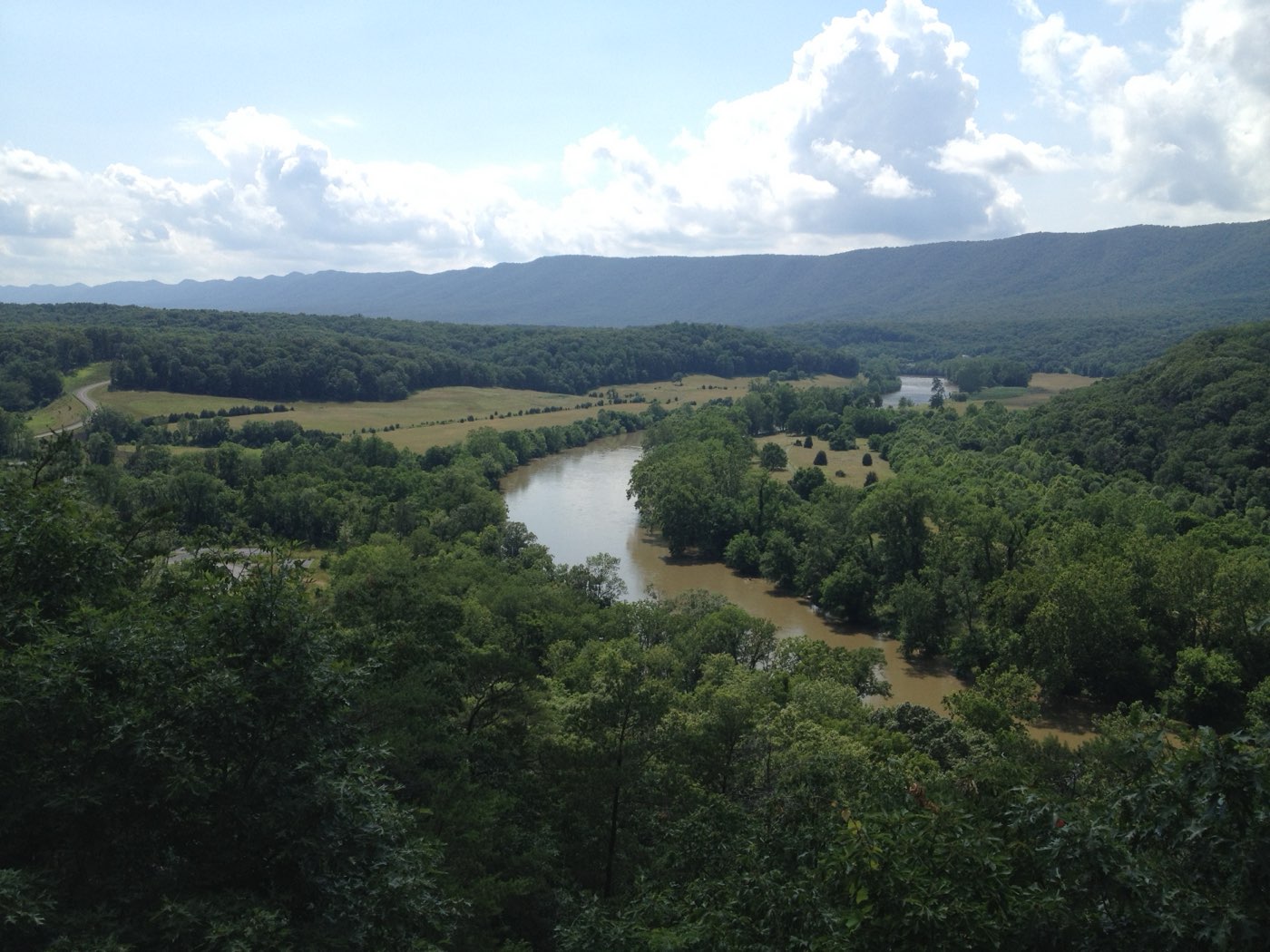
The Shenandoah River runs 150 miles through northern Virginia, from the South Fork's headwaters near Port Republic to the confluence with the Potomac at Harpers Ferry. The South Fork, the North Fork, and the Main Stem below Front Royal are the three sections fly anglers actually fish. Together they form one of the most productive smallmouth bass fisheries on the East Coast — a fishery that pulls Mid-Atlantic anglers through July when the trout streams blow out for summer.
This guide focuses on the South Fork below Luray and the Main Stem from Front Royal to Harpers Ferry. Both sections fish similarly: float-or-wade, primarily smallmouth, with seasonal sunfish and channel cat by-catch. The North Fork is shallower, more wadable, and more pressured by canoe traffic — secondary water for serious smallmouth anglers.
When to fish
The smallmouth season runs from late April through October. Productivity tracks water temperature; fish hardest when temps are 60–78°F.
Late April – early June: Pre-spawn through spawn. Smallmouth move to gravel flats and stage near current breaks. The most aggressive surface fishing of the year happens during the pre-spawn window when males defend nesting territory. Crayfish patterns and dark woolly buggers fish below; poppers fish at first light. Water can still run high from late spring rains; check USGS gauges for Front Royal (gauge 01631000) before driving in. Optimal flow for fly fishing is 200–600 cfs at Front Royal; above 1,000 cfs, switch to bait water or wait it out.
Mid-June – mid-July: Peak topwater. White sulphurs, hex spinner falls, and damselfly emergences put smallmouth on the surface in the late afternoon. Boogle Bug poppers in white and yellow draw strikes from the largest fish of the year. Float-fishing dominates this window — drift boats, rafts, and canoes cover water faster than wading and put more flies in front of more fish.
Late July – mid-August: Heat suppression. Water temps push 80°F+ in afternoons; smallmouth go deep and feed less aggressively. Pre-dawn topwater and post-dusk crawler patterns produce; midday is dead. Most serious smallmouth anglers shift to West Virginia mountain water in this window — the Shenandoah comes back to life when the heat breaks.
Late August – October: Fall feed-up. Cooler nights drop water temps back into the 70s, smallmouth feed aggressively for winter, and structure-oriented fishing returns. Crayfish patterns (Whitlock's NearNuff Crayfish, Schultzy's Cray), Murdich Minnows in baitfish colors, and bigger streamers swung deep produce some of the largest fish of the year. Lower angling pressure, brilliant fall foliage on the Massanutten ridge.
November – March: Smallmouth become dormant below 50°F. Catchable but slow. Most anglers don't fish smallmouth winter; pivot to trout in the Shenandoah National Park streams or to the Gunpowder Falls tailwater up the road.
What to fish
The Shenandoah smallmouth bass diet is roughly 60% crayfish, 25% baitfish (shiners, sunfish, young-of-year smallmouth), 15% terrestrials and aquatic insects. Fly selection follows that distribution.
Topwater (mid-June through August, dawn and dusk):
- Boogle Bug poppers, sizes 4–6, white/chartreuse/yellow
- Tap's Bug or hair-bug variations in size 2–6
- Sneaky Pete sliders for spookier fish post-spawn
- Foam grasshopper patterns (Morrish Hopper) in late summer
Crayfish (year-round, primary food source):
- Whitlock's NearNuff Crayfish, sizes 2–6, brown/olive
- Schultzy's S3 Crayfish (Mike Schultz original) — best in stained water
- Clouser Crayfish for fishing deep along the bottom
Baitfish streamers (spring and fall):
- Murdich Minnow, sizes 2–4, white/chartreuse
- Clouser Minnow, sizes 2–4, chartreuse-and-white or olive-and-white
- Game Changer (smaller scale, 4–6") for fall trophy water
- Woolly Bugger in black/olive — never out of place
Generalist nymph and dropper patterns:
- Squirmy Wormy as a dropper off a popper — see our pattern guide
- Walt's Worm when smallmouth eat smaller invertebrates
- Lefty's Bugger variations
Tippet: 12 lb fluorocarbon for streamers and crayfish, 8–10 lb for topwater poppers, 1X-2X mono for shallow-water dropper rigs. Smallmouth are not leader-shy in stained water; size up tippet to handle hard strikes and grabby cover.
How to fish it
Three approaches dominate Shenandoah smallmouth fishing. Choose by water type and time of year:
Float-fishing from a raft or canoe. The dominant tactic on the South Fork below Luray and on the Main Stem. A two-angler float covers 6–10 river miles in a half-day. The downstream angler casts to bank cover and structure as the boat drifts; the upstream angler rolls poppers and streamers through riffles and pool tails. Anchor on productive banks and work them with multiple casts before drifting on. Outfitters in Bentonville, Luray, and Front Royal run guided floats April through October.
Wading riffle-and-pool sections. Wadable from any of the public access points listed below. Cast across and downstream with streamers, swinging the fly through pool tails and riffle drops. Smallmouth hold tight to seams, just like trout, but they hold deeper and farther downstream of the seam break. Don't cast directly upstream of holding water; cast to the seam and let the streamer swing across.
Sight-fishing the gravel flats. Pre-spawn (May) and during the spawn (late May through mid-June), smallmouth defend nests on visible gravel flats in 2–4 feet of water. Walk the bank, polarized lenses on, spot the nesting fish. Cast a small Clouser or crayfish 6 feet upstream of the nest; the male will charge and strike on the third cast at the latest. Catch and release immediately; the spawn is short and disturbing nesting fish damages the population.
For technique-focused tactics in either tactic, see smallmouth bass fly fishing.
Access
Public access on the Shenandoah is excellent through Virginia Department of Wildlife Resources (VDWR) boat ramps and through Shenandoah River State Park. Most ramps are free; some charge a $3-5 day-use fee. Top to bottom on the South Fork and Main Stem:
South Fork:
- Massanutten / Foster Fall — Page County; primitive ramp, good float launch for the Massanutten section
- Inskeep — Page County; concrete ramp, popular put-in for the Inskeep-to-Bealer's Ferry float (~7 miles, half-day)
- Bealer's Ferry — Page County; concrete ramp, take-out for the Inskeep float
- Burner's Bottom — Warren County; primitive ramp
- Bentonville — Warren County; concrete ramp, the central put-in for the famous Bentonville-to-Karo Landing float (8 miles)
- Karo Landing — Warren County; concrete ramp, take-out for the Bentonville float
Main Stem (below confluence at Riverton):
- Riverton / Morgan's Ford — Warren County; concrete ramp at the confluence
- Lockes Landing — Clarke County; concrete ramp, classic put-in for the Lockes-to-Berry's float
- Berry's Ferry — Clarke County; concrete ramp, take-out for the Lockes float and put-in for the Berry's-to-Castleman's float
- Castleman's Ferry — Clarke County; concrete ramp
- Watermelon Park — Clarke County; private campground with public boat access for a fee
Shenandoah River State Park (Bentonville) is the single best access for an out-of-state angler new to the system. The park has multiple boat ramps, a campground, picnic shelters, and 24 miles of hiking trails along the river. Day-use fee runs $7-10 in season. The park's smallmouth water is among the most productive on the South Fork.
Wading vs. floating. Most of the South Fork can be waded at the listed access points, but covering water on foot is slow — a wading angler covers maybe 1/2 mile in a half-day. Float-fishing is the high-percentage approach for anglers traveling to the river. Wade if you live nearby and fish small windows after work; float if you've come for a destination day.
Stream access law. Virginia does not have a stream-access law as broad as Montana's. The river bottom of the Shenandoah Main Stem and the South Fork below Port Republic was ruled "Crown grant" — public-bottomed and accessible without trespass — by the Virginia Supreme Court in Kraft v. Burr. Practically: wade and fish anywhere you can legally enter the river. Do not cross private upland without permission to access the water. The North Fork below Mount Jackson is similarly public-bottomed; above Mount Jackson, the law is more contested.
Regulations
Read the current VDWR regulations before fishing — they update annually and the Shenandoah has section-specific rules.
The fixed elements:
- License required. Virginia freshwater fishing license, sold online via the VDWR website, at any sporting goods store, or at the river-side outfitters. Non-resident annual license is $47; non-resident 5-day license is $23.
- Smallmouth limit: Statewide limit is 5 fish daily, 11" minimum size on the Shenandoah Main Stem and South Fork. Most fly anglers practice catch and release — the trophy fishery depends on it. Photograph and release any fish over 16".
- Catch and release of smallmouth between 11" and 14" is required on the South Fork from the Massanutten access downstream to the confluence at Riverton. This protects the breeding population.
- No fishing during the smallmouth spawn — the VDWR closes specific spawning gravel flats from May 1 through June 15 in some years. Check the current regulations before fishing in May.
- Other species: Channel catfish, sunfish, and rock bass have their own limits. Walleye are stocked in the lower Main Stem and require a 15" minimum.
Treble hooks are legal but discouraged on flies; the Shenandoah's gravel cover snags treble hooks aggressively.
Where to base
- Front Royal, VA — Northern entry to the river system, easy access from I-66 and Northern Virginia. Closest base for Bentonville-to-Karo and Riverton floats.
- Luray, VA — Central South Fork base; closest to Inskeep and Massanutten access. Quieter than Front Royal.
- Bentonville, VA — Smallest of the three, but home to Shenandoah River State Park and several outfitters. The right base for an out-of-state angler doing 2-3 days on the water.
- Charles Town / Harpers Ferry, WV — North end of the system at the Potomac confluence. Best for fishing the lowest stretch of the Main Stem.
Guides and shops
The Shenandoah outfitter scene is smaller than Montana's but capable. Brief picks:
- Front Royal Outdoors (Front Royal) — Outfitter and shuttle service for the Main Stem and lower South Fork. Tube, kayak, raft rentals. The default choice for self-guided floats.
- Shenandoah River Outfitters (Bentonville) — Full-service outfitter on the South Fork; runs guided trips and rents canoes, kayaks, and rafts.
- Murray's Fly Shop (Edinburg) — North Fork shop; the classic Shenandoah Valley fly shop with deep ties to the regional smallmouth scene. Worth a visit for fly selection and current intel.
- Shenandoah Fishing Adventures (Bentonville) — Guided wade and float trips with a smallmouth specialist guide bench.
- Mossy Creek Fly Fishing (Harrisonburg) — Larger regional shop covering Shenandoah Valley and Massanutten-area fisheries; books Shenandoah trips alongside trout work.
A guided full-day smallmouth float on the Shenandoah costs $400–550 for two anglers in 2026, plus tip, lunch, and gratuity for the shuttle. Book 30+ days out for prime June and September weekends.
What to bring
- A 6 or 7-weight fly rod for streamers and crayfish; an 8-weight if you're committed to throwing 6" Game Changers or large hair bugs all day.
- Floating line for everything except deep-water late-summer streamer fishing, where a Type II sink-tip or full-sink line takes the fly to where the fish are. RIO Gold WF5F sized to the rod's line weight is fine for most situations.
- Polarized sunglasses with a copper or amber tint for spotting fish on gravel flats.
- A waterproof boat bag or sling. Fishpond Thunderhead Submersible Sling handles the volume of fly boxes a smallmouth angler carries.
- Wet-wading shoes and quick-dry pants for summer floats; full waders are unnecessary May through September. Bring waders only in April or after October.
- Sunscreen and a sun hat. The Shenandoah Valley runs open to direct sun for most of the float water. UV-protective long sleeve fishing shirts pay off after a few hours of June float-fishing.
- A landing net with rubber mesh — smallmouth fight hard and rubber mesh protects fins and slime coat better than knotted nylon. Fishpond Nomad Mid-Length Net.
Patterns that work here
- Mop Fly — heavy crawfish-imitation point fly in deep pools
- Walt's Worm — smaller meat-and-potatoes nymph as a dropper
- Squirmy Wormy — dropper off a popper for sluggish summer fish
Techniques to master
- Smallmouth bass fly fishing — the technique guide for warmwater fly tactics
- Reading water on trout streams — same principles apply to smallmouth seam-and-pocket water