Reading water on trout streams
Fly fishing technique comes down to presentation, and presentation is downstream of positioning. An angler who can read a stream selects the correct position before casting — and from the correct position, even a mediocre drift catches fish. Without water-reading, the same drift misses them entirely. The skill is that consequential.
Reading water means inferring where fish hold, where they feed, and what controls both — from visible surface clues: current speed, color change, seam formation, and structure. None of it requires seeing through the water. The stream tells you where to look once you know the language.
TL;DR
Trout hold where they can stay still with minimal energy expenditure and access food that drifts to them. Current seams — the transition zones between fast and slow water — concentrate drift while providing a rest. Depth and structure (boulders, logs, undercut banks) provide cover from predators and light. Inside each water type, fish stack vertically by level (top, mid-column, bottom) and laterally by lane. The angler's job is to identify those seams and structures, approach without spooking the fish, and present the fly in the right lane at the right level so the drift passes through the feeding zone.
Why fish hold where they hold
Trout are cold-blooded and their metabolism tracks water temperature. Cold water holds more oxygen; trout in oxygenated, temperature-stable water eat more and grow faster. That's the background driver.
The foreground driver is energy budget. A trout holds a position by doing work — swimming against current. Any position that costs more in swimming energy than it returns in food intake is a losing position. Fish move out of those lies or don't hold them at all. Trout that get the calculation wrong starve; trout that get it right grow. Reading water is reverse-engineering that calculation from the bank.
Three factors converge at productive lies:
- Slow or broken current the fish can rest in. Behind a boulder, inside a seam edge, in a pool tail-out where velocity drops — any structure that lets the fish stop working against current while staying accessible to the food line.
- Food delivery. Drift concentrates in current seams. A trout holding just outside the seam intercepts everything that enters it without fighting the main flow. The seam does the sorting.
- Cover or depth. Trout are prey. Overhead light and exposed positions keep them wary and suppressed in feeding behavior. Depth, structure, or overhead shade lets a fish focus on eating rather than watching for herons.
Hold depth and velocity together in your head when reading any piece of water. The sweet spot for actively feeding trout is usually 2-4 feet of water moving at a comfortable wading pace — fast enough to deliver food, slow enough that the fish isn't burning calories fighting current. Very fast water holds fish only where structure interrupts the current; very slow water holds fish only where there is nearby depth or structure for refuge.
One more constraint worth carrying: a trout facing into current makes a profitable strike only within roughly a 45-degree arc of its holding position. Fish rarely move farther than that to eat. Read the likely feeding lane before the first cast — the first cast should bisect it.
The four water types
Riffles
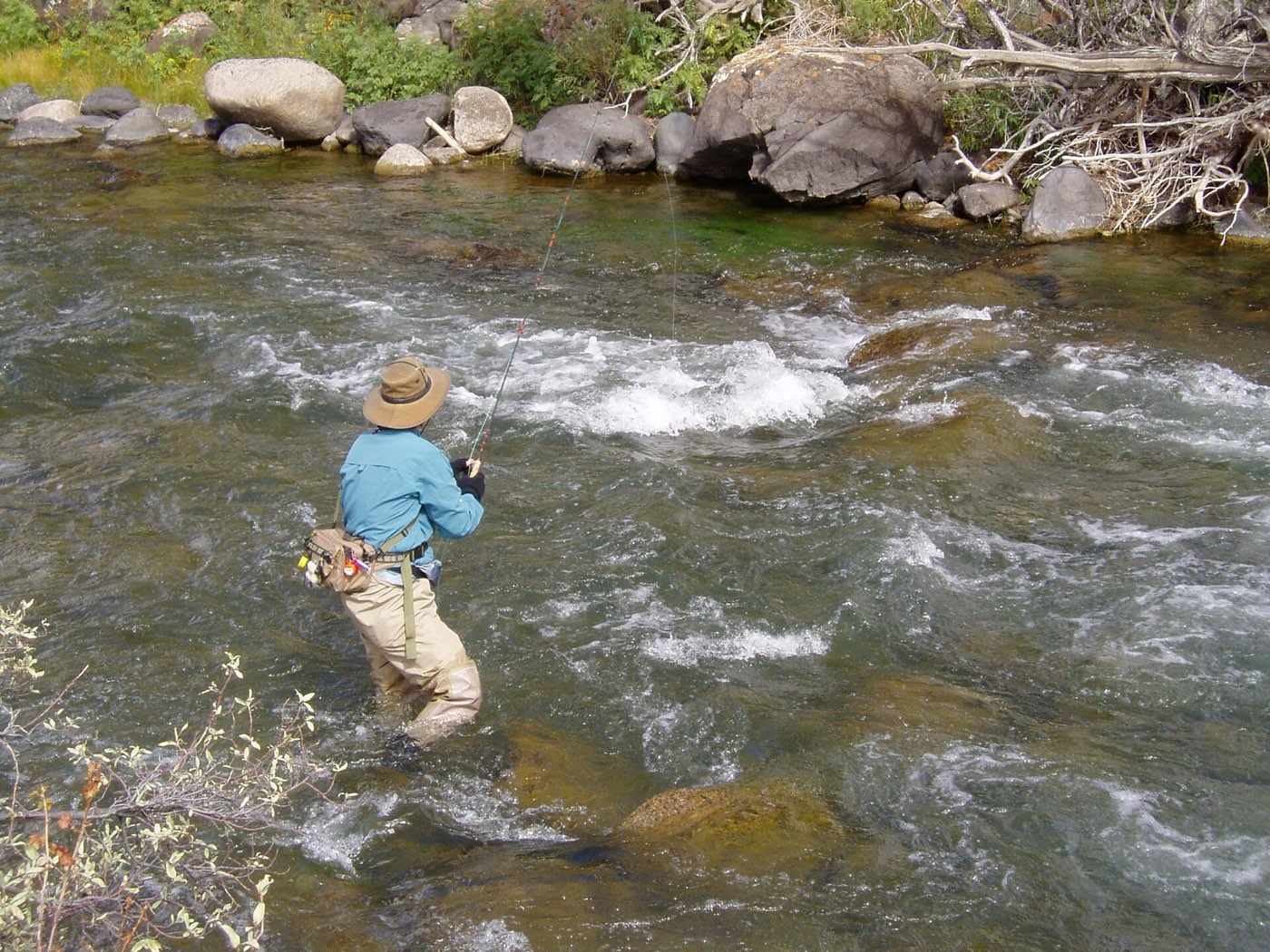
A riffle is shallow, fast water with a broken, choppy surface and a rocky or gravelly bottom. Current velocity is high; depth is typically 6 inches to 2 feet. The broken surface creates oxygenation — riffles are among the highest-dissolved-oxygen zones in any stream. They are also the stream's food factory: most of a stream's insect life is produced in riffle substrate, which makes riffles chronically underrated by anglers who fix on the more obvious pools downstream.
Where fish hold in riffles: Behind any rock that breaks the current, no matter how small, and in slight depressions in the bed where the flow shadow lets them rest. Pea-sized gravel doesn't hold fish; fist-sized cobble does. The fish sits in the seam immediately downstream of the obstruction where the bow-wave of the rock creates slack. Look for the slick — a small tongue of flat, slower water running 6-24 inches off the downstream face of structure.
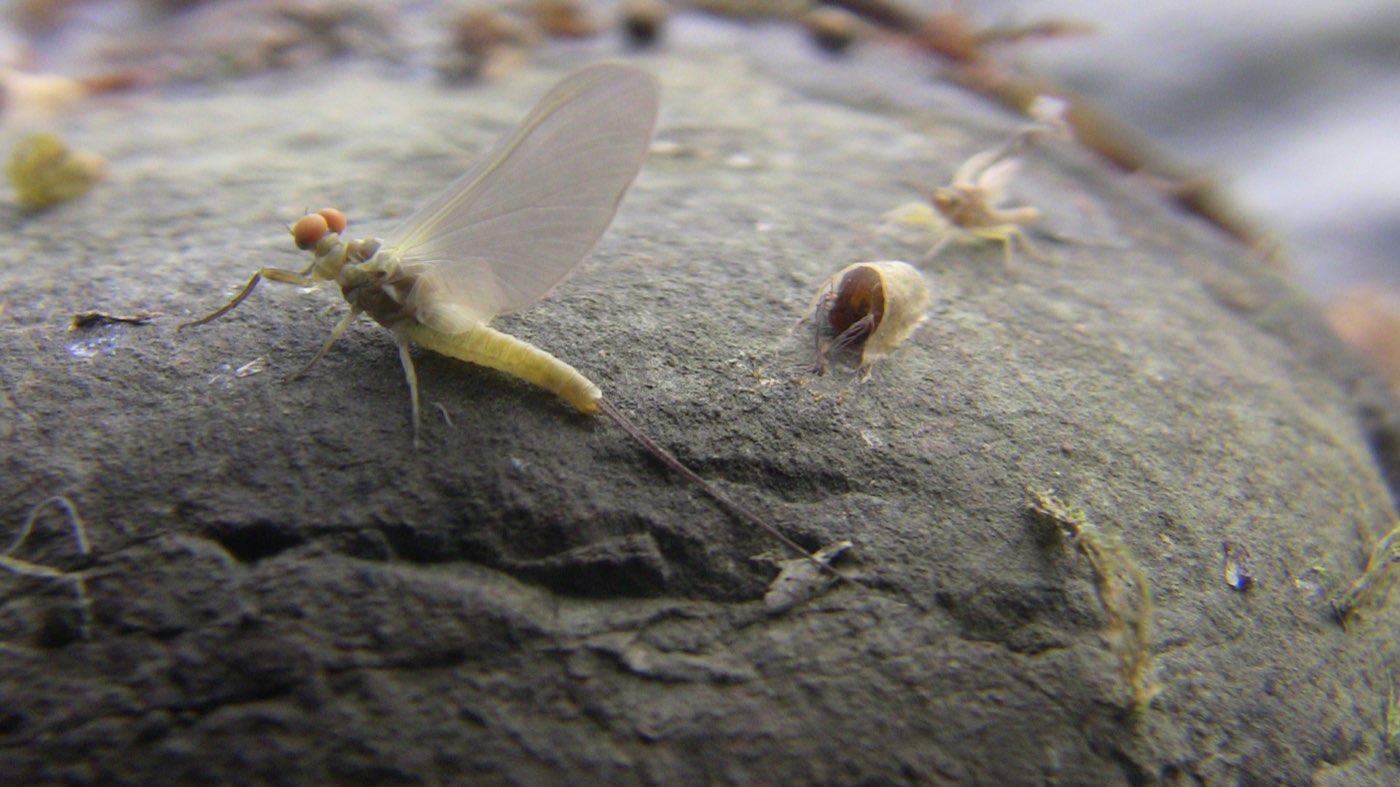
What fish eat in riffles: Riffle-dwelling invertebrates: Baetis (Blue-Winged Olive), various stonefly species, hydropsychid caddis larvae. During hatches, riffles produce the most active surface feeding.
How to approach: Stay downstream and low. Riffles are shallow — the fish can see any silhouette approaching from any direction. Approach from directly downstream, crouch, and cast upstream at roughly 45 degrees into the seam behind target structure.
Runs
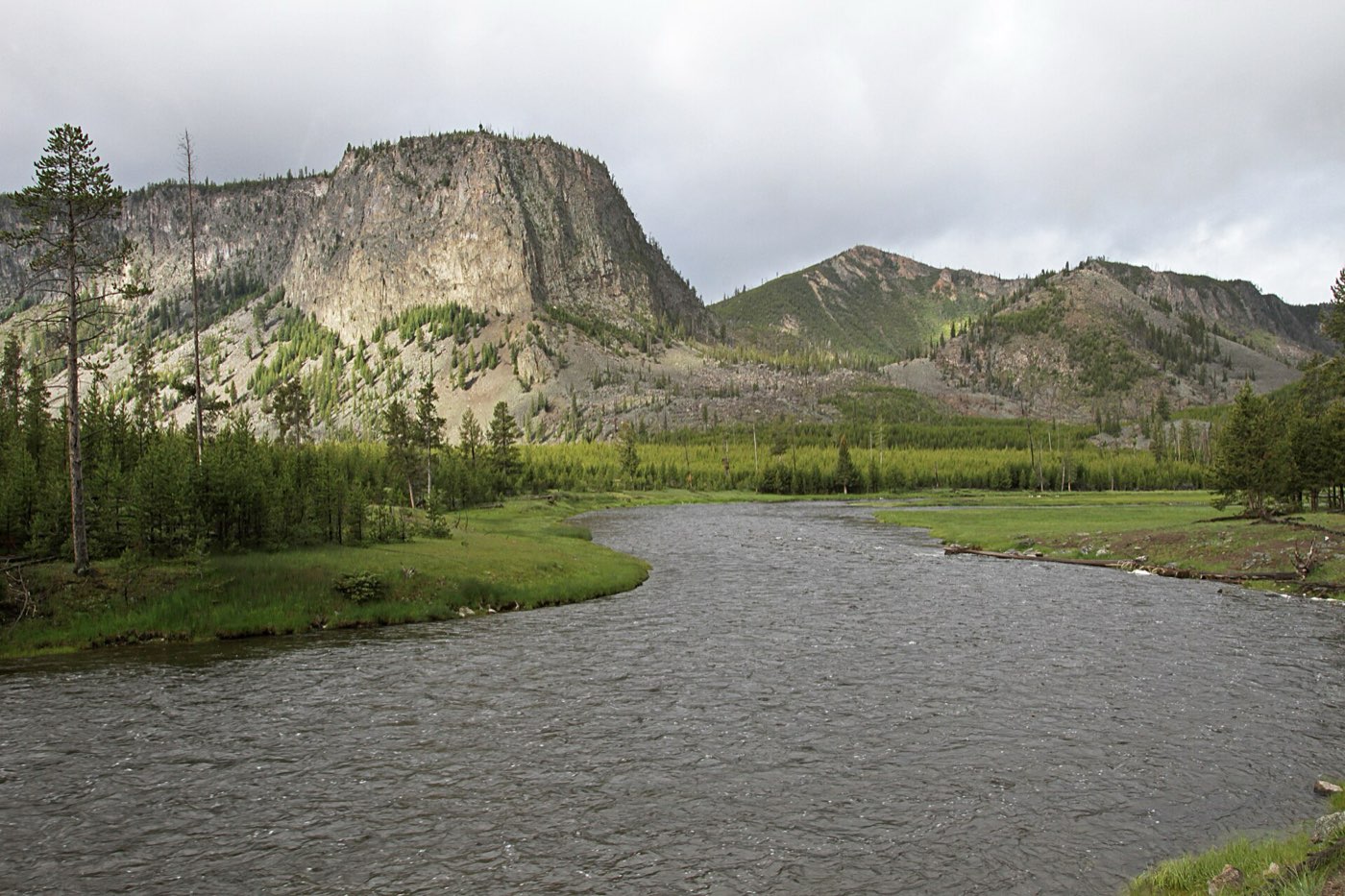
A run is a deeper, more uniform section of current — typically 2-5 feet deep, with a smooth or lightly broken surface. Runs are the highways of the stream: food moves through them in quantity, and the depth provides both the cover and the energy savings the fish need.
Where fish hold in runs: Along the seam between fast and slow water — the lateral seam, visible on the surface as the line between textured current and a smoother flow. Also at any depth change: the head of the run where water accelerates, or the tail where it begins to slow and spread. The transition zone between riffle and run (the "riffle-run break") is often the most productive single lie in the entire reach.
What fish eat in runs: Subsurface food primarily — nymphs and caddis pupae drifting through the water column. In low-light periods, streamer presentations through deep runs move large fish.
How to approach: Position upstream and across, or directly upstream. Cast to the seam edge; let the fly sink into the column. In a euro nymph rig, the drift should run parallel to the seam — not across it — with the flies hanging in the feeding zone.
Pools
A pool is deep, slow water, typically 4-10+ feet deep, where current energy dissipates. Pools form below falls, below bends, or anywhere the gradient drops and the current spreads.
Where fish hold in pools: At the head of the pool, where current enters and concentrates food. At the tail of the pool, where water narrows back to riffle speed and concentrating food is easiest for the fish. Mid-pool fish exist but are often dormant during daylight — pool bottoms are resting habitat, not feeding habitat, during normal light conditions. A pool holds fish but not always feeding fish; a pool in midday summer heat holds trout stacked at the coolest, deepest point, resting.
The tailout deserves its own attention. The shallow lip where the pool funnels back into the next riffle is often the most productive part of the pool during an active feed. Fish sip emergers in tailouts because there is enough depth nearby to feel safe and enough surface food to make rising worth it. The back of a pool in evening light almost always beats the center of the pool at noon. Tailouts are also spawning territory in fall and spring — read for redds before wading in.
What fish eat in pools: Large hatches draw pool fish to the surface — spinner falls and emerging caddis move them aggressively. Subsurface: pools hold large fish that respond to streamers retrieved through the depth. Mysis shrimp and sculpin imitations work in tailwater pools.
How to approach: Pool fish are the wariest in any stream because the calm surface transmits vibration and they can see across significant distance. Move slowly, reduce wading disturbance, and approach the pool head from downstream before casting.
Pocket water
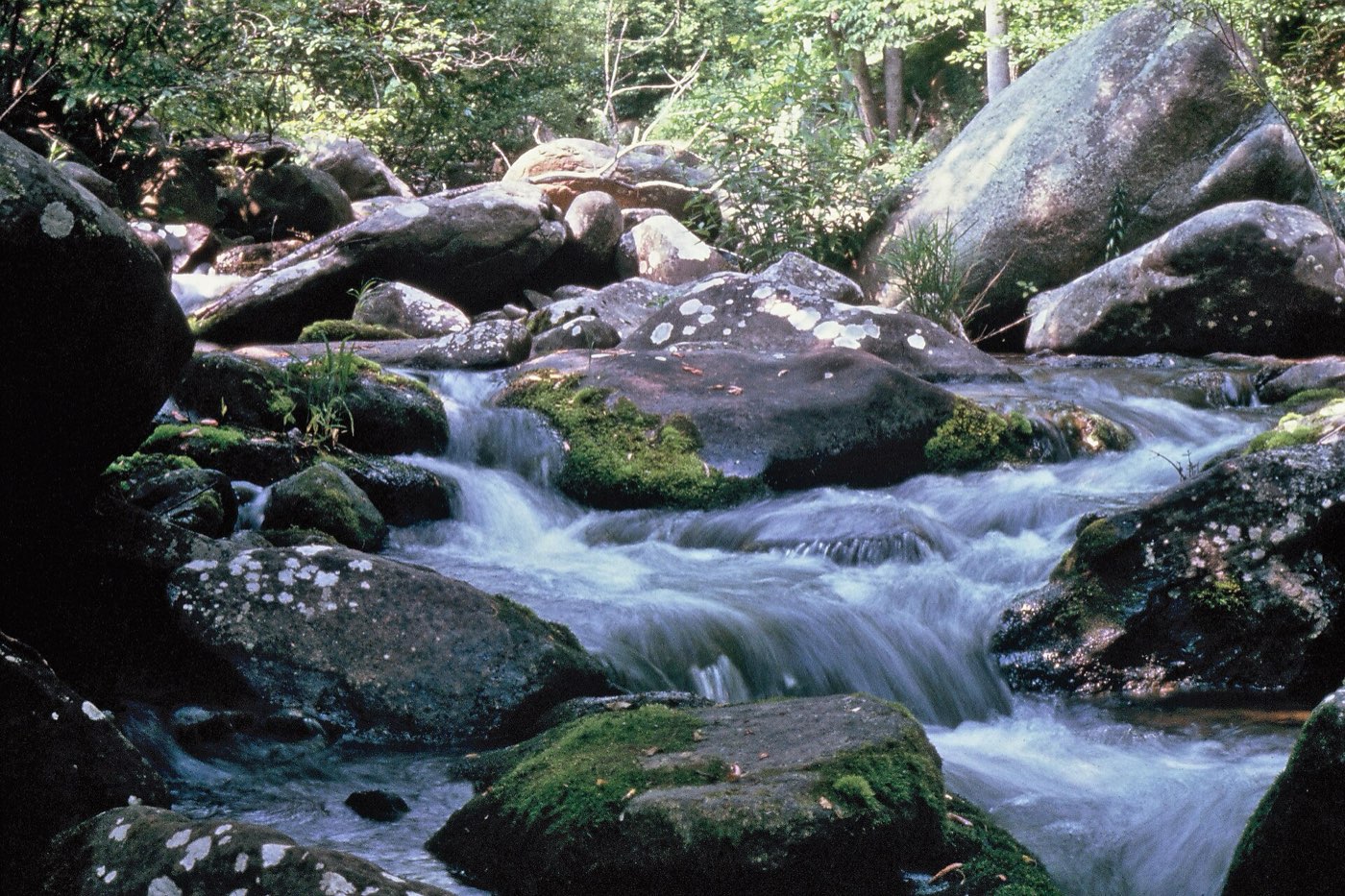
Pocket water is the most irregular of the four types — fast water broken by large boulders or bedrock, creating small pockets of slack behind and in front of each piece of structure. Depth varies wildly: 4 inches next to a boulder, 6 feet in the scour immediately behind one. It is also the densest fishable habitat in any freestone stream — a single 100-foot section can hold 30 fish in 30 pockets — and most anglers walk right past it on the way to the next pool.
Where fish hold in pocket water: The pillow — the upwelling of pressure water on the upstream face of a boulder where current deflects upward. The seam immediately behind the boulder where the wake creates a slack zone. In fast pocket water, fish may feed in water as shallow as 6 inches if the current is completely broken by structure.
What fish eat in pocket water: Whatever the current delivers — predominantly nymphs and stonefly larvae in high-velocity water. Large stonefly shuck patterns, rubberleg nymphs, and heavy beadheads fish well here.
How to approach: Pocket water rewards short-line techniques. Each pocket offers only 12-36 inches of fishable water, so presentations must be precise and quick. Euro nymphing, high-stick nymphing, and Czech-style tight-line methods cover pocket water better than indicator rigs because the currents are too variable to maintain a consistent drift with a bobber — indicators blow through too fast to control depth.
Seams — the key structural concept
Every productive lie is adjacent to a seam. A seam is the boundary line between two current speeds — fast water on one side, slow water on the other. The seam is where:
- Drifting food concentrates (the faster current deposits onto the slower current)
- Fish can hold with minimal energy expenditure (sitting in the slow water, intercepting from the seam)
- The cast and drift converge on a predictable lane
The fish breaks current in the slow water and feeds from the fast water without ever leaving the slow. Maximum food, minimum effort — which is why "foam is home" is folk wisdom in fly fishing. Foam marks seams, and seams hold most of the fish in any river. Find every visible foam line on a piece of water before casting; each one is a candidate.
Seams take 4 forms:
- Lateral seam — a fast current lane against a slow lane beside it; the classic riffle-run edge
- Eddy seam — the main current against a slack pocket behind a boulder or against a bank eddy
- Vertical seam — the slow boundary layer along the bottom against the faster mid-column current above it
- Junction seam — 2 converging currents at a confluence or below an island
How to identify seams on the surface:
- A foam or bubble line is the most visible indicator — foam collects exactly where current transitions occur. If you see a ribbon of bubbles, there is a seam beneath it.
- A color change on the surface: darker water (deeper, slower) alongside lighter, choppy water (faster, shallower).
- The visible edge of a riffle as it meets a run — the texture breaks; one side rough, one side smooth.
Treat the seam as a zone, not a line. The visible foam marks the surface boundary, but the productive seam often extends 6-24 inches to either side and well below the surface. If a perfect drift down the foam line produces nothing, drift 6 inches inside it, 6 inches outside it, and deeper — most missed seam fish are in adjacent water, not on the line itself.
Subsurface seams matter as much as the visible ones. A seam between a fast deep lane and a slow shallow lane on the inside of a bend can hold the biggest fish in a run even when the surface gives no clue. Polarized lenses, water clarity, and the small current indicators — drifting debris, bubbles, slight changes in surface texture — reveal them.
The inside seam vs. the outside seam: On any bend, the current runs fastest on the outside of the bend and slowest on the inside. The inside seam is where food concentrates on the low-velocity side; the outside has depth and cover. Both sides produce fish; they produce them differently. Inside bend fish are often smaller but more actively feeding; outside bend fish are often larger and holding deeper.
Lanes and levels — where fish sit inside each water type
The water types tell you where the fishable structure is. Lanes and levels tell you where the fish are within it.
Lanes (lateral). A run or riffle isn't a single current — it's a stack of parallel current lanes flowing at different speeds, and the fastest lane is usually the deepest. Each lane carries its own load of drifting food and holds its own fish. Effective fishing means presenting the fly in the same lane as the target fish, not the lane next to it. Drag is what happens when a fly crosses lanes mid-drift; trout reject dragged flies because no real food crosses lanes that fast.
Levels (vertical). Trout occupy 3 levels of the water column:
- Bottom. Fish on the streambed, sheltering against current in the boundary layer — the thin band of slow water immediately above the bed. Most large fish hold here most of the time. Reach them with weighted nymphs.
- Mid-column. Fish suspended at mid-depth, actively feeding on emerging insects or swimming nymphs. Reach them with lighter nymphs, soft-hackle wets, or unweighted streamers stripped through the column.
- Top. Fish keying on emergers, dries, or terrestrial drops. Reach them with floating patterns and emergers in the surface film.
A fish's level is set by what it's eating, not by preference. A fish on the bottom is there because that's where the food is; as an emergence begins, fish migrate up. Reading water without reading levels means casting bottom flies to top-feeding fish.
Put the two together and every fish sits at a specific coordinate — a level, a lane, and a position relative to structure. The cast and drift have to match all 3.
Structure
Structure is any physical feature that displaces current: boulders, logs, bridge pilings, undercut banks, weed beds. Structure changes where water goes, and by changing where water goes, it creates seams.
Boulders: Create a pillow of slow water on the upstream face, a turbulent scour immediately behind, and seam edges on both sides. The most productive zone on a single boulder is typically the lateral seam on the downstream-left or downstream-right edge, where the wake creates a current break.
Undercut banks: The earth on stream bends has eroded away below the waterline, creating a roof of bank material that overhangs the water. Fish hold under the overhang for shelter, especially large brown trout. The seam that runs along the bank margin is where food delivers to the fish resting under the cut. Long, reach casts parallel to the bank drop a fly into that delivery lane.
Log jams and woody debris: Same principle as boulders — the debris creates current break. In addition, logs create shade, and shade suppresses the fish's wariness. Log jam pockets hold fish in shockingly shallow water because the overhead cover compensates.
Eddies: Reverse-flow water where current circulates back upstream against an obstruction or bank. Eddies collect drifting insects and dead organisms — they are the river's pantry. Fish hold at the eddy line, where forward current meets reverse current, not in the dead center of the eddy.
Reading features together: Good water reading connects the elements rather than checking them off in isolation. A seam feeding the head of a pool, with a foam line on the surface and a boulder 2 rod-lengths upstream creating a soft pillow, holds fish in 3 separate lies at once — the foam line, the pillow, and the tailout below. The common mistake is fishing the most obvious lie and moving on. A rising fish in the tailout is easy to spot and easy to target; the fish sitting in the pillow upstream is harder to see, less often targeted, and just as catchable.
Reading water by season
Water temperature and flow volume shift where fish position throughout the year:
| Season | Water temp | Primary holding zone | Notes |
|---|---|---|---|
| Early spring | 38-48°F | Deep, slow runs; pool heads | Fish lethargic; require fly to drift very close to nose |
| Late spring | 48-60°F | Riffles and riffle-run breaks; full activity | Peak feeding; hatches begin |
| Summer (normal flow) | 60-68°F | Oxygenated zones: riffles, below falls, inlet streams | Higher temps mean fish favor oxygenated water over deep slow water |
| Summer (low water, heat) | 68°F+ | Thermally refugia: spring-fed tributaries, deep shaded pools | Fish stop feeding actively; don't target them in warm water |
| Fall | 48-60°F | Riffles and runs return to high productivity; spawning redds visible | Don't wade or cast into redds during active spawning |
| Winter | 34-42°F | Deep pools, mid-depth runs; fish stack and barely move | Midge clusters and small nymphs on very slow, very precise drifts |
Two numbers to carry: the productive feeding window for most trout streams runs 50-65°F, and trout stop feeding aggressively above 68°F. A stream thermometer earns its place in a wading pack. Staying on a warm August afternoon because it feels fine costs fish and can kill them; leaving at 11am because the thermometer reads 67°F and climbing saves both. The thermometer costs about $12 and eliminates the guesswork.
In cold water — below 45°F — trout still feed, just slower. Holds shift toward the slowest, deepest water, and takes become subtle enough that indicator nymphing often outperforms tight-line methods. Look for deep outside bends where current drops to a crawl, fish a weighted nymph along the bottom on a long dead-drift, and strike at anything: a cold-water fish that has moved to intercept a fly will not reposition for a second attempt.
The one observation that changes everything
Before making a single cast in any new stretch, watch the water for five minutes. Just watch. Look for:
- Rises. Any dimple, ring, splash, or swirl means a fish is actively feeding on the surface. That fish's position is now known; the question is only what it's eating.
- Flashes. Subsurface feeding: a fish's flank or belly reflects light as it turns to take a nymph. Even in fast water with no visible rise, subsurface flashes locate feeding fish with precision.
- Wake behind structure. In low to moderate flow, a subtle wake behind a boulder indicates a fish is actively displacing water. High fish density in a seam creates visible turbulence patterns that differ from the turbulence caused by the structure alone.
Five minutes of observation eliminates the casts that catch nothing. It concentrates effort on the water that produces.
Applying the read: the pre-cast checklist
Before every cast at a new piece of water, answer three questions:
- Where is the seam? Find the bubble line or current break. That's where the fly needs to land and drift.
- Where is the fish? Resting in the slow water adjacent to the seam, intercepting from the edge. Position the cast to deliver the fly into the seam, not directly onto the fish's nose.
- What is my approach angle? For upstream presentations: approach from downstream and keep the rod below the bank if possible. For across-and-downstream: stay back, minimize line on the water.
After a successful drift, stop and articulate why the fish was there. "It held below the boulder because the eddy seam delivered emergers at mid-column" builds the skill; "we caught a fish" doesn't.
Common mistakes
Fishing the obvious water and walking past pocket water. The angler steps into the pool below the parking access, casts to the visible center for 15 minutes, sees nothing, and walks to the next pool. Pools are visible; pockets aren't, so pocket water reads as the stretch between fishable water. The fix: treat the riffle and pocket water between two pools as the destination, not the connector.
Changing flies instead of changing lanes. Fish refuse the drift, so the angler cycles patterns — but the problem is usually the lane, not the fly. Before changing flies, change lanes: cast 18 inches farther out, then 18 inches closer in, then deeper, then shallower. The fish is somewhere; find the lane first.
Misreading the level. Fish are visibly rising and the angler dredges a heavy nymph, or nothing is moving on top and the angler insists on a dry. Identify the level before committing to a technique: rising fish mean surface or emerger; bulges and boils mean mid-column; no surface activity means bottom nymphs.
Fishing for the trout you want, not the trout that's there. Wanting to fish dries when nothing is surface-feeding ends in a fishless day. Read first, technique second — some days the river is a streamer river, some days a tight-line day, some days dry-dropper. The fish set the rules.
When reading water doesn't matter
Three contexts where the skill adds little:
- Freshly stocked water, within about 24 hours of stocking. The fish are everywhere because they haven't sorted into lies yet.
- A heavy hatch with committed surface feeding. Reading the column stops mattering; matching the dun is the whole game.
- Tiny mountain streams where every pocket holds water. A 4-foot-wide brook trout creek doesn't reward the taxonomy; walk and fish every spot.
In every other context, reading water is the leverage that separates anglers who catch fish consistently from anglers who catch fish on lucky days.
Patterns that pair with the read
Reading water tells you which fly to tie on:
- Perdigon Nymph — bottom-level fish in fast runs and pocket water; sinks fastest of anything in the box
- Hot Spot Pheasant Tail — mid-column fish during a mayfly emergence in seams
- Mop Fly — stained-water and post-runoff conditions where you have to cover all levels with a high-attractor pattern
- Squirmy Wormy — same conditions; complements the Mop on tandem rigs
Related techniques
- Euro nymphing — reads the water exactly as described; the sighter shows you what the drift is doing in the column
- High-stick nymphing in pocket water — short-line version optimized for the pocket water type described above
Where to practice
Any stream with mixed water types — riffles, runs, and pools in the same reach — works for developing this skill. Mid-Atlantic freestone streams are ideal because they have all four water types in close succession:
- Gunpowder Falls, MD — riffle-to-run transitions throughout the catch-and-release section, with a long pocket-water stretch below Prettyboy; see the Maryland hatch chart
- Savage River, MD — boulder pocket water in the canyon below the dam
- North Branch Potomac — large tailwater with defined pool, run, and riffle structure
- Shenandoah River, VA — smallmouth water with all four types visible from any riffle access point
- Penn's Creek, PA — the best classroom on Eastern water for pool/run/riffle variety; see the Pennsylvania hatch chart
- Mossy Creek, VA — slow limestone water where lanes and levels are subtler to read than on freestone; see the Virginia hatch chart
*Last updated: 2026-07-05. *
Sources cited: Troutbitten — Understand the River, [Troutbitten — Reading Water in Levels, Lanes and Seams], Orvis — Reading Trout Water, MidCurrent — How to Read Trout Water, [George Daniel — Dynamic Nymphing (Stackpole Books, 2012)], [Dave Hughes — Reading Trout Water (Stackpole Books)], [Dave Hughes — Trout from Small Streams (Stackpole Books, 2002)].