Quick reference
| Field | Value |
|---|---|
| State / region | Hawaii, east side of Kauai |
| Species | Smallmouth bass, largemouth bass, tucunare (peacock bass), bluegill sunfish; giant trevally reported near the estuary |
| Best months | Year-round; stable-weather windows with moderate flows fish best |
| Water type | Tropical lowland stream, reservoir, and navigable tidal river — a warmwater system, not a trout fishery |
| Difficulty | Intermediate — the fishing is forgiving, but access takes research and self-reliance |
| Wading | Limited: careful wading on slick rock in upper stream reaches; bank fishing at the reservoir; boat or bank on the lower river |
Why fish here
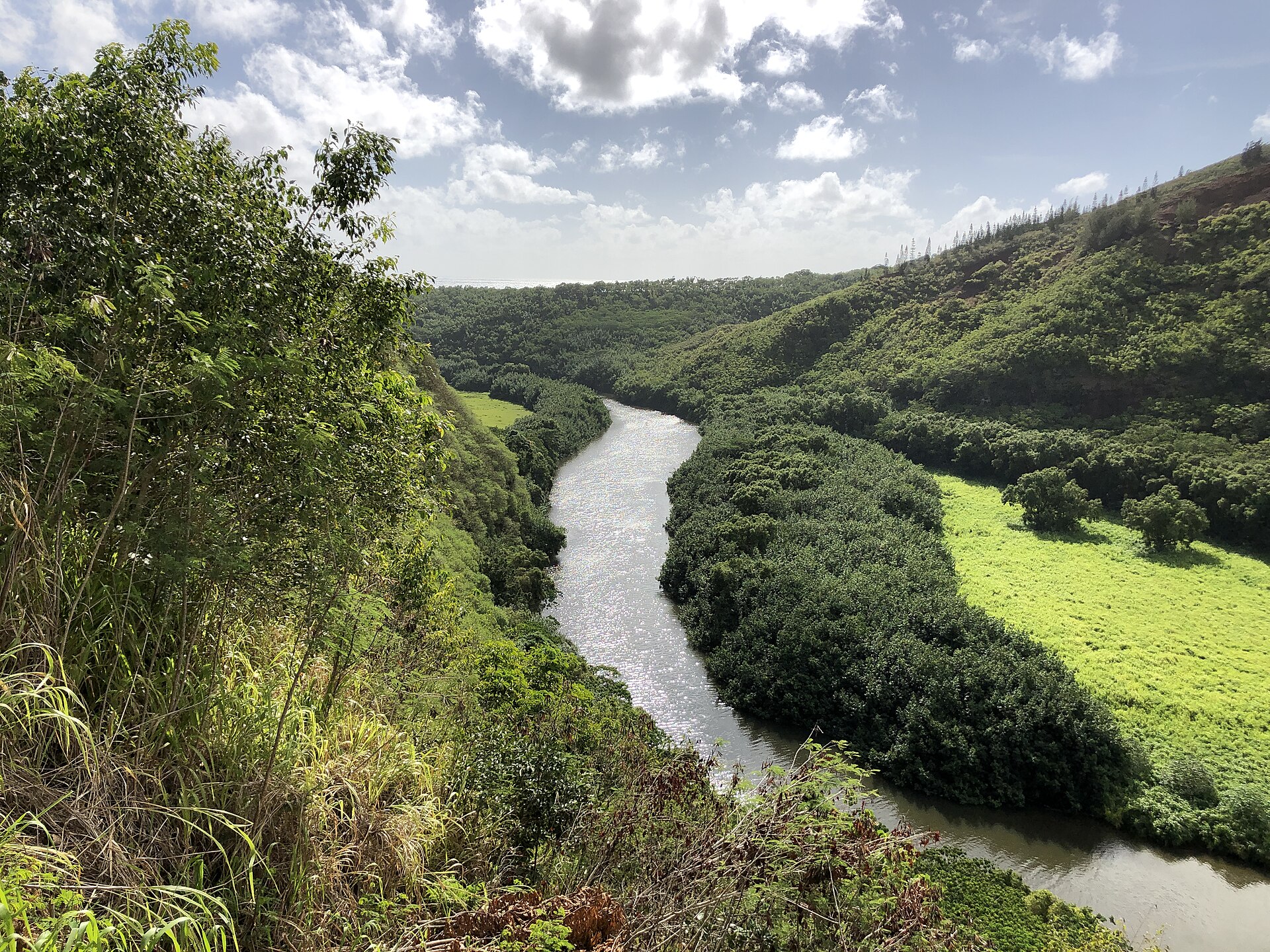
The Wailua is not a mainland river transplanted to the tropics — it is its own thing, and worth understanding on its own terms. The system runs from mountain stream reaches through the Wailua Reservoir Public Fishing Area down to the only navigable river in the Hawaiian Islands, ending at the ocean near Wailua Beach. For a fly angler, its significance is specific: this is one of the few places on Kauai where you can deliberately target smallmouth bass in moving water, with published state management and regulations behind the fishery. Hawaii's Division of Aquatic Resources describes Wailua Stream and its tributaries as offering good smallmouth bass fishing — consistent opportunity, not occasional bycatch.
The species mix widens from there. DLNR's special provisions for Wailua Reservoir cover largemouth bass, smallmouth bass, tucunare (peacock bass), and bluegill sunfish, making the reservoir a managed multispecies warmwater fishery. Near the river mouth, angler reports add giant trevally and other salt-tolerant predators moving with the tides. Few destinations let you fish for stream smallmouth in the morning and cast at estuarine predators on the evening tide.
Set expectations accordingly. There is no hatch calendar, no fly shop on the next corner, and public access is patchy and lightly documented. Most visiting anglers on Kauai default to saltwater; the Wailua rewards the ones willing to do some legwork for an exploratory freshwater fishery in jungle-valley terrain.
The river, section by section
Upper Wailua Stream and tributaries
Access: Via upland roads and trails in the Wailua uplands; no named public angler access points are clearly documented, so treat access as exploratory and verify on-site or with local authorities, starting from DLNR's Kauai freshwater fishing guidance. Character: A tropical mountain-foothill stream — narrower than the lower river, with pocket water, short runs, and pools formed around boulders and small drops; moderate gradient, dense riparian cover, limited casting room. Species mix: Good smallmouth bass fishing per state guidance; largemouth, tucunare, and bluegill fall under nearby special provisions and may appear in connected water. Native stream invertebrates (hihiwai, hapawai, opae kalaole) are present but protected, not sport targets. Crowding: Light — most visitors to the valley are sightseers, not anglers; pressure stays modest even on weekends. Notable hatches: None documented; think forage — small fish, aquatic insects, crustaceans — fished year-round with streamers, nymphs, and terrestrials.
This is the most stream-like fishing on the system, and the most physical. Flows rise fast in heavy rain, the rocks carry an algae slick that punishes casual footing, and plunge pools run deeper than they look. The dense canopy favors shorter casts and roll casts over open-loop distance work.
The reward is smallmouth in pocket water with almost nobody around. Work the boulder seams and pool heads the way you would any bass stream, keep an eye on the weather upstream, and accept that part of the outing is figuring out where you can legally and safely get in.
Wailua Reservoir Public Fishing Area
Access: The designated PFA, managed by DLNR's Division of Aquatic Resources under Hawaii Administrative Rules 13-65; specific parking areas are not well documented online, so confirm entry points with DLNR or local sources before going. Character: Impounded stillwater suited to bank fishing — no riffle-run-pool structure, and no boats: regulations prohibit launching any vessel or floatable craft on the reservoir. Shoreline structure, submerged timber, and drop-offs hold fish; water levels fluctuate with irrigation and rainfall. Species mix: Largemouth and smallmouth bass (combined bag of 10, 9-inch minimum), tucunare (12-inch minimum, bag of 3), and bluegill under their own provisions — bass are the primary sport targets, panfish the bonus action. Crowding: Likely concentrates local bank anglers along shore access zones; weekends, holidays, and school vacations see the most use, weekdays the least. No documentation of chronic overcrowding. Notable hatches: None documented; forage is small fish, insects, and invertebrates, so fish baitfish patterns, leeches, and attractor nymphs rather than timing anything.
The reservoir is the system's most structured opportunity — a designated public fishing area with codified rules and a real multispecies bass fishery. Because everything happens from the bank, read the shoreline the way a boat angler reads a lake map: points, timber, and drop-offs within casting range are the game.
The no-vessel rule cuts both ways. It limits how much water you can reach, but it also means no boat traffic and a fishery that never gets pounded from open water. A weight-forward floating line and a box of Clousers and buggers cover most of what the shoreline asks.
Lower navigable Wailua River
Access: Riverside parks, kayak and boat launches, and tour-operator areas along Kuhio Highway in the Wailua–Kapaa corridor; there are no fly-fishing-specific access points, so anglers adapt general boat-ramp and park access and fish where bank access is legal and safe. Character: Broad, slow to moderately flowing tropical river with flatwater sections, deep channels, and backwaters — low gradient, jungle-lined banks, brackish toward the estuary on tides. Wading is limited by depth, soft substrate, and boat traffic; bank or boat fishing is more practical. Species mix: Smallmouth and largemouth bass upstream in the lower river; giant trevally and other reef-associated or coastal species move into the brackish zone with the tides. Crowding: Heavy recreational traffic — kayak tours and boat sightseeing dominate midday, weekends, and peak visitor seasons — though actual angling pressure is low. Early morning and evening sessions dodge most of it. Notable hatches: None; key on baitfish, shrimp, and estuarine forage with streamers, shrimp patterns, and surface flies in low light.
The lower river is where the Wailua turns estuarine and the target list gets interesting. Bass hold in the freshwater reaches; closer to the mouth, tide-driven predators including trevally patrol the brackish water, and dawn or dusk around a favorable tide is the high-percentage window — both for fish moving shallow and for having the river to yourself before the tour boats launch.
Fish it like flats-adjacent water rather than a river: cover the channel edges and backwater seams with baitfish and shrimp patterns, and bring corrosion-resistant gear, because the lower river will put salt on everything.
Seasons and forage
| Months | Conditions/forage | Flies |
|---|---|---|
| Year-round (tropical system) | No seasonally distinct mayfly, caddis, or stonefly hatches; forage is small fish, aquatic insects, crustaceans, and other invertebrates across freshwater and estuarine zones | Woolly Bugger 4–8, Clouser Minnow 2–6, Deceiver-style baitfish 2–6, Prince Nymph and Hare's Ear 8–12 for broad non-hatch feeding |
Recommended flies (by season)
| Season | Top patterns | Why |
|---|---|---|
| Spring | Clouser Minnow (chartreuse/white, tan/white) 2–6, Deceivers 2–6, Woolly Bugger 4–8, small crayfish and shrimp imitations | Stable tropical temperatures and lengthening days keep bass and estuarine predators feeding actively on general forage |
| Summer | Weighted streamers (Clouser, jig buggers) 2–6, bass poppers 4–6, foam beetles and hoppers for upper-stream pockets | Warm water keeps fish active but pushes them deeper midday; weighted flies reach structure, while mornings and evenings open popper and terrestrial windows around cover |
| Fall | Clousers, Deceivers, and baitfish streamers 2–6, leech-style flies, darker Woolly Buggers | Predators stay keyed on baitfish and larger forage, and crowds thin; baitfish-centric fly fishing is a fall strength across Hawaiian waters |
| Winter | Smaller streamers and nymphs 6–10, balanced leeches, slow-retrieved dark baitfish patterns | Winter rain and occasional cooler spells call for slower presentations and smaller profiles in the deepest, most stable water |
Gear notes
A 9-foot 6–8 weight covers the whole system — backbone for bass and the occasional estuarine surprise, without overgunning typical bass flies. A weight-forward floating line handles the reservoir and stream work; add an intermediate for deeper structure and the brackish lower river. Run 0X–2X leaders (10–15 lb) for bass and step to 15–20 lb fluorocarbon bite tippet if trevally are a possibility. Skip chest waders — the climate makes them pointless. What matters is secure, high-traction footwear for slick stream rock and muddy reservoir margins, quick-drying clothing, sun protection, and corrosion-resistant reels and hardware anywhere near the estuary.
Logistics
- Regulations: Freshwater fishing in Wailua Stream and Reservoir requires a Hawaii Freshwater Game Fishing License, administered by DLNR's Division of Aquatic Resources. Wailua Reservoir is a designated Public Fishing Area under HAR 13-65, which prohibits live bait, nets, spears, and all vessels or floatable craft, and restricts entry to sanctuary areas. Statewide provisions set a 9-inch minimum and combined bag of 10 for largemouth and smallmouth bass, a 12-inch minimum and bag of 3 for tucunare, and license requirements for bluegill. No fly-only or catch-and-release-only sections exist beyond these rules. Regulations change — confirm current DLNR rules and posted PFA notices before fishing.
- Access points:
- Wailua Reservoir Public Fishing Area — designated shore-fishing access under DLNR-DAR; confirm current entry points and parking with DLNR or local notices
- Lower Wailua River roadside and park access near Kuhio Highway — riverside parks and kayak launches in the Wailua–Kapaa corridor, adaptable for shore casting where legal and safe
- Closest fly shop: Fly Fishing Hawaii (guide service), Honolulu — no dedicated fly shop is documented on Kauai's east side
- Nearest towns: Wailua, Kapaa, Lihue
- Closest gauge: USGS 16060000 — SF Wailua River near Lihue, Kauai, HI — gauges the South Fork only, so the mainstem below the forks carries more water than the reading shows
When NOT to fish here
Heavy tropical rain is the hard stop. Hawaiian streams flash-flood fast, and during or immediately after big rain the stream and river run high, muddy, unsafe, and unproductive; reservoir margins also turn slick and treacherous in prolonged wet weather, and turbidity kills sight-fishing near the brackish zone. The other avoidance is traffic, not weather: midday on the lower navigable river belongs to kayak tours and sightseeing boats, especially on weekends and in peak tourist season. Fish dawn and dusk and leave the middle of the day to the paddlers.
Where to fish next
- Fly Fishing in Hawaii — the full state guide
- Kokee streams — Kauai's rainbow trout fishery in the high country, the island's one coldwater option
- Other Kauai warmwater streams — DLNR lists additional freshwater fishing waters across the island for anglers extending the exploratory trip