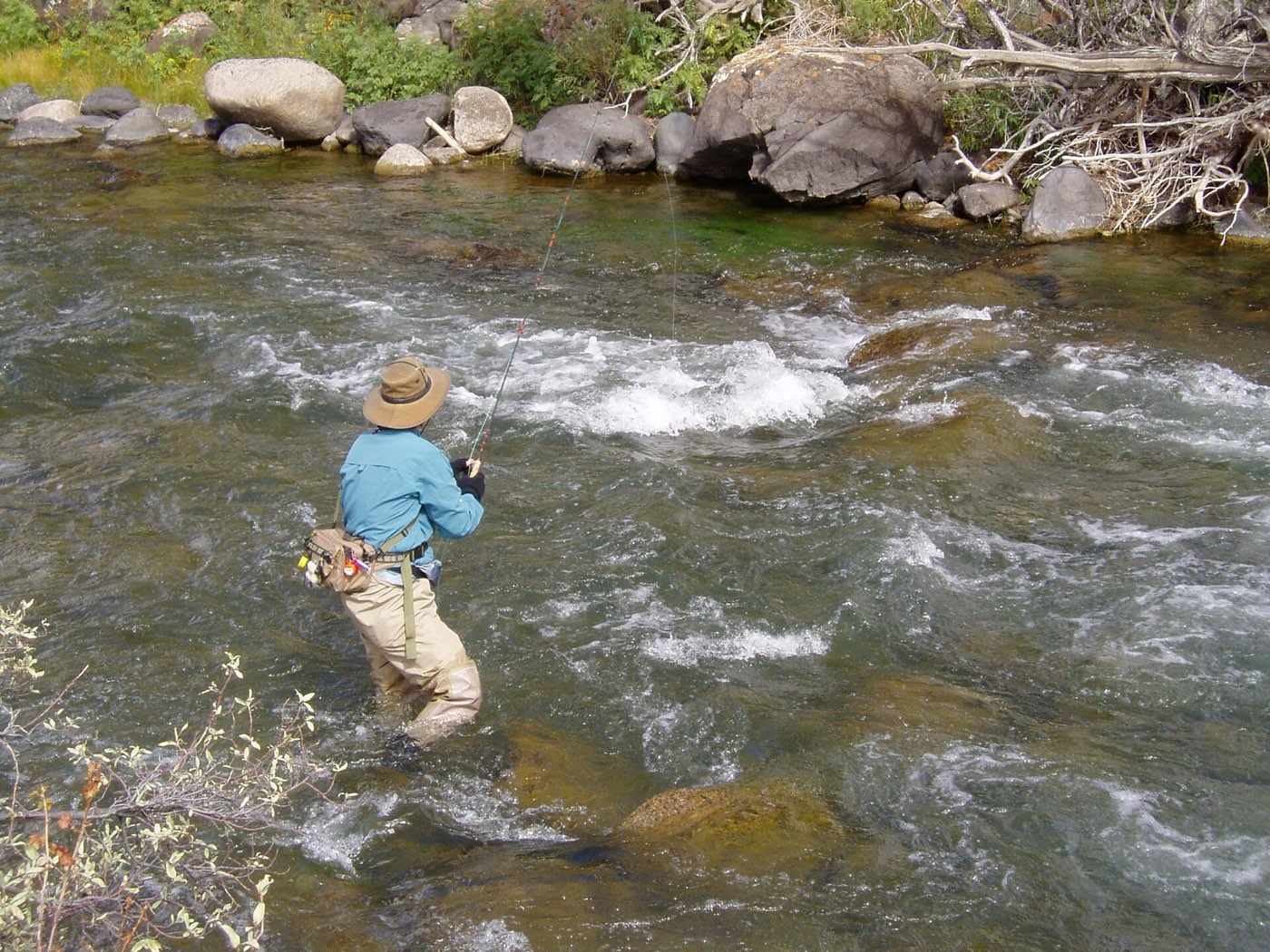
A euro nymphing leader is a long, thin, mostly level run of nylon, 14 to 24 feet, that ends in a bright sighter, a 2 mm tippet ring, and a few feet of fluorocarbon tippet to two weighted nymphs. It beats a standard tapered trout leader any time you are fishing tight-line inside 30 feet, because a 0.010-inch butt stays off the water and transmits a take that a 0.021-inch butt swallows in sag. The thing people get wrong is not the knot or the brand. It is buying a 20-foot leader, tying 3 feet of tippet to the ring, and then wondering why the sighter droops and the flies never reach bottom. Match the butt to your rod first; everything below the ring is adjustable on the water. This guide expands the leader section of our euro nymphing pillar, which sketches one formula.
When to use it
Fish a dedicated euro leader when you are tight-line nymphing runs, riffles, and pocket water 1 to 4 feet deep at 10 to 30 feet of range. That describes most of the Savage River below the dam, the upper Gunpowder, and Penns Creek pocket water in fall. It earns its keep on pressured fish that refuse anything under an indicator, in cold water where a take is a half-inch pause, and in broken water where a floating indicator drags the flies through six current lanes on one drift.
Build your own after a season on a commercial leader. Most anglers want it thinner (less sag) or shorter (small streams), and both are five-minute fixes with a spool of level mono.
When to fish something else
Water deeper than 4 feet, or fish holding past 40 feet, wants an indicator on a standard 9-foot leader; our strike indicator roundup covers that rig. Wind above 15 mph turns a 0.009-inch butt into a kite: step up to 0X or go to the indicator. Without a 10-foot rod, and with fish inside a rod length in boulder pockets, high-stick nymphing on a normal leader gets you there faster. When trout are rising, take the euro leader off. Nothing about it turns over a size 18 dry.
What you need
- A 10-foot 2- or 3-weight rod. A 9-foot 5-weight works with the small stream formula below.
- Level nylon for the butt, 0X to 3X (0.011 to 0.008 inch). Cortland's Indicator Mono runs 0.006 to 0.014 inch on 50-foot spools ($12.95 as of September 2026).
- Or a commercial leader, $12.99 to $24.95 as of September 2026: RIO Euro Nymph Leader (11 ft), RIO Technical Euro Nymph Leader (14 ft), Scientific Anglers Absolute Euro Nymph (13.5 or 30 ft), Cortland Euro Nymph Leader (20 ft), Umpqua Egan's Euro Leader, or the Hends Camou French Leader (350 to 900 cm, 7.20 to 10 euros).
- Sighter material: RIO Two-Tone Indicator Tippet (1X to 6X, color change every 8 inches, $15.99), Cortland bicolor Indicator Mono, or Scientific Anglers Absolute Tri-Color Sighter.
- 2 mm tippet rings. Umpqua's are rated 26 lb, 10 for $8.49.
- Fluorocarbon tippet in 4X, 5X, and 6X.
- Two tungsten jig nymphs per rig. A Hanak H400 BL Jig Hook in sizes 12 to 16 carries a 1/8-inch bead on the point and a 3/32-inch bead on the tag. The 1/8-inch Hareline Tungsten Slotted Bead 3.2mm is the workhorse (Hareline's own listing rounds it to 3.3 mm). The 5/32-inch Hareline Tungsten Slotted Bead 3.8mm is for fast water over 3 feet.
- Nippers, a foam leader spool, a marker.
Butt section: three ways to build it
Level mono, 0X to 3X
The butt is the leader; everything else is a connection. Level nylon hangs from the rod tip at one angle along its whole length, so a change at the fly reaches the sighter without passing through thicker material first.
Pick the diameter by rod and cast, not by fish. 0X (0.011 inch) casts easily on a 10-foot 3-weight, tolerates wind, and is where a first build should start. 1X (0.010) and 2X (0.009) sag less and show softer takes, but the tuck cast has to be crisper because there is less mass to load the rod. 3X (0.008) is a competition micro-leader: perfect with two size 16 nymphs in slow clear water, a pile the moment you throw a 3.8 mm bead into a headwind. Length: 12 to 15 feet for a 10-foot rod, 8 to 10 for a 9-foot rod. Build the first one in a hi-vis color; you learn faster when you can see the leader in the air.
Commercial tapered leaders
Buy one if you want to fish this weekend. Every current model ends in a tippet ring, so the tippet below is yours. RIO's 11-foot Euro Nymph Leader (9 feet of taper plus a 22-inch 2X sighter) is short enough for a 9-foot rod and needs 5 to 6 feet of tippet. Cortland's 20-footer has the heaviest butt of the group (0.015 to 0.017 inch) and is the one for big Pennsylvania freestones in wind. Scientific Anglers' 30-foot Absolute is the closest packaged thing to a level DIY leader; cut it to length and keep the rest. Shorten any tapered leader from the butt end, then retie the loop, so the working taper does not change.
French leader formulas
The French competition leader is a long, steep taper, thick to very fine, that casts without fly line in the guides and turns over two small nymphs at 25 feet. Hends' Camou French Leader is the commercial version: the 900 cm model tapers 0.57 to 0.21 mm, the 350 and 450 cm models 0.50 to 0.15 mm. It is the tool for slow glassy pools where a level butt lands too hard and the fish sit 20 to 30 feet out, and the wrong tool for Savage boulder pockets, where you fish under the rod tip and the extra length only snags.
Sighter construction
Bicolor mono. RIO's Two-Tone alternates fluorescent pink and chartreuse (or black and white) every 8 inches; Cortland's runs red and yellow; Scientific Anglers' adds a third color. The color break is the point: solid orange tells you where the leader is, a color break tells you it moved a quarter-inch. Use 18 to 24 inches, one X-size thinner than the butt.
Coiled or straight. The old French curly sighter, wound around a pencil and set in hot water, stretches and relaxes with the drift and reads well at long range with very light flies. On a level leader at 15 to 25 feet it adds slack that hides the small takes you built the leader to find. Fish straight, and leave the blood knot tags at each end a quarter-inch long; they twitch before the sighter does.
Tippet ring or blood knot. Blood knot at the top of the sighter, 2 mm ring at the bottom. The knot is slim and permanent; the ring is where you rebuild, at zero cost in sighter length. Blood-knot tippet straight to the sighter and you lose an inch per retie and own a 10-inch sighter by July.
Two formulas you can copy
Written from the fly line down, lengths before flies.
Mid-Atlantic freestone, about 22 feet
- Perfection loop to the fly line's welded loop
- 14 feet of level 0X (0.011 inch) nylon, hi-vis while learning, clear or camo on low water
- Blood knot (5 turns each side) to 20 inches of 2X bicolor sighter, tags at a quarter-inch
- 2 mm tippet ring, clinch-knotted
- 5 to 6 feet of 5X fluorocarbon to the point fly
- Triple surgeon's knot 20 inches above the point, one tag left 5 inches, tag fly on it
That is 21 to 22 feet and covers the Savage, Gunpowder, North Branch Potomac, and Penns at normal flows on a 10-foot 3-weight. When flows drop in September, swap 5X for 6X and the 1/8-inch point bead for a 3/32. Leave the butt alone.
Small stream, about 14 feet
- Perfection loop to the fly line
- 9 feet of level 2X (0.009 inch) nylon
- Blood knot to 16 inches of 3X bicolor sighter
- 2 mm tippet ring
- 3.5 to 4 feet of 5X or 6X fluorocarbon to one fly, or a dropper tag 16 inches above the point
This fishes off a 9-foot 5-weight or a short 3-weight on brook trout water 15 feet wide, where the freestone leader would leave 8 feet of butt on the rocks behind you. The thinner butt sags less at short range, and there is no wind under a rhododendron canopy to punish it.
Tippet length and diameter
Start with tippet 1.5 times the water depth. In 3 feet of moderate current that is 4.5 feet from ring to point fly, which puts the sighter a foot above the surface with the rod tip at eye level. In 18 inches of riffle, 3 feet is enough. In a 4-foot slot, run 6 and accept a sighter close to the water.
Diameter follows the bead, not the fish. 5X (0.006 inch) handles a 1/8-inch bead on a size 14 and is the Mid-Atlantic default. 4X (0.007) when you hang a 5/32-inch bead or a size 10 stonefly in heavy water; a 4 mm bead on 5X snaps at the ring on the third snag. 6X (0.005) in September low water with 3/32-inch beads and size 16 to 18 flies. Fluorocarbon for the tippet: it is denser than nylon, sinks instead of floating in the film, and takes rock abrasion better at the same diameter. Nylon above the ring, because fluorocarbon there sinks the sighter.
Weight distribution: tag and point
Heavy fly on the point, light fly on the tag. The point fly is the anchor; it sets the depth of the rig and keeps the tippet straight. The tag fly rides 18 to 24 inches above it and fishes higher with almost no weight of its own. A Perdigon or Walt's Worm with a 1/8-inch bead on the point and a Frenchie with a 3/32-inch bead on the tag is the standard pair.
Beads by water: 3/32-inch (2.3 mm) and 7/64-inch (2.8 mm) for riffles under 2 feet and for tag flies; 1/8-inch (3.2 to 3.3 mm) for 2 to 3 feet of moderate current; 5/32-inch (3.8 mm) for 3 to 4 feet or fast slots; 3/16-inch (4.6 mm) rarely, and never in competition. Two 3.8 mm beads to reach bottom means you are in indicator water.
Distance between flies: 20 inches. Closer than 18 they tangle on the tuck cast; past 24 the tag fishes so high it becomes a second rig instead of a second depth.
The FIPS-Mouche rule
The 2025 FIPS-Mouche competition rules cap the rod at 12 feet and the leader, tippet included, at twice the length of the rod used, except in lake and dry-fly sectors. On a 10-foot rod that is 20 feet, so the freestone formula above is 1 to 2 feet over. No fish on the Savage will notice; for regional competitions cut the butt to 12 feet. The same rules require a fly line of at least 0.55 mm coated diameter (no pure mono rig), allow at most three tippet rings under 3 mm outside diameter, want knots at least 30 cm apart, cap a visible bead at 4 mm, and limit you to three barbless flies at least 50 cm apart. Build to those numbers on a Saturday and you lose nothing.
The technique, step by step
Step 1: Straighten and cut the butt
Pull 14 feet (9 for the small stream) off the spool and run it through folded leather until the coil is gone. Held by one end, it should hang straight with no spiral. Skipping the stretch is the error; a coiled butt casts fine and lands in loops.
Step 2: Tie the loop
Small perfection loop, a quarter-inch, seated wet and looped to the fly line. The two loops should seat square, not girth-hitched. A big loop catches the tip guide every time you bring a fish close.
Step 3: Join the sighter
Blood knot the sighter to the butt, five turns each side, tags at a quarter-inch. Wet it and pull steadily; the wraps should roll into a tight barrel. A lumpy barrel means one side slipped, so cut and retie. A surgeon's knot here hangs at an angle that catches the guides.
Step 4: Add the tippet ring
Clinch (five turns) the sighter to a 2 mm ring, then the tippet to the other side, leaving the ring on its wire until the first knot seats. Both knots should sit snug against the ring. A 3 mm ring is legal but heavy enough to pull the sighter under in slow water.
Step 5: Tippet and dropper
Cut 5 feet of 5X and tie a triple surgeon's knot 20 inches from the bottom, leaving one tag 5 inches. Point fly on the bottom, tag fly on the tag, which should stand off the tippet at a slight angle. Past 6 inches it wraps the main line on every cast.
Step 6: Fish it, then adjust
Cast, lead the drift, and watch the sighter angle. It should enter the water at 30 to 45 degrees with the rod tip at eye level. Vertical means the flies are dragging bottom: shorten tippet a foot or drop a bead size. Flat on the surface means not deep enough: lengthen tippet before adding weight. Adjusting the butt is the error; depth lives below the ring. The knots page covers the perfection loop, blood knot, and surgeon's knot.
Common mistakes
Too little tippet below the ring
Three feet of tippet on a 20-foot leader puts the sighter in the water on any run over 2 feet deep, and you cannot read a submerged sighter. Run 4 to 6 feet and shorten from there.
Butt too thick
A 0.021-inch trout-leader butt was designed to turn over a dry with fly line behind it. On a tight-line rig it sags in an arc from rod tip to water, and every take has to pull that arc straight before you see it. Nothing thicker than 0X.
Tag fly heavier than the point
The rig fishes upside down: the tag drags bottom, the point trails above it with slack between them, and you feel rock all day and see no takes. Heavy fly on the point, always.
Flies too close together
Twelve inches apart looks natural and tangles on every tuck cast. Twenty inches, minimum 18.
Fishing a leader straight out of the bag
Commercial leaders come coiled tight. Stretch the whole length under tension before the first cast, or you spend the first 20 minutes untangling loops on the water.
Storing and rebuilding
Wind the finished leader, ring and tippet attached, onto a foam spool and mark the foam with length and butt size ("22 / 0X"). Carry one spare per formula in a zip bag, loop end out. Rebuild from the ring down: tippet is consumable, replaced after two wind knots or any fish over 16 inches; the sighter lasts a season unless it goes chalky or kinks in a snag; the butt lasts until you cut it too short. Check the blood knot above the sighter after every hard snag. Stretch the butt each morning; ten seconds of tension removes a night of reel memory.
Flies that fit this technique
The point fly needs to sink fast and stay slim; the tag fly needs to ride high and suggest something alive.
- Perdigon Nymph: the fastest-sinking point fly per bead size.
- Walt's Worm: the Pennsylvania point fly, 1/8-inch bead on a size 12 to 14 jig hook.
- Frenchie Nymph: the standard tag fly, 3/32-inch bead, size 14 to 16.
- Hot Spot Pheasant Tail: tag fly when the water has color.
- Squirmy Wormy and Mop Fly: point flies for stocked water and high flows.
Questions people ask
How long should a euro nymphing leader be?
Twenty to 24 feet for a 10-foot rod on rivers like the Savage or Penns, 14 to 16 feet for small streams or a 9-foot rod. The tippet (4 to 6 feet) is what you adjust; the butt is set once.
What size tippet ring for euro nymphing?
2 mm. It passes a tip guide, holds 26 lb in Umpqua's rating, and sits under the 3 mm competition limit.
Can I euro nymph with a regular 9-foot 5-weight?
Yes, with the small stream formula. You lose reach and the fly line touches water more often, but the sighter still reads takes. Buy the 10-foot 3-weight after you know you like it.
Related reading
- Euro nymphing: the complete guide covers the cast, the drift, and the four regional styles this leader serves.
- High-stick nymphing in pocket water for the same water without the specialty leader.
- Essential fly fishing knots for the perfection loop, blood knot, and surgeon's knot.
- Best strike indicators for nymph fishing for the deep-water rig this leader does not replace.
- Savage River, Maryland, the freestone this formula was written for.
Updated September 7, 2026.