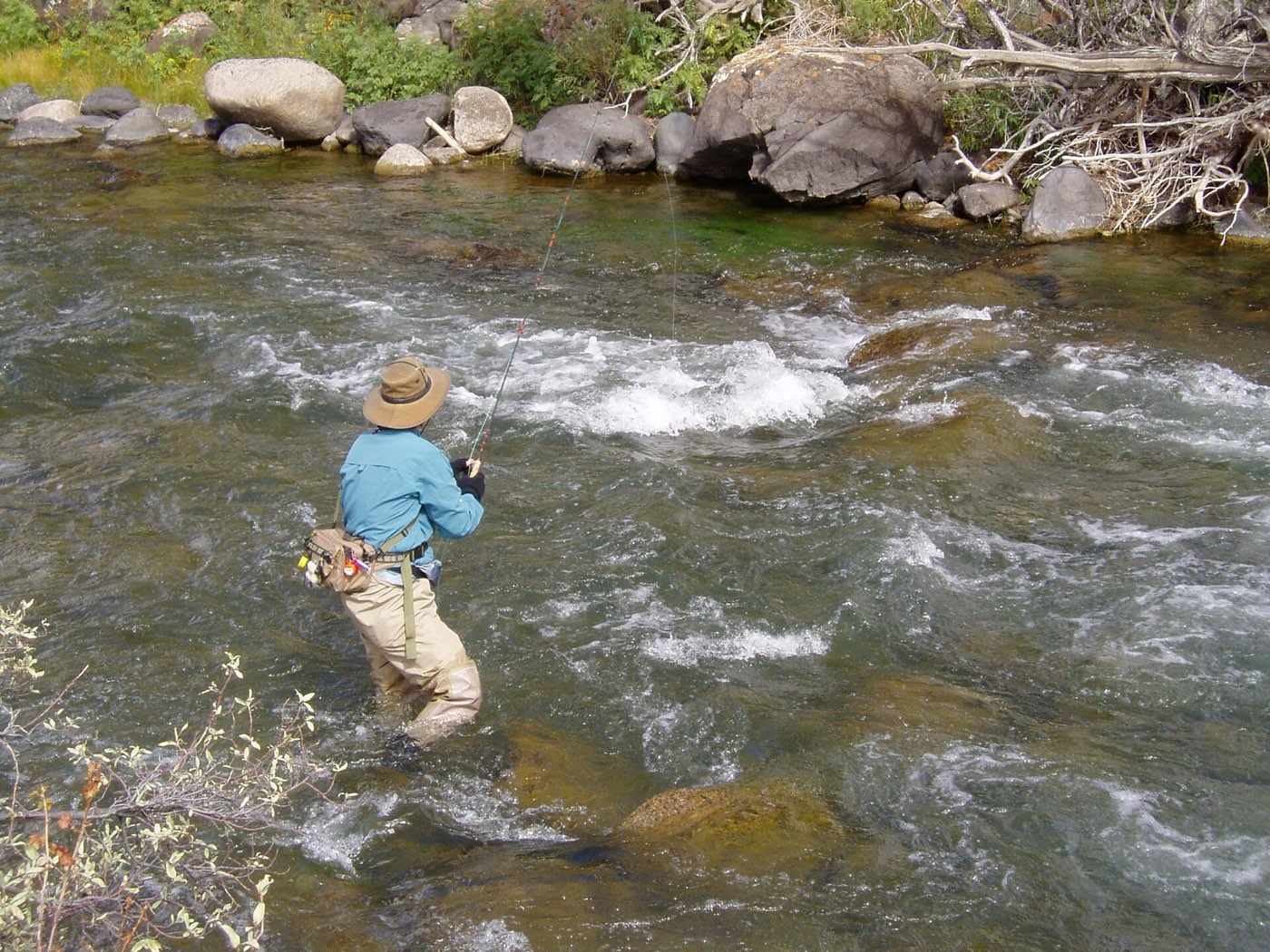
RIO's FIPS Euro Nymph Line ($59.99) is the best euro nymphing fly line for most anglers: an 80 foot floating line, one size fits rods from 2 through 5 weight, thin enough that RIO built it to meet FIPS Mouche's competition rules. If you already fish a 9 or 10 foot rod with a decent floating line and want to try the technique before buying a dedicated spool, RIO's Euro Nymph Shorty ($29.99) loops onto the front of that line and converts it for a fraction of the cost. Anglers who fish through cold months have a third option: the Cortland Euro Nymph Braid Core ($59.95), a level line built around a supple braided core that resists coiling in the cold. All three are level, near-invisible-diameter lines built to sit off the water instead of sagging into it, which is the entire point of tight-line nymphing.
The variable that decides this category is diameter, not taper. A standard weight-forward trout line runs a thick front taper into a thinner running line, and that mass hangs in a belly between the rod tip and the water on every drift. A dedicated euro line skips the taper and runs level, or nearly level, at a diameter closer to heavy monofilament than to a fly line. It lies straighter off the tip, so a take moves the sighter instead of getting absorbed in slack. The leader below it still does most of the actual fishing (see our euro nymphing leader guide for that build), but the line on the reel decides whether the rod loads at all when two size 14 tungsten nymphs are the only weight in the system.
The picks at a glance
| Pick | Best for | Price (as of September 2026) | Distinguishing spec |
|---|---|---|---|
| RIO FIPS Euro Nymph Line | Replacing your floating line for dedicated euro work | $59.99 | 80 ft, one size fits 2 to 5wt, FIPS Mouche approved |
| RIO Euro Nymph Shorty | Adding a euro tip without a second reel spool | $29.99 | 20 ft loop-on section, welded loops both ends |
| Cortland Euro Nymph Braid Core | Fishing through cold months without a stiff, coil-prone core | $59.95 | Braided nylon multifilament core, 0.022 in diameter, dual sage and chartreuse color |
How to choose a euro nymphing line
Diameter and sag: why a level line beats a weight-forward taper
A weight-forward line's front taper is built to turn over a leader and a dry fly with the line's own mass. That mass is the problem for tight-line nymphing: hang 20 feet of a tapered floating line off a rod tip at head height and it bellies toward the water in an arc, and a trout's take has to straighten that arc before you see it move. A level or near-level line at a fraction of the diameter lies almost flat from tip to leader, so there is little arc to straighten. Cortland's Euro Nymph Braid Core lists a 0.022 inch (0.56mm) diameter for its level line, and that number is the class this whole category lives in: thin enough that the line's own weight barely sags between two points a rod length apart.
What the line still contributes when the leader does the fishing
A straight mono rig (no fly line at all, just a long thin monofilament or fluorocarbon butt straight to the reel) removes line mass from the system entirely. That works at close range because the caster is lobbing the weight of two tungsten flies with a water load or a tuck cast, not carrying a line through the air. Past 25 to 30 feet, or into wind, a mono rig runs out of energy to turn over: there is no grain weight anywhere in the system to extend the cast. A level euro line adds a small amount of mass at the front, just enough to carry that energy a little further and let the leader unroll rather than pile. The line handles the delivery, and the leader handles the drift.
Core material and taper: supple core, stiff mono core, and the shooting-head shortcut
RIO builds its FIPS Euro Nymph Line on what the company describes as a thin, low stretch, supple core, prioritizing sensitivity over stiffness. A separate RIO product, the Technical Euro Nymph Line, takes the opposite approach: a stiff monofilament core that extends past the coated section to become the leader butt itself, trading some suppleness for less sag between guides and one fewer connection knot. Cortland runs the same supple-versus-stiff split under one product line: the Euro Nymph Braid Core uses a braided nylon multifilament core for cold-weather handling and less coiling, while the Euro Nymph Mono Core swaps in a stiffer monofilament core for extra shoot-ability and less sag between guides, the same tradeoff RIO makes between its FIPS line and the Technical Euro Nymph. Scientific Anglers sells a Euro Nymph Kit built around a 20 foot floating tip section (0.025 inch diameter per SA's own listing) bundled with its Absolute Euro Nymph leader, the same shooting-head concept as RIO's Shorty. Airflo made a similar SLN Euro Nymph line at 0.60mm diameter with a hi-vis tip, but as of this research date it no longer appears in Airflo USA's current Specialty fly line lineup, so it is not reviewed here as a current pick. The taper choice that matters for a buyer is level versus shooting-head: a full-length level line replaces everything on the reel, while a shorty or kit tip only replaces the front section and leaves a standard taper behind it.
FIPS Mouche legality: what "competition legal" actually means
RIO states that its FIPS Euro Nymph Line has been vetted and approved by FIPS Mouche as Competition Legal, with a system of marks on the line itself so a judge does not have to stop and measure it during a match. Cortland's Euro Nymph Braid Core carries no such statement on its own product page as of this research date: its 0.022 inch diameter sits in the same class as the RIO lines above, but treat it as a strong level line rather than a confirmed competition-legal one until Cortland states otherwise. The rule behind that claim, a minimum coated line diameter so competitors cannot fish a bare mono rig, is covered in detail in our leader setup guide, which also lays out the leader length and tippet ring limits that apply alongside it. You do not need to fish competition rules to benefit from a legal line: the same minimum diameter that satisfies a judge is also thick enough to still cast like a line, not a strand of mono.
Cold weather and guides
Wet fly line picks up a film of water on every strip, and in freezing air that film turns to ice in the guides. A level euro line at 0.022 to 0.024 inch carries far less wet surface through each guide pass than a weight-forward belly several times that diameter, so it builds ice more slowly on a cold morning. It still stiffens in real cold and still needs to be stretched before the first cast, same as any coated line; a thin line with memory from a tight spool will pile just as badly as a thick one. The advantage is in how much water the line brings through the guides, not in the coating chemistry, which none of these manufacturers detail beyond calling their coatings low friction.
RIO FIPS Euro Nymph Line: the standard dedicated line
Specs:
- Length: 80 ft (24.4 m)
- Line size: one size fits 2 through 5 weight rods
- Density: floating
- Core: thin diameter, low stretch, supple core (RIO does not publish an exact diameter figure for this line)
- Tip: high visibility section for detecting subtle takes
- Competition status: approved and endorsed by FIPS Mouche as Competition Legal
- Price: $59.99 as of September 2026
This is RIO's answer to a dedicated euro reel spool: designed by Steve Parrott to be, in RIO's words, a one size fits all European style nymphing line, it replaces a normal weight-forward floating line entirely rather than attaching to the front of one. Because the line carries so little mass, the caster relies on the weighted flies to load the rod tip, not on the line's grain weight, which is why the same 80 foot spool works whether the rod is a 2 weight or a 5 weight. That is a different relationship between line and rod than a standard AFTMA-matched WF setup, where the line's weight is what loads the blank.
The FIPS Mouche approval matters even if you never fish a sanctioned match: it means the diameter and coating meet a published minimum, so the line still behaves like a line and not a bare strand of mono, and the marks on the coating are simply a visual aid RIO added for judges rather than a feature that changes how the line fishes.
The limit is cost of entry, not performance. Fishing this line means dedicating a reel or a spare spool to euro work, since it replaces your everyday floating line rather than sitting in front of it. At $59.99 that is a reasonable outlay next to a rod or reel, but it is money spent before you know whether the technique sticks for your kind of water.
Buy if: Euro nymphing is now a regular part of your rotation and you want a dedicated spool built specifically for it.
Skip if: You are still deciding whether the technique is worth a second setup.
RIO Euro Nymph Shorty: add a tip section without a second reel
Specs:
- Length: 20 ft (6.1 m)
- Line size: 2 through 5 weight
- Density: floating
- Construction: ultra-thin line with welded loops on both ends
- Role: loops onto the front of a standard weight-forward line to convert it for euro nymphing
- Price: $29.99 as of September 2026
The Shorty solves a different problem than the FIPS line. Instead of replacing everything on the reel, it loop-to-loop connects to the welded loop most modern fly lines already carry, turning the front 20 feet of a normal setup into a euro nymphing tip. RIO deliberately kept it at 20 feet, long enough to cover the level-butt zone a euro leader occupies at typical high-stick range, short enough that the standard line's front taper stays out of the equation entirely while it is looped on.
The upside is cost and flexibility: $29.99 buys a way to test the technique on a rod and reel you already own, and swapping back to normal fly fishing means unclipping one loop connection. For a reader deciding whether a dedicated euro setup is worth the money, this is the cheaper first step.
The limit is the loop itself. A loop-to-loop connection is a small lump that has to pass through the tip-top guide on every cast and every hookset, which a continuous level line does not have. And because the Shorty sits in front of whatever line you already own, the line beyond it still carries the mass and taper of a normal WF line; at longer range, or on the back cast, that mass behaves differently than a full 80 foot dedicated spool like the FIPS line.
Buy if: You want to try euro nymphing on gear you already own before committing to a dedicated spool.
Skip if: You already know the technique is staying in your rotation and want one continuous line rather than a loop connection.
Cortland Euro Nymph Braid Core: the supple cold-weather line
Specs:
- Length: 90 ft
- Taper: level, one size (".022 - LEVEL"), 0.022 in diameter
- Density: floating
- Grain weight: 40 gr
- Core: braided nylon multifilament, built for supple handling and reduced coiling in cold conditions
- Color: dual sage green and chartreuse profile, for a hi-vis or a low-visibility read depending on which section is showing
- Price: $59.95 as of September 2026
Cortland's pitch for the Braid Core is cold-weather handling: the braided nylon core stays supple instead of stiffening into coils on a freezing morning, which is the failure mode of a lot of monofilament-core lines once the temperature drops. Cortland rates the line's coating from 30 to 50 F on the cold end and 50 to 70 F on the warm end, and pairs it with a Heat-Tempered Surface Treatment and Shooting Technology coating for the shoot through the guides. It is made in Cortland, New York, and the dual sage and chartreuse coloring gives a caster a hi-vis tip or a stealthier profile depending on how much of the line is out past the rod tip.
The limit is the connection at the front. Cortland ships its nymphing lines without welded loops, the same as its Mono Core sibling, because the company expects anglers to pair them with a mono extension or sighter material rather than a standard leader loop: the recommended connection is a uni knot or a nail knot, not a loop-to-loop like the RIO Shorty above. The Braid Core's own product page also does not carry a FIPS Mouche statement, so it should not go on a reel expecting to fish a sanctioned match without checking with Cortland first. And because a braided core is inherently softer than a stiff mono core, it sags a little more than Cortland's own Euro Nymph Mono Core on a long reach; if that matters more to you than cold-weather suppleness, the Mono Core in .022 DT runs $38.47 (on sale from $54.95) and trades some of the supple handling for extra shoot-ability and less sag between guides.
Buy if: You fish through cold mornings and want a core that stays supple and resists coiling instead of a stiff mono core.
Skip if: You need welded loops out of the box or a line with a stated FIPS Mouche legality claim.
Which one to buy
Start with how often you actually fish tight-line nymphs. If it is most of your trips on water like the Savage below the dam or Penns Creek pocket water, buy the FIPS Euro Nymph Line and put it on a dedicated spool for a 10 foot 3 weight; the best 3-weight rods for small streams roundup on this site covers that rod category, and pairing a euro-specific rod with a euro-specific line is where the technique actually separates itself from high-stick nymphing on a standard leader. If most of that dedicated fishing happens after the first frost, the Cortland Euro Nymph Braid Core at $59.95 is worth weighing against the FIPS line instead: the braided core stays supple and builds less guide ice on a cold morning, at the cost of a tied leader connection instead of a welded loop and no stated FIPS Mouche legality.
If you are not sure yet, the Shorty is the more honest starting point. Loop it onto the front of the floating line already on your reel, spend a season working the leader formulas in our leader setup guide, and decide from there whether a dedicated spool earns its keep. The standard weight-forward lines most anglers already own were never built for this job, which is exactly why a $29.99 add-on section exists.
For the typical reader of this site, fishing 20 to 40 days a year on Mid-Atlantic freestone and limestone water, I would buy the Shorty first. It costs a third of a dedicated spool, it answers the only question that matters (does the technique catch more fish on your water), and if the answer is yes, the choice between a dedicated spool comes down to season: the FIPS Euro Nymph Line at $59.99 for most of the year, or the Cortland Euro Nymph Braid Core at $59.95 if winter fishing is a real part of your rotation.
Questions people ask
Do I need a dedicated fly line for euro nymphing, or can I fish my regular line?
You can start with your regular floating line and a long leader, but its front taper sags more than a level line at close range, which hides light takes. A $29.99 Shorty looped onto the front of that same line removes most of the sag for a fraction of the cost of a dedicated spool.
Can I skip the fly line entirely and fish a straight mono rig?
You can outside of competition, and many anglers do at short range. Past 25 to 30 feet, or in wind, a mono rig has no line mass to carry the cast, and it fails the FIPS Mouche minimum coated line diameter rule covered in our leader setup guide, so it is not legal in FIPS-sanctioned sectors.
What line weight euro nymph line should I buy?
RIO's FIPS Euro Nymph Line and Shorty are both sold as one size that fits 2 through 5 weight rods, because the line's own grain weight is not what loads the rod, the weighted flies are. Neither is rated for 6 weight or heavier rods.
Will a euro nymph line work on a standard 9-foot rod?
Yes. You lose reach compared to a 10-foot rod, and the fly line touches the water more often, but the small-stream leader formula in our leader setup guide is built around exactly that setup.
Related reading
- Euro nymphing leader setup for the leader formulas these lines connect to.
- Euro nymphing: the complete guide for the cast, the drift, and the regional styles.
- Best 3-weight fly rods for small streams for the rod category built around a dedicated euro line.
- High-stick nymphing in pocket water for the same water without a specialty line or leader.
- Best 5-weight fly lines for the standard weight-forward lines a euro line is built to replace.
Updated October 2, 2026.