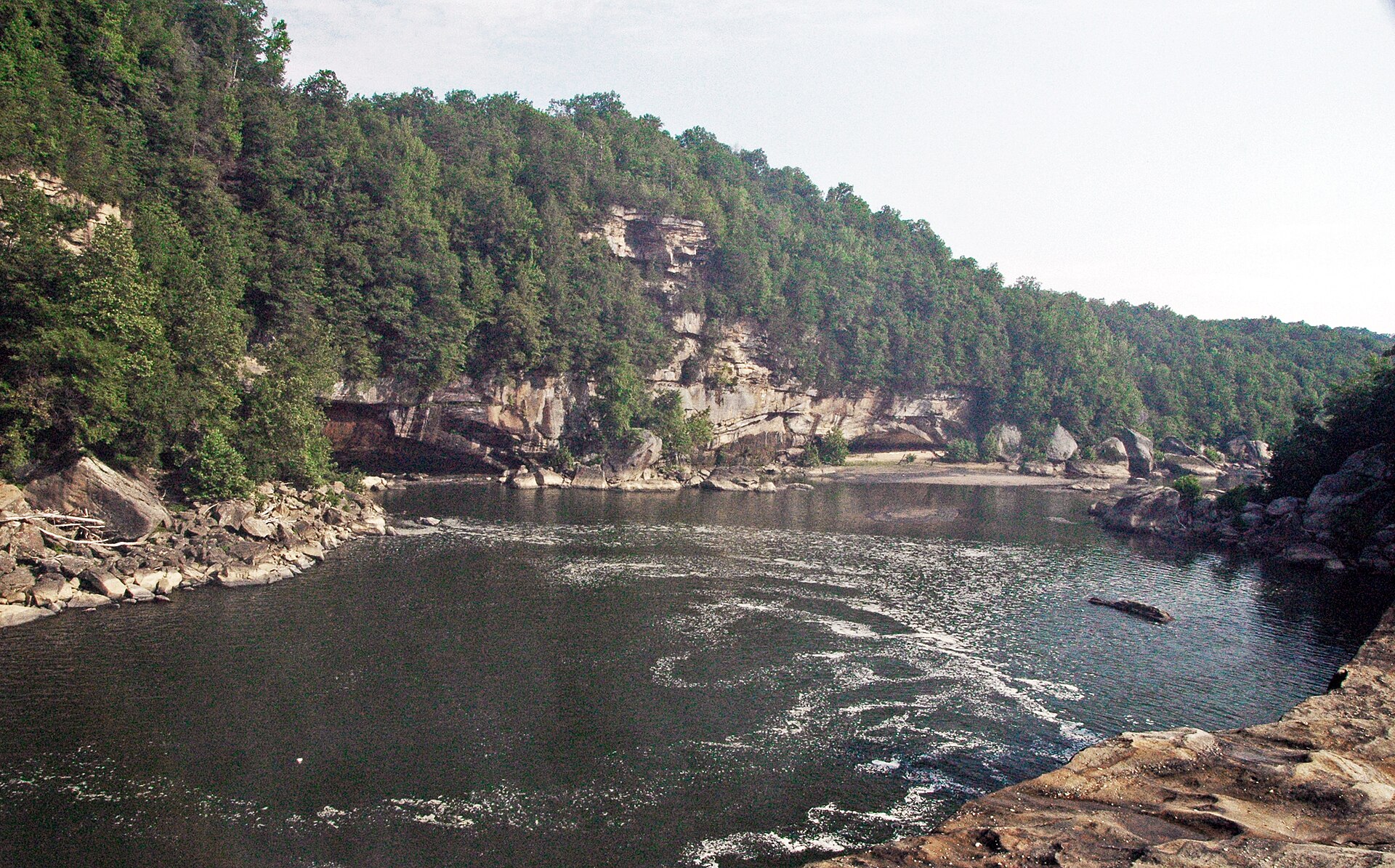
Quick reference
| Field | Value |
|---|---|
| State / region | Kentucky, south-central Kentucky below Lake Cumberland near Jamestown |
| Species | Rainbow trout, brown trout, smallmouth bass; striped bass possible in some reaches |
| Best months | Late April–early June for the best hatch mix; trout fishing holds year-round |
| Water type | Tailwater (bottom-release from Lake Cumberland) |
| Difficulty | Intermediate — big water, generation-driven flows, and boat-first logistics |
| Wading | Limited and strongly flow-dependent; safe only in posted low-flow windows near the dam and at select shoals |
Why fish here
The Cumberland below Wolf Creek Dam is a large coldwater tailwater fed by hypolimnetic releases from Lake Cumberland, and those bottom-draw releases create year-round trout habitat for roughly 75 miles downstream — an enormous amount of cold water for a southern state. Anglers travel from across the region for the combination that defines the fishery: high catch rates of stocked rainbows, consistent flows, and a realistic chance at a trophy brown trout.
The two sides of that fishery ask for different games. The rainbows come steadily to technical midge and nymph rigs — midges produce every month of the year, backed by strong seasonal caddis, sulphur, and BWO hatches. The big browns are a predator hunt: they key on shad and baitfish and respond to large streamers when the turbines run and the water comes up. Few rivers let an angler switch between numbers fishing and trophy hunting on the same day's float.
The trade-off is logistics. At normal generation flows most of the river is boat water, with wading confined to limited low-flow windows immediately below the dam and at select shoals downstream. The generation schedule is not a detail here — it is the organizing fact of every trip.
The river, section by section
Wolf Creek Dam to Helm's Landing
Access: The Wolf Creek Dam tailwater area (parking, bank fishing, boat access) and the Helm's Landing boat ramp. Character: Wide, deep, and highly regulated by turbine releases — strong currents, broad runs, fewer defined pools, modest gradient, and flows that can change rapidly. At true low water, limited gravel bars and shoals allow cautious wading close to the bank. Species mix: Stocked rainbows dominate the catch, with increasing numbers of browns — including large fish keyed on shad and baitfish. Striped bass show in the upper tailwater during some periods. Crowding: The heaviest use on the river, especially weekends in spring and fall; guide boats are common when flows suit drifting. Weekdays run quieter but still see traffic in prime conditions. Notable hatches: Year-round midges under indicators; strong black caddis and mixed caddis in spring, plus Hendricksons and March Browns in March–April; sulphurs and BWOs late spring into summer; early-spring stoneflies and late-summer terrestrials along the banks.
This upper reach is the fishery's front door and its most concentrated water. When a posted low-flow window opens, the bars below the dam offer the river's best wade fishing; when the turbines run, it becomes big-boat water where attention to the generation schedule is a safety matter, not just a fishing one.
Helm's Landing to Burkesville
Access: Helm's Landing boat ramp upstream; public access and ramp at Burkesville downstream. Character: Large and tailwater-stable, with long riffle-run sequences over gravel bars, deep ledges, and broad pools that fish well from a drift boat. Gentle gradient, but the volume and width make wading limited and often hazardous outside specific low-flow shoals. Species mix: Rainbows common throughout; browns increasingly targeted with nymphs and streamers near woody cover and deeper structure. Warm-season baitfish concentrations can pull striped bass into parts of the reach. Crowding: Regular boat traffic from guides and DIY anglers in good conditions, heavier on weekends and during strong spring hatches. The river's size lets boats spread out, though ramps and obvious shoals can feel busy. Notable hatches: Midges all year for consistent rainbow action; black caddis, March Browns, and mixed mayflies in spring; sulphurs and BWOs from May to July with good afternoon and evening dry-fly fishing; foam hoppers, beetles, and ants along the banks in late summer.
This is the classic Cumberland float — seams, structure, and ledges covered from a moving boat. The May–July sulphur and BWO period is the closest the river comes to dependable dry-fly fishing, and the terrestrial banks in late summer reward a hopper with a midge or nymph dropper.
Burkesville and the lower tailwater
Access: Burkesville boat ramp and associated public access. Character: Still broad, but with more mixed character — long slow pools, deep bends with wood, extended runs over gravel and cobble. Tailwater influence keeps flows and temperatures relatively stable, though tributaries can add color; wading remains limited and flow-dependent. Species mix: Rainbows and browns remain the primary targets, with browns relating to deeper bends, wood, and ledges where streamer presentations shine. Striped bass and warmwater species mix in depending on season and flows. Crowding: Generally lighter than below the dam. Longer distances between ramps spread out the boat traffic, though good generation schedules and strong hatch windows still draw anglers. Notable hatches: Ever-present midges over deep bars and slow pools; caddis, sulphurs, and BWOs in spring and early summer; terrestrials along vegetated banks in late summer.
The lower river is where the brown trout hunt gets serious. The wood-lined bends and ledges are streamer water, and the reduced pressure means fish that see fewer flies. It is also the reach that asks the most planning — ramps are farther apart, and the float distances are real.
Hatches and seasons
| Months | Hatches | Flies |
|---|---|---|
| Mar–Apr | Hendricksons, March Browns, early caddis (including black caddis), midges, early stoneflies | Hendrickson and March Brown dries (#12–14); beadhead Prince and Pheasant Tail (#14–18); black caddis emergers/pupae (#14–16); stonefly nymphs (#4–10); midge larva/pupa — WD-40, Brassie (#18–20) |
| May–Jul | Sulphurs, Blue-Winged Olives, mixed caddis, midges | Sulphur and BWO parachutes (#16–20); Barr's Emerger (#18–20); Copper John and Prince (#16–18); soft-hackle caddis pupae (#14–16); tandem midge rigs (#18–22) |
| Aug–Sep | Midges, residual BWOs and caddis, strong terrestrial activity | Foam hoppers, beetles, ants (#10–16) with droppers; small BWO and caddis dries (#16–20); Brassie and WD-40 midges (#18–22) |
| Oct–Feb | Midges and small BWOs primary; sporadic caddis and stonefly nymph activity in warm spells | Midge larva/pupa in cream, black, olive (#18–22); BWO dries/emergers (#18–20); sowbugs and scuds (#14–18); buggers, sculpins, shad-style streamers (#2–8) for browns in higher flows |
Recommended flies (by season)
| Season | Top patterns | Why |
|---|---|---|
| Spring | Hendrickson and March Brown dries, black caddis pupae, Prince Nymph, Pheasant Tail Nymph, Copper John, stonefly nymphs, Brassie and WD-40 midges | Strong mayfly and caddis hatches plus active stonefly nymphs; trout take medium-sized nymphs and matched dries, with midges as the reliable base when nothing larger is hatching |
| Summer | Sulphur and BWO dries, soft-hackle caddis pupae, tandem midge rigs, foam hoppers, beetles, ants, Woolly Bugger and shad imitations | Stable tailwater temperatures keep sulphurs, BWOs, caddis, and midges driving the feeding; terrestrials matter along banks in late summer, and high-water or cloudy days favor streamers for browns hunting baitfish |
| Fall | Midge nymphs and pupae, BWO dries and emergers, Prince, Pheasant Tail Nymph, Copper John, buggers and articulated sculpin patterns | Cooler air with continued cold releases concentrates trout on midges and small mayflies, while pre-spawn browns turn aggressive on streamers |
| Winter | Midge larva/pupa rigs (#18–22), small BWOs, sowbugs and scuds, Woolly Bugger and shad-style streamers in generation flows | The tailwater stays cold but fishable; midges and small nymphs are the consistent producers, and browns and rainbows opportunistically chase baitfish during higher, off-color releases |
Gear notes
A 9-foot 5- or 6-weight covers most of the trout fishing — some anglers carry a 4-weight for delicate nymphing and a 6-weight for larger streamers. Fish floating lines for indicators and dries, with sink-tips or polyleaders for streamers in generation flows. Common leader setups: 9–12 feet in 5X–6X for dries; a 9–12 foot leader with 3–4 feet of added 4X–5X tippet for nymph rigs; and short 7.5–9 foot leaders in 0X–2X for streamers. Flows change quickly and depths are substantial, so sturdy waders, a wading belt, and often a wading staff are important — and the river should be treated primarily as a boat fishery outside clearly posted low-flow windows.
Logistics
- Regulations: The tailwater is managed by the Kentucky Department of Fish and Wildlife Resources, which stocks rainbows and browns and sets seasons, size limits, and creel limits. A valid Kentucky fishing license is required, plus a trout permit to keep trout. Gear restrictions, special trout zones, and any catch-and-release or slot sections are set in the statewide regulations — consult KDFWR directly before fishing, as regulations change annually.
- Access points:
- Wolf Creek Dam tailwater area — parking, bank fishing, and boat access to the upper tailwater; wading only at posted low-water levels
- Helm's Landing — public boat ramp a short distance below the dam; the standard launch for drifts of the upper and middle reaches
- Burkesville boat ramp — public ramp near Burkesville serving the mid-to-lower tailwater, used frequently by guides
- Nearest towns: Jamestown, Burkesville
- Closest gauge: USGS 03414100 — Cumberland River at Burkesville, KY. The nearest active gauge sits about 15 miles below Wolf Creek Dam, at the downstream end of the trophy reach, so releases at the dam show up here on a lag — a rising trace means generation started a while ago and the upper water is already up. The normal range runs roughly 6,400–12,300 cfs. Read it alongside the Corps' Wolf Creek generation schedule rather than on its own; on this tailwater the schedule, not the gauge, tells you whether you can wade.
When NOT to fish here
Do not plan on wading — and think hard about boating — when multiple turbines are generating and flows are high, especially near the dam. Spring rains can push discharges up and turn the river fast and off-color, which guts nymphing and dry-fly fishing; streamers may still move fish, but conditions are difficult. Crowds are the other factor: peak spring hatch weekends and holidays compress traffic around Wolf Creek Dam and Helm's Landing, so anglers wanting room should aim for weekdays or the lower ramps.
Where to fish next
- Fly Fishing in Kentucky — the full state guide
- Cumberland River above Wolf Creek Dam — the warmwater side of the same system, a different fishery above Lake Cumberland
- Kentucky's other stocked trout waters — the state lists additional tailwaters and streams for anglers building a longer trip