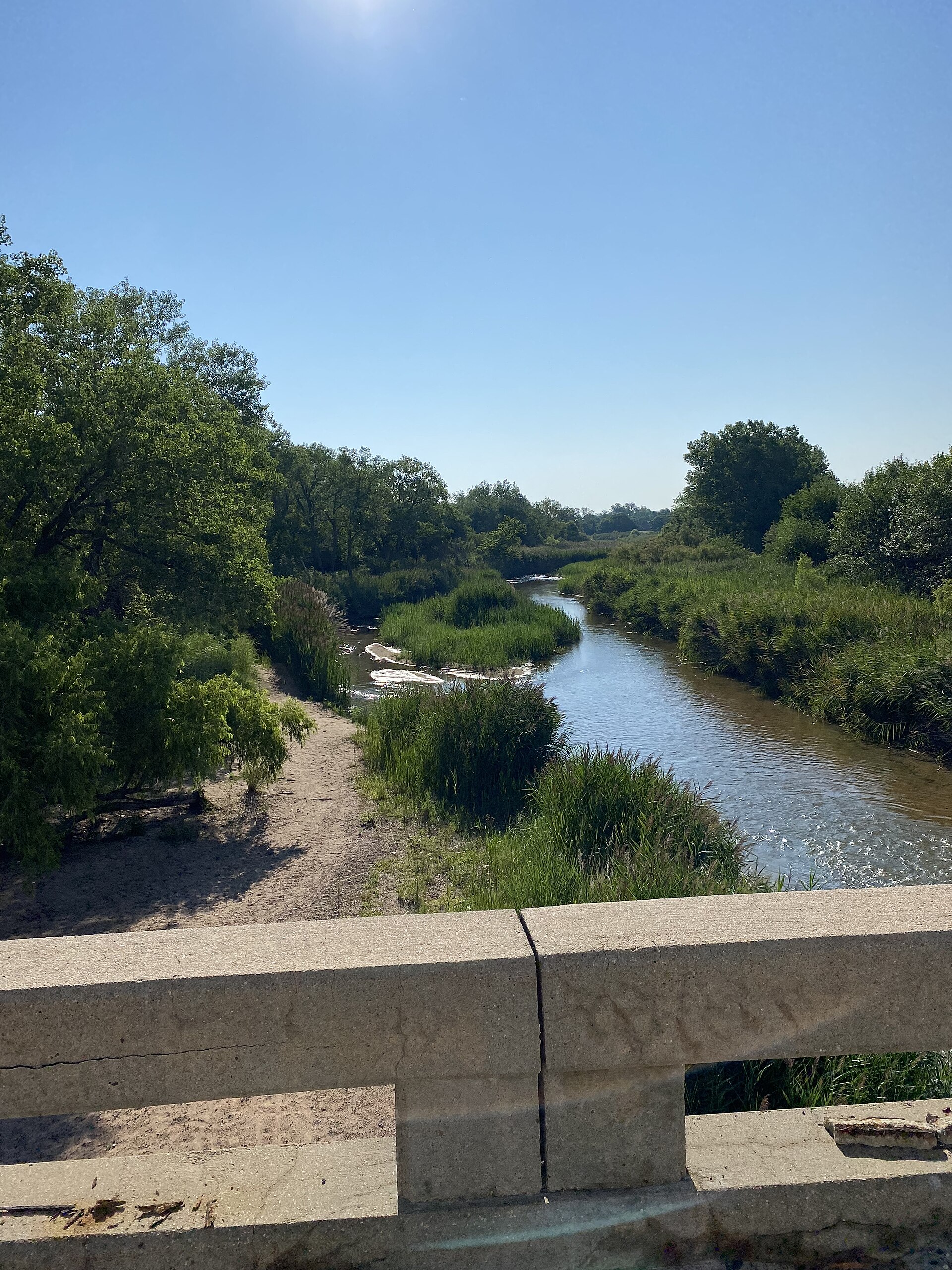
The water
Kansas River
The Kaw is the state's marquee fly water, a broad warmwater river running the northeast corridor past Wamego, Manhattan, Lawrence, Topeka, and Kansas City. White bass and smallmouth fish best in spring and early summer, with steady mixed-species action — smallmouth, wipers, channel cats, and common carp — through fall. Forage is baitfish, shad, and minnows, so streamers, Clousers, and poppers do the work; there is no hatch-matching game here. Access comes through public parks, river access sites, and bridge and boat access points along the corridor, and the carp flats near the metro areas have built a following among sight-fishing anglers. Statewide warmwater rules apply unless a specific access area posts otherwise.
Arkansas River
The Arkansas through south-central Kansas, near Wichita, Derby, and Arkansas City, is the state's most notable trout option. Stocked rainbows and browns hold in managed reaches from November through April, driven by stocking rather than insect life — midges and standard nymph and streamer patterns are the practical staples. Outside the trout season, spring and fall fish best for catfish and smallmouth in cooler water. This is a shoreline-and-access-point river, fished from city- and state-managed reaches and public fishing access areas rather than floated. During the stocked season, trout fishing falls under Kansas trout-season rules and permit requirements, and some reaches carry their own special regulations. Full Arkansas River guide
Blue River
The Blue drains northeast Kansas near Blue Rapids, Marysville, and Junction City, and it is a smallmouth-first river with largemouth, catfish, and panfish mixed in. Late spring through fall is the productive window, with the most consistent fly action coming in moderate flows and warm-water periods. Forage is minnows, crayfish, and terrestrials along the banks, which keeps the fly selection simple: streamers, crayfish patterns, and poppers. Access runs through county and community access points, and most anglers fish short walk-in stretches and roadside reaches rather than covering miles. Standard statewide rules apply, with occasional local access-area rules worth checking.
Republican River
The Republican crosses north-central and northwestern Kansas near Colby and Beloit, carrying channel catfish, carp, wipers, smallmouth, and white bass. Spring and fall are typically best; in summer, fish the cooler ends of the day. It is primarily a baitfish-and-streamer river, though terrestrials and crayfish patterns earn their keep when the water drops low and clear. Access is the planning problem: public fishing access is scattered and can be water-level dependent, so anglers work bridges, designated access areas, and walk-in sites where available. Expect standard statewide rules outside specially regulated segments.
Smoky Hill River
The Smoky Hill runs through central and western Kansas near Salina, Lindsborg, and Ellsworth, holding smallmouth, carp, catfish, and white bass. Spring and fall bring the best water clarity and the most reliable feeding windows. Forage follows the prairie-river pattern — minnows, crayfish, terrestrials — and streamers and bottom-oriented patterns usually outperform dries. Public access is mixed and often limited by flow and private property, so focus on public crossings and designated access areas rather than improvising. No special trout-style regulations are widely cited, but check current access rules before building a trip around a specific reach.
Fall River
Southeast Kansas's Fall River, near Fredonia and Piedmont, is a warmwater freestone where smallmouth, largemouth, panfish, and catfish share the water. Spring through early summer is the window, before heat and dropping flows shut things down. Crayfish, minnows, and terrestrial insects matter far more than aquatic hatches, so fish accordingly. Access is mainly through public crossings and nearby public land and park areas along the river corridor. Statewide warmwater regulations apply, with any county-specific or access-area rules worth a quick check.
El Dorado Reservoir tailrace and outlets
The waters around El Dorado Reservoir in south-central Kansas — near El Dorado, Augusta, and Andover — fish like a compact tailwater system for warmwater species: largemouth, white bass, crappie, and channel catfish concentrated around moving water below control structures. Spring and fall are usually strongest. Shad and small baitfish dominate the forage base, making streamers, Clousers, and small baitfish imitations the core patterns. Public access is strongest around the reservoir, state park, and outlet and shoreline access areas rather than long river miles, and some reservoir-connected waters carry site-specific rules, so verify current regulations before fishing the outlets.
Marais des Cygnes River
The Marais des Cygnes drains east-central Kansas near Paola and Ottawa, with smallmouth, largemouth, catfish, and carp. Spring and fall bring comfortable water temperatures and better bank access. Minnows, crayfish, and terrestrials are the forage themes; fish streamers through current and surface bugs in quieter water. Public access is available in some stretches through wildlife areas, crossings, and public land near the river corridor — and where you fish inside a wildlife area, check for area-specific bank access rules before assuming statewide regulations cover you.
Seasons at a glance
The Kansas year splits cleanly in two. From November 1 through April 15, the stocked trout season runs: rainbows go into selected public waters, the trout permit applies, and the Arkansas River reaches and other managed waters offer the state's only trout fishing. The rest of the year belongs to warmwater fish, with spring and fall as the clear prime windows — milder temperatures, better clarity, and consistent feeding from smallmouth, white bass, wipers, and carp.
Summer is workable but demanding. Heat and low flows push activity to early mornings and evenings, and low water can pinch access on the prairie rivers. If you get to pick your dates, April through June and September through November cover the best of the warmwater fishing, and the trout season handles the cold months.
Beyond trout
In Kansas the "beyond trout" section is the main event. Smallmouth, largemouth, white bass, wipers, carp, catfish, and crappie are the state's strongest fly-rod fisheries, concentrated in eastern and central Kansas where baitfish and shoreline structure hold fish. The Kansas River, Milford Lake, Clinton Lake, and the other big impoundments produce the most consistent non-trout action, and the urban carp fishing in the river corridors around Topeka, Wichita, and Kansas City is a legitimate sight-fishing game in its own right.
Licenses and regulations
The Kansas Department of Wildlife and Parks manages the fisheries. Anglers 16 and older need a Kansas fishing license. The trout permit is seasonal: it is required during the trout season from November 1 through April 15, and generally not required after April 15 — with one exception. The Mined Land Wildlife Area requires a trout permit year-round. Special-regulation notes for individual waters are flagged per river above. Regulations change annually, so confirm the current rules at Kansas Department of Wildlife and Parks regulations before you go.
Where to start
For one weekend, the answer depends on the calendar. In the warm months, base in the northeast and fish the Kansas River corridor: white bass and smallmouth in late spring, carp flats through summer mornings, and mixed-species streamer fishing into fall, with fly shops in the Kansas City and Lawrence area to fill gaps in your box. In winter, point the truck at the Arkansas River's stocked reaches near Wichita, or better, at the Mined Land Wildlife Area in the southeast — its year-round trout permit requirement filters out casual pressure, which is exactly what you want.
Neighboring states widen the options considerably: Fly Fishing in Missouri, Fly Fishing in Colorado, and Fly Fishing in Oklahoma.