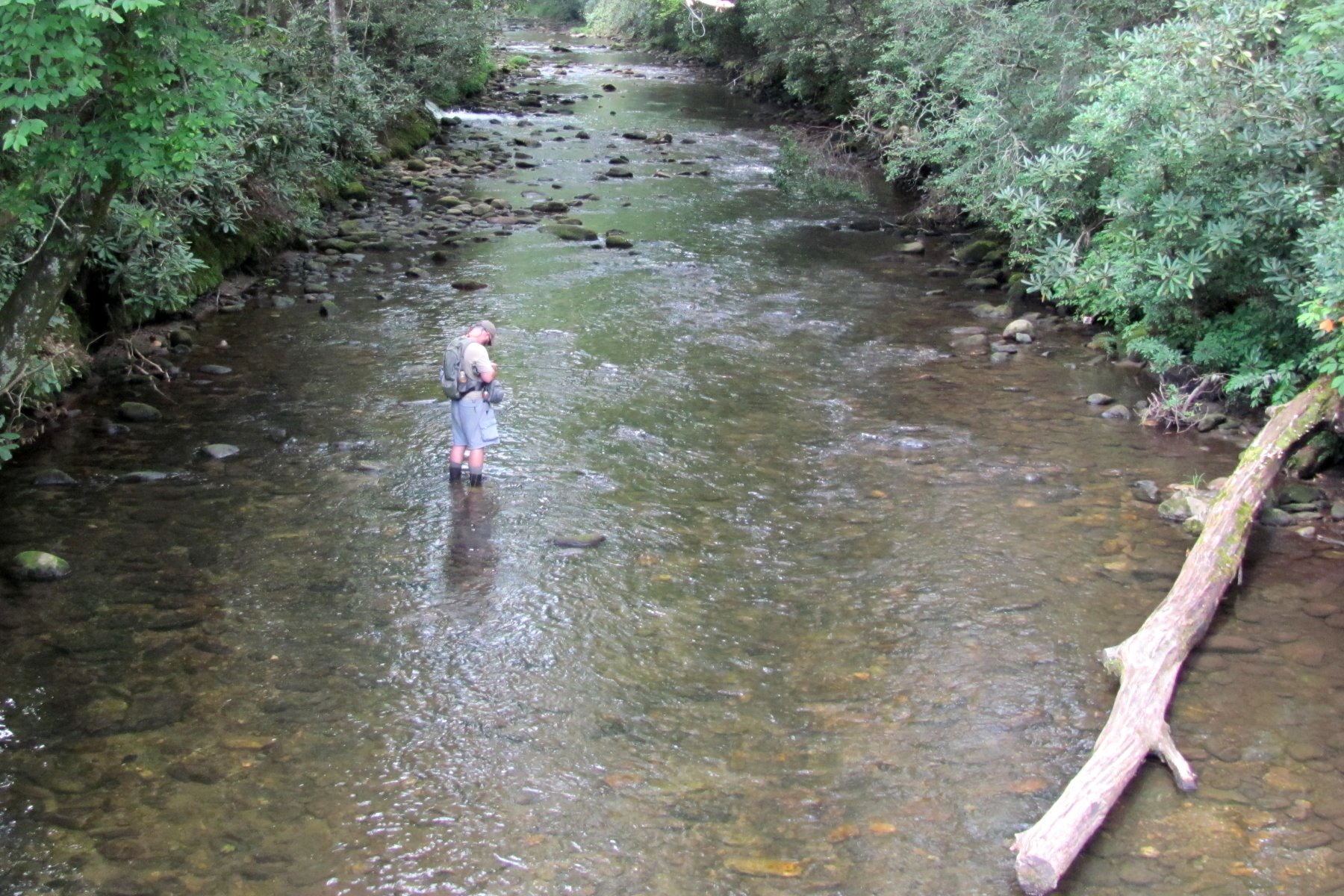
The water
Davidson River
The Davidson, along US 276 through Pisgah National Forest near Brevard, is the state's most famous trout stream. Rainbows, browns, and brookies hold in its clear freestone water, and pressure has made them educated — this is technical fishing by North Carolina standards. Spring and fall bring the most consistent action, with blue-winged olives from late winter into spring, caddis from spring into early summer, and beetles and ants through late summer; midges matter year-round. Winter produces quality fish for skilled anglers, and summer fishes best early and late. Access is easy — pullouts, picnic areas, and trails through public forest land line the highway. Sections carry catch-and-release, artificials-only special trout regulations; check NCWRC's designated trout waters maps. Full Davidson River guide
Tuckasegee River
The "Tuck" flows through Sylva, Dillsboro, and Bryson City in Jackson County, and its delayed harvest stretches are among the state's most productive — heavily stocked, clearly signed, and managed catch-and-release with single-hook artificials during the DH season. Rainbows, browns, and brookies give anglers a shot at the "Tuckasegee Slam" when spring or fall flows and temperatures line up; lower sections turn over to smallmouth and largemouth in summer. Expect mountain mayflies, caddis, and stoneflies in spring, terrestrials in summer, and baitfish and crayfish patterns in the warmwater reaches. Public access is plentiful through town parks, roadside pullouts, and the DH reaches themselves. Regulations shift to general trout rules after the DH period.
Nantahala River
The Nantahala, in its namesake national forest west of Bryson City, splits into two games. The upper river holds designated wild trout and special-regulation water; the lower tailrace section fishes well too, but shares the gorge with a heavy rafting schedule, so time summer sessions around the boats. Rainbows, browns, and brookies feed on blue-winged olives and other mayflies in spring, caddis and stoneflies into early summer, midges year-round, and terrestrials along the forested banks in late summer. Spring and fall offer the best combination of flows and temperatures. Roadside and trail access is good throughout, with established parking at rafting and fishing areas. Verify current NCWRC trout-water classifications — designations vary by section.
Watauga River
The Watauga drains the High Country around Boone and Valle Crucis, holding rainbows, browns, brookies, and smallmouth as it drops toward Tennessee. Spring and fall are the favored windows for trout, with stable flows and active fish; summer offers mixed trout and smallmouth fishing in the cooler stretches, and winter can produce big trout for persistent anglers. Mountain mayflies and caddis come off in spring, stoneflies show in the higher-gradient reaches, and minnow and crayfish patterns work the transitional water. Access is a mix of public and private — bridge crossings, road pullouts, and park areas around Valle Crucis and Boone, with float access farther downstream. Delayed harvest and special-regulation stretches apply on some reaches.
South Toe River
The South Toe heads up near Mount Mitchell north of Asheville, and it's the pick for anglers who want wild fish with easy logistics. The upper river is recognized as a high-quality wild trout stream under special wild-trout regulations, while lower and mid sections carry stocked and delayed harvest water — a full spectrum in one drainage. Spring and fall are ideal, with blue-winged olives and other small mayflies, caddis into early summer, and a strong ant-and-beetle bite in late summer; hot-weather fishing is best in the early mornings or the higher headwaters. Access runs through Pisgah National Forest and along secondary roads, with bridge pullouts and informal walk-in trails.
French Broad River
The French Broad through Asheville is the state's flagship warmwater float: smallmouth, largemouth, sunfish, and muskellunge in a big river with public boat ramps, city parks, and greenway access through Asheville and the downstream towns. Late spring through early fall is prime, with summer bringing consistent topwater fishing for bass. This is forage-based fishing, not hatch-matching — streamers, poppers, and large subsurface flies imitating baitfish and crayfish. The musky fishery draws anglers willing to throw big flies for one eat a day. General inland regulations and standard creel limits apply.
Wilson Creek
Wilson Creek, in Pisgah National Forest near Collettsville, is the underrated pick: clear freestone water, wild scenery, and convenient access without the crowds of the famous mountain streams. Rainbows and browns feed on spring mayflies and caddis, with terrestrials falling from the heavily forested corridor in late summer — attractor dries and nymphs cover most days. Spring and fall bring good flows, cool water, and lighter recreational pressure; summer draws swimmers to the corridor, but mornings and evenings still fish. Access is excellent along Brown Mountain Beach Road, with parking and trails near the Wilson Creek Visitor Center. NCWRC manages sections as special trout waters, including stocked and catch-and-release reaches that vary by segment.
Helton Creek
Helton Creek sits in Ashe County near the Virginia line, in the state's quiet northwest corner, and it's one of the better delayed harvest streams nobody talks about. Stocked trout are abundant during the spring and fall DH seasons, when catch-and-release, artificials-only rules apply and flows run stable; winter and summer still fish for anglers who adapt. Expect general mountain mayfly and caddis activity in spring and terrestrials in summer — nymphs and attractor dries are the standards. Access is good along roads and bridges in upper Ashe County, with clearly marked DH sections and multiple walk-in points on NCWRC-designated trout water.
Seasons at a glance
Spring and fall carry the state. Delayed harvest seasons concentrate stocked fish under catch-and-release rules in both windows, mountain hatches peak in spring, and October–November brings cool water and thin crowds. Summer splits the effort: trout fishing retreats to early mornings, evenings, and high-elevation water, while the French Broad and lower Tuckasegee hit their stride for bass and musky, and the coast produces through the warm months. Winter is quieter but far from dead — the Davidson and Watauga both give up quality fish to anglers willing to work for them, and inshore stripers add a cold-weather option.
Beyond trout
North Carolina's non-trout fishing is a destination in itself. The French Broad and other mountain and piedmont rivers hold smallmouth, largemouth, musky, and seasonal stripers. On the coast, fly anglers sight-fish redfish and speckled trout on inshore flats, marshes, and brackish rivers from the Outer Banks to the southern beaches, with seasonal cobia and stripers in the mix. Spring and summer are most productive for bass and coastal species; winter offers white bass and inshore striped bass for anglers who keep fishing.
Licenses and regulations
Anglers need a valid North Carolina fishing license, plus a separate trout license to fish designated public mountain trout waters — a detail that trips up visitors. The North Carolina Wildlife Resources Commission (NCWRC) publishes maps and classifications for all special-trout waters, and those classifications do the heavy lifting here: delayed harvest, wild trout, catch-and-release, and hatchery-supported designations each carry different rules, noted per river above. Regulations change annually; verify current rules with the NCWRC before fishing. [NCWRC regulations link — TK official URL]
Where to start
One weekend, first trip: base in Brevard. Fish the Davidson for the technical, big-fish game, then hit a delayed harvest stretch — the Tuckasegee is about an hour west — for numbers. Go in April–May or October–November, when DH rules are in force and the hatches are on. If you'd rather trade fish counts for solitude, point the truck at Wilson Creek or Helton Creek instead and have the water mostly to yourself.
Neighboring states worth pairing with a trip: