Quick reference
| Field | Value |
|---|---|
| State / region | North Carolina, Pisgah National Forest near Brevard |
| Species | Rainbow trout, brown trout, brook trout |
| Best months | April–June, September–November |
| Water type | Freestone |
| Difficulty | Advanced (technical, heavily pressured, fine-tippet water) |
| Wading | Manageable at normal flows, but algae-slick rock; a staff helps |
Why fish here
The Davidson is an unusually fertile freestone stream for the Southeast, and that fertility shows up in the fish. Cold water year-round, nutrient input from the Pisgah fish hatchery outflow, and dense midge and mayfly populations support trout numbers well above what most North Carolina freestones carry — including large, educated browns and rainbows in the long catch-and-release, fly-fishing-only reach. Anglers drive from across the region for the specific experience the river offers: sight-fishing to big fish holding in clear, shallow water.
The catch is that those fish have seen everything. The Davidson is one of the most technical public fisheries in the Southeast — small flies, 6X and 7X tippet, and a careful approach are the baseline, not the exception. Many anglers treat it as a proving ground: if a presentation works on pressured Davidson trout, it works most places. That difficulty is a feature. Long-standing catch-and-release management means the fish that refuse a bad drift are still there next weekend, and there is a realistic chance at a large brown on public water.
The river also offers range. Above the hatchery, wild rainbows and brookies hold in small pocket water with far less pressure. The middle reach is the famous technical water. The lower mile below Avery Creek is hatchery-supported and heavily stocked — reportedly the most heavily stocked stretch in North Carolina — so the same road corridor covers everything from spooky headwater fish to easy roadside action.
The river, section by section
Headwaters and wild trout reach (upstream of Pisgah Fish Hatchery)
Access: Forest roads and trails in Pisgah National Forest above the hatchery; pull-offs and trailheads rather than named, paved lots Character: Small, high-gradient headwater water — pocket water, short riffles, small pools, boulders and woody cover; narrow and confined Species mix: Primarily wild rainbows and brook trout, some wild browns in tributaries; smaller fish, better numbers, far less pressure Crowding: Light to moderate; quiet on weekdays, and crowds thin fast as you walk away from road access Notable hatches: Midges year-round; spring BWOs, March Browns, Hendricksons, caddis, and stoneflies; summer Yellow Sallies and terrestrials; fall BWOs
This is the escape valve for the Davidson's pressure. The wading is mostly manageable — slippery, uneven cobble rather than anything dangerous — and the fishing is classic small-mountain-stream work: short casts, quick drifts, wild fish that eat attractors when they haven't been bothered. Flows are naturally flashy after rain, so this steeper water blows out and clears on a faster cycle than the main stem.
Fish here run smaller than in the catch-and-release reach, but they are wild, plentiful, and much more forgiving of a merely good presentation. If the roadside pools downstream are shoulder-to-shoulder, walking upstream from the hatchery is the reliable fix.
Catch-and-release, fly-fishing-only section (Pisgah Fish Hatchery to Avery Creek)
Access: Multiple signed pull-offs and parking areas along US 276, concentrated near the Pisgah Fish Hatchery; the public corridor runs roughly 14 miles from the headwaters down to Avery Creek Character: Medium-sized freestone with long glassy runs, shallow riffles, and pool tailouts; moderate gradient, open banks, good casting room in many reaches Species mix: High densities of browns and rainbows plus some brook trout; the reach best known for large, educated fish Crowding: Heavy — the roadside pools near the hatchery are the most pressured water on the river, busy even on winter weekdays when the weather is mild Notable hatches: Winter midges and BWOs; April–June March Browns, Hendricksons, Green Drakes, Sulphurs, and caddis (the river's peak); summer Yellow Sallies, golden stones, tricos, terrestrials; fall BWOs and midges
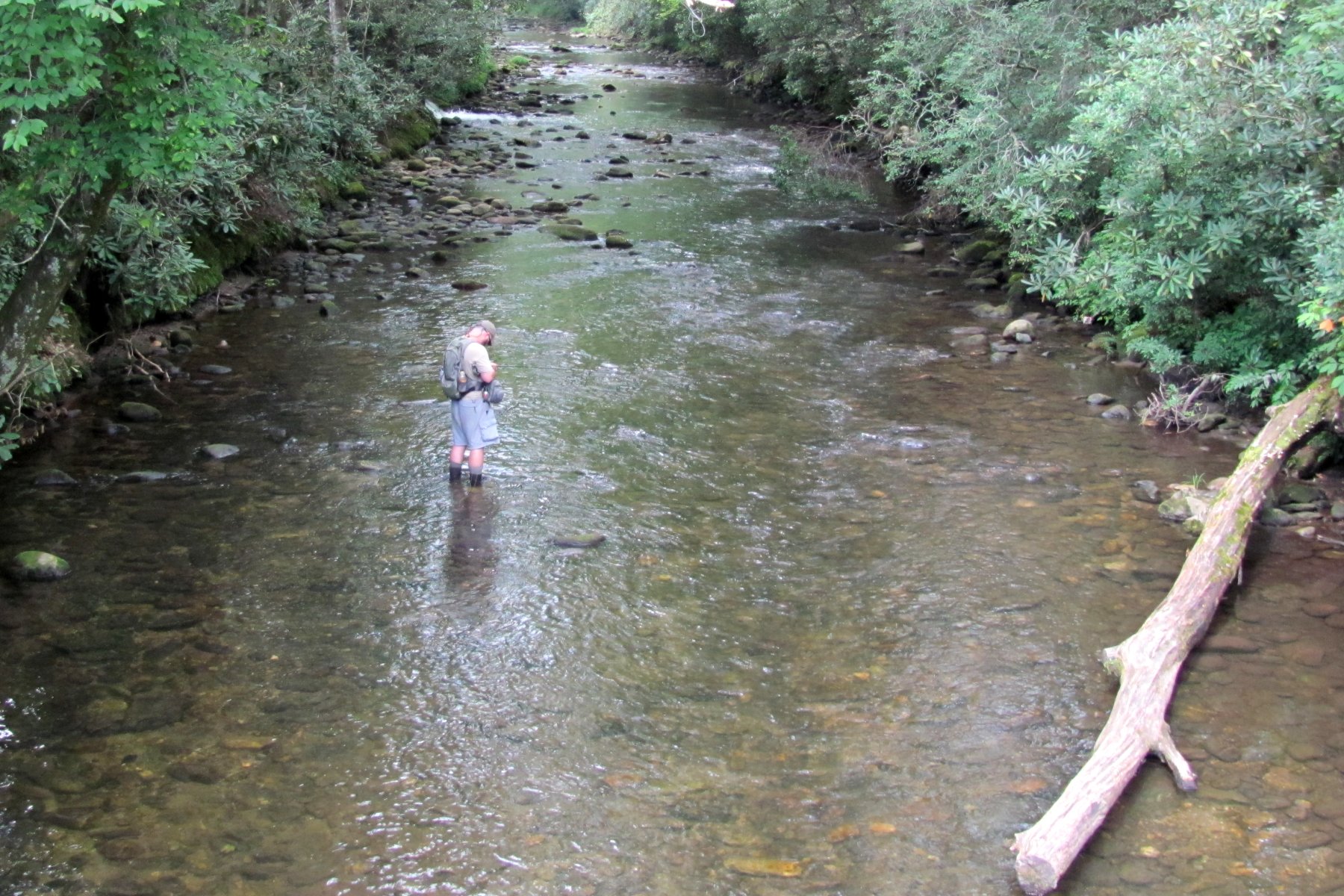
This is the water the Davidson's reputation rests on. Clear water and abundant structure — boulders, undercut banks, woody debris — make sight-fishing to holding fish common at lower flows, and the fish you can see are the fish that have been cast to hundreds of times. Long, drag-free drifts with small nymphs and emergers on fine tippet are the standard play; the glassy runs punish any drag immediately.
Wading is generally fine at normal flows but the rock carries algae, and the deeper slots and ledges demand careful footwork. The April-through-June window, when March Browns, Hendricksons, Green Drakes, Sulphurs, and multiple caddis species overlap, is the best combination of rising fish and comfortable flows — and also the busiest. Fishing early and late, and moving to find unbothered fish rather than camping on famous pools, materially improves the odds.
Avery Creek to USFS boundary (hatchery-supported lower Davidson)
Access: Roadside pull-offs along US 276 from the Avery Creek confluence down to the Forest Service boundary near Pisgah Forest Character: Moderate-width freestone with long runs, deeper pools, and riffles; broad gravel bars, easy wading at typical flows, pushy after heavy rain Species mix: Heavily stocked browns, rainbows, and brook trout — about 1,100 trout per month from March through August by published accounts — with some wild fish mixed in Crowding: Consistently busy in stocking season and on weekends; fly anglers share this water with bait and spin anglers Notable hatches: Midges and small mayflies year-round; spring caddis, March Browns, and Sulphurs; terrestrials and midges in summer and fall
The lower mile is a different river culturally. Hatchery fish dominate the catch, harvest is legal in season, and easy access keeps traffic steady. It is the right water for a fast half-day, for newer anglers who want willing fish, or for anyone who would rather fish attractor nymphs, eggs, and midges than grind out 7X drifts upstream.
The hatches still matter — spring caddis and Sulphurs bring fish up here too — but presentation standards relax considerably. Weekdays outside the March–August stocking peak are the quietest window.
Hatches and seasons
| Months | Hatches | Flies |
|---|---|---|
| Dec–Mar | Midges (cream, olive, black), Blue-Winged Olives, early black stoneflies | Zebra Midge 18–22, Griffith's Gnat 18–24, RS-2 18–22, BWO Sparkle Dun 18–22, Parachute Adams 18–22 |
| Mar–Apr | BWOs, early caddis, early stoneflies, midges | Parachute Adams 16–20, Elk Hair Caddis 14–16, Pheasant Tail Nymph 14–18, Pat's Rubber Legs 8–10 |
| Apr–Jun | March Browns, Hendricksons, Green Drakes, Sulphurs, multiple caddis species | March Brown Parachute 10–14, Light Hendrickson 12–16, Elk Hair Caddis 12–16, Pheasant Tail Nymph 12–16, Parachute Sulphur 14–18 |
| Jul–Sep | Yellow Sallies, golden stoneflies, terrestrials (hoppers, beetles, ants, inchworms), tricos | Yellow Sally dry 12–16, Chubby Chernobyl 8–12, Foam Beetle 12–16, Green Weenie 12–16, Trico spinner 22–26 |
| Sep–Nov | BWOs, midges, caddis, scattered fall mayflies | BWO Sparkle Dun 18–22, Zebra Midge 18–22, WD-40 18–20, Parachute Adams 18–22, Elk Hair Caddis 14–18 |
Recommended flies (by season)
| Season | Top patterns | Why |
|---|---|---|
| Spring | March Brown Parachute 10–14, Light Hendrickson 12–16, Parachute Sulphur 14–18, Elk Hair Caddis 12–16, Pheasant Tail Nymph and Hare's Ear 12–16, Pat's Rubber Legs 6–10 | April–June brings overlapping mayfly and caddis hatches, so imitative dries and nymphs match what fish see; stonefly nymphs earn their keep in high water |
| Summer | Yellow Sally dries 12–16, Elk Hair Caddis 14–16, Chubby Chernobyl and Stimulator 8–12, foam hoppers and beetles 8–14, Green Weenie 12–16, Trico spinners 22–26 | Warm-season fish key on Yellow Sallies, caddis, and bank terrestrials; tiny Tricos and midges cover low, clear mornings |
| Fall | BWO dries and emergers 18–22, Zebra Midge and WD-40 18–22, Griffith's Gnat 18–24, small soft hackles 16–20, Parachute Adams 18–22 | Cooling temperatures and low flows push trout onto small BWOs and midges; subtle emergers suit the fine tippet the river demands |
| Winter | Cream/olive/black midge larvae and pupae 18–24, BWO nymphs and emergers 18–22, Griffith's Gnat 20–24, RS-2 18–22, small stonefly nymphs 14–18 | Midges and BWOs keep hatching all winter; tiny nymphs fished near the bottom of slow runs and pools produce despite cold, clear water |
Gear notes
A 4–6-weight rod in the 8½–9-foot range covers the river, with a longer 5- or 6-weight favored in the more open lower water for reach and drift control. Run a weight-forward floating line, a 9–12-foot leader, and 5X–6X tippet as the default — stepping down to 7X for the most pressured, clear-water fish in the catch-and-release section. Felt or sticky rubber-soled boots plus a wading staff are worth carrying on the algae-covered rock, and the cold, clear water justifies chest or hip waders year-round.
Logistics
- Regulations: From the headwaters through the hatchery reach down to Avery Creek: catch-and-release, artificial-flies-only (single hook), open all year, no harvest. From Avery Creek to the USFS boundary: hatchery-supported water — no lure restrictions, seven-trout daily limit, harvest season from the first Sunday in April through the last Sunday in February (typically closed in March for stocking). A North Carolina license is required at age 16+. Regulations are administered by the North Carolina Wildlife Resources Commission and change annually — verify current designated trout waters maps before fishing.
- Access points:
- Pisgah Fish Hatchery area pull-offs — signed parking along US 276 at the heart of the catch-and-release, fly-only section
- Avery Creek confluence area — roadside pull-offs marking the downstream end of catch-and-release water and the start of the stocked stretch
- USFS boundary pull-offs — informal parking along US 276 for the heavily stocked lower mile
- Closest fly shop: Davidson River Outfitters, Pisgah Forest; Headwaters Outfitters, Rosman
- Nearest towns: Pisgah Forest, Brevard, Rosman
- Closest gauge: USGS 03441000 — Davidson River near Brevard, NC
When NOT to fish here
Skip it during and immediately after heavy rain: this is a freestone that runs high and off-color fast, wading gets unsafe, and the steeper upper reaches blow out hardest. If solitude matters to you, avoid midday on spring weekends and peak hatch periods in the catch-and-release section — the roadside pools get extremely crowded. And in mid-summer, midday water temperatures climb in the lower hatchery-supported stretch; the river stays fishable, but mornings and evenings are both more productive and easier on the fish.
Where to fish next
- Fly Fishing in North Carolina — the full state guide
- Avery Creek — the Davidson's tributary at the regulation break, small water with wild fish close to the main stem
- North Fork French Broad River — nearby Transylvania County water for a change of scenery when the Davidson is crowded