Quick reference
| Field | Value |
|---|---|
| State / region | South Dakota, Black Hills (through Rapid City, west toward Pactola Reservoir) |
| Species | Rainbow trout, brown trout, brook trout in the headwaters |
| Best months | April–October; late May–early July and early September for the best mix of flows and hatches |
| Water type | Freestone above Pactola Reservoir; cold tailwater below Pactola Dam |
| Difficulty | Intermediate — technical tailwater fishing for the biggest fish, forgiving water elsewhere |
| Wading | Generally easy at normal flows; hazardous during spring runoff and heavy dam releases |
Why fish here
Rapid Creek is an 86-mile Black Hills trout stream that flows east from the high country, through Pactola Reservoir, and directly through Rapid City before joining the Cheyenne River. It fishes like a classic freestone above the reservoir, then becomes a productive cold tailwater below Pactola Dam, with stable flows and strong bug life. That split personality is the draw: remote canyon water, a technical tailwater, and urban park stretches all on one creek, and all legally fishable year-round.
The fishery delivers both quality and quantity. The catch-and-release tailwater below Pactola Dam holds some of the biggest brown and rainbow trout in the Black Hills, while the urban and edge-of-town reaches produce fish averaging in the 15–16 inch range at good density. The upper creek adds small brook trout in a traditional Black Hills freestone setting. Hatches run strong from spring through fall — baetis, caddis, PMDs, little yellow stoneflies, Tricos, and midges through the calendar — so a skilled angler can usually find feeding fish somewhere along the drainage in any month.
Access seals the case. Between Black Hills National Forest roads, the Pactola Basin Road trail corridor, and Rapid City's park system, Rapid Creek may be the easiest quality trout water to reach in South Dakota.
The river, section by section
Upper Rapid Creek above Pactola Reservoir (Black Hills National Forest)
Access: Forest Service and county roads west of Rapid City reach the upper stretches within Black Hills National Forest. Character: Freestone headwater water — moderate gradient, narrower channel, riffles and short pools typical of small Black Hills streams. Wading is easy at normal flows; spring runoff can make it unsafe. Species mix: Primarily brook trout, with browns appearing as the creek approaches Pactola Reservoir. Crowding: Lightly fished compared to the tailwater and town water; low weekday and shoulder-season pressure, modest bumps on summer weekends and holidays. Notable hatches: April–September baetis/BWOs, caddis, PMDs, little yellow stoneflies, Tricos; midges year-round; terrestrials in mid- to late summer.
The upper creek is the change-of-pace option: smaller water, smaller fish, and more solitude. It suits anglers who want to prospect pocket water with attractor dries and light rods rather than pick apart pressured tailwater trout. During runoff, bank fishing beats wading.
Pactola Tailwater: Below Pactola Dam to Placerville footbridge
Access: Pactola Basin Road off Highway 385; a hiking trail follows the creek from Pactola Dam downstream toward Placerville Camp. Character: Classic tailwater — relatively stable flows, clear cold water, and a mix of pocket water, riffles, deeper runs, and pools in a forested canyon. Moderate channel width; good wading at normal releases, hazardous during high spring or heavy-release flows. Species mix: A catch-and-release section holding some of the biggest brown and rainbow trout in the Black Hills, mixing stocked and wild fish. Crowding: One of the most popular reaches in the region — busy on spring-through-fall weekends and peak summer vacation periods. Weekdays and shoulder seasons ease but never empty out; the quality of the fishery keeps regular pressure on it. Notable hatches: Strong April–September activity: baetis/BWOs, caddis, PMDs, Tricos, little yellow stoneflies, and year-round midges. Hoppers, beetles, and ants matter in mid- to late summer.
This roughly two-mile reach is the marquee water. Stable dam releases keep temperatures cold and food production high, and the catch-and-release, artificial-lures-only rules let fish grow. The trade-off is education: these trout see flies constantly, so longer leaders, finer tippet, and drag-free drifts separate good days from blank ones. Scuds and shrimp are important tailwater forage worth carrying alongside the mayfly and midge box.
Mornings and evenings fish best for the larger browns and rainbows, which makes the tailwater pair naturally with a midday session in town.
Rapid Creek through Rapid City (Park Drive to Jackson Boulevard)
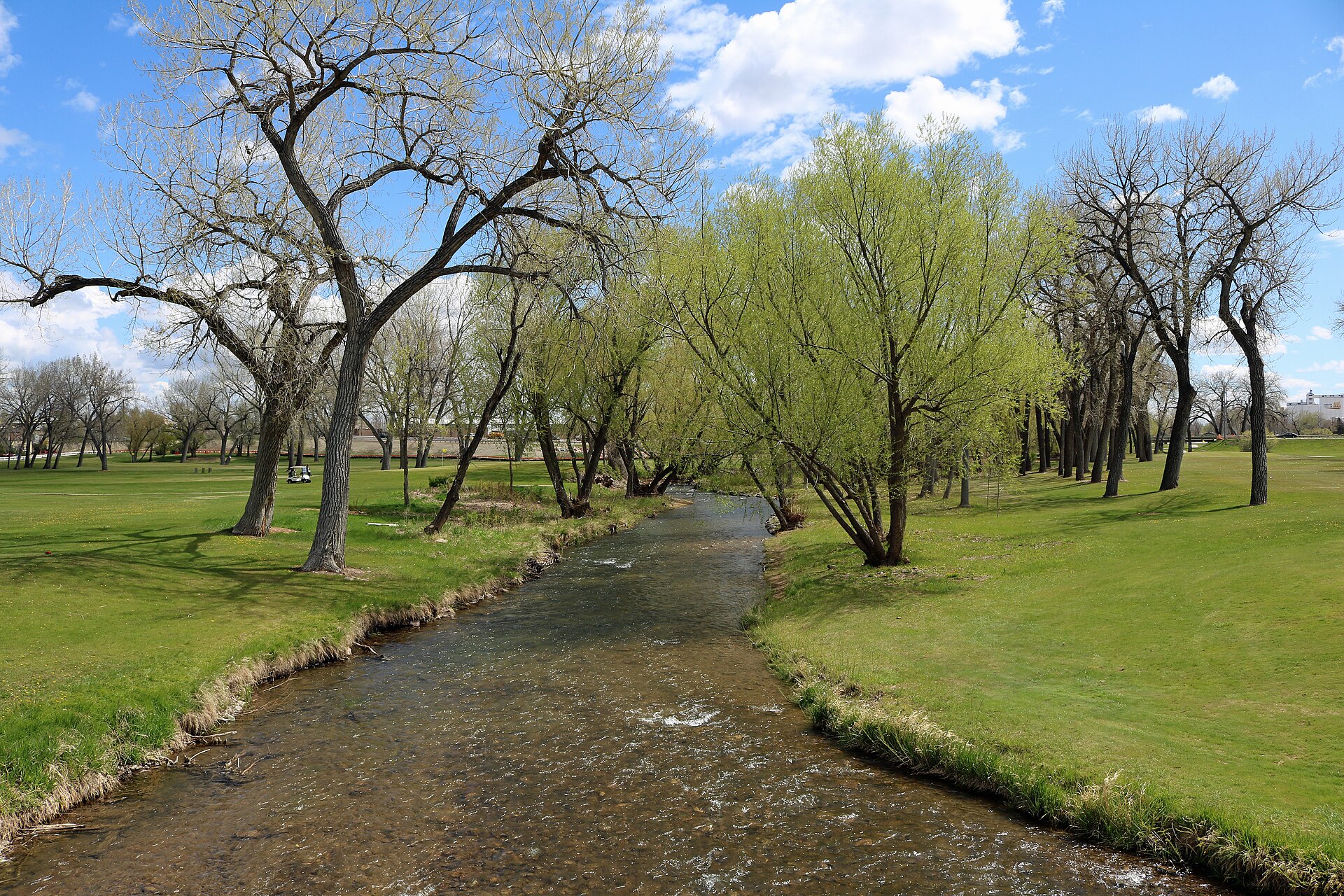
Access: Multiple public access points along Rapid City's park system, including Founders Park and spots along West Main Street and surrounding roads. Character: An urban trout stream running through city parks — a modified but still fairly natural channel of runs, pools, and short riffles. Wading is easy at typical flows, though some stretches fish better from shore around landscaping and structures. Species mix: Managed trout water with stocked and wild rainbows and browns; the brown trout population at the edge of town is healthy, with fish commonly reaching the mid-teens in length. Crowding: Moderately to heavily fished, especially near park amenities and Founders Park. Weekends, pleasant-weather evenings, and tourist season bring the most anglers; weekdays and winter are quiet. Notable hatches: The same suite as the tailwater — BWOs, caddis, PMDs, Tricos, little yellow stoneflies, midges — plus productive summer terrestrial fishing. When the water stains, larger streamers and nymphs beat technical dry-fly work.
Few towns offer sight-fishing to mid-teens brown trout inside city limits. The Park Drive-to-Jackson Boulevard corridor carries its own regulations — trout over 10 inches must go back, artificial lures only — which sustains the quality. Midday, when the tailwater slows, the town water's easy access and visible fish make it the logical second stop.
Lower Rapid Creek east of Rapid City toward the Cheyenne River
Access: General roadside and bridge access east of town as the creek leaves the Black Hills; no specific named angling sites — scout it yourself. Character: Transitional water — canyon and urban character giving way to a lower-gradient, meandering prairie-edge creek. Easy wading at lower flows, but turbidity rises quickly after storms. Species mix: Trout present but less dense and smaller than upstream; warm-water species appear toward the Cheyenne River confluence. Crowding: Lightly fished — most visiting anglers concentrate on the tailwater and city reaches, leaving this water to local use. Notable hatches: Standard regional hatches — baetis, caddis, Tricos, stoneflies, midges — with success hinging on water clarity and temperature. Terrestrials work along grassy banks in summer.
The lower creek is exploratory water, best treated as a low-pressure option when conditions upstream are crowded or off.
Hatches and seasons
| Months | Hatches | Flies |
|---|---|---|
| Mar–Apr | Blue-winged Olives/baetis, early caddis, midges | BWO parachute and baetis comparadun #16–20, Zebra Midge #18–22, Hare's Ear #16–18, Pheasant Tail #16–20 |
| May–Jun | PMDs, caddis, little yellow/golden stoneflies, midges | Elk Hair Caddis #14–18, PMD parachute #16–18, little yellow stonefly dry #14–16, Prince Nymph #14–18, Stimulator #14–16 |
| Jul–Aug | Tricos, caddis, stoneflies, terrestrials, midges | Trico spinner #20–22, Elk Hair Caddis #16–18, foam hopper #8–12, beetles and ants #12–16, Woolly Bugger #6–10, crayfish patterns |
| Sep–Oct | BWOs/baetis, caddis, midges, remaining Tricos; strong nymphing and streamer fishing | BWO parachutes #18–20, soft-hackles and emergers #16–20, Pheasant Tail and Hare's Ear nymphs #16–20, Woolly Buggers and other streamers #6–10 |
| Nov–Feb | Midges, occasional baetis on mild days | Zebra Midge #18–22, small baetis nymphs #18–20, scuds #14–18, small balanced leeches and streamers #8–12 |
Recommended flies (by season)
| Season | Top patterns | Why |
|---|---|---|
| Spring | BWO/baetis dries and emergers, Zebra Midge, Pheasant Tail Nymph, Hare's Ear Nymph, small stonefly nymphs | Strong baetis and caddis activity runs March through late spring, and trout feed heavily on nymphs and emergers in cooler, often higher flows; generic nymphs cover stoneflies and early caddis |
| Summer | Elk Hair Caddis, PMD and Trico dries, hoppers, beetles, ants, Prince Nymphs, Woolly Bugger, crayfish patterns | Prolific caddis, PMD, stonefly, and Trico hatches plus abundant terrestrials along grassy banks; attractor nymphs and streamers take over in stained or deeper water, especially in and below town |
| Fall | BWO dries, caddis, midges, scuds, smaller streamers and leeches | September–November brings cool stable flows and good baetis and caddis activity; pre-spawn browns respond to nymphs and streamers, and scuds are key tailwater forage |
| Winter | Midges (nymphs and small dries), baetis nymphs, scuds, small streamers | The creek is open year-round; winter trout key on midges, occasional baetis, and scuds in slower water — subtle nymphs fished low and slow match reduced metabolism |
Gear notes
Rapid Creek favors lighter rods than most destination trout water: 6.5- to 8.5-foot rods for 3- to 5-weight lines, with an 8.5-foot 4-weight and 6X tippet a common local choice. A weight-forward floating line covers everything. Carry 9–12 foot leaders in 5X–6X for technical dry-fly and nymph work on the tailwater, and 3X–4X for streamers in stained or high water. Hip waders suffice on much of the drainage, though chest waders earn their keep in the tailwater and in colder months. Polarized glasses matter — much of this fishery, especially in town, rewards sighting fish before casting.
Logistics
- Regulations: From below Pactola Dam downstream to the Placerville Camp footbridge (about two miles), trout fishing is catch-and-release only, artificial lures only, with no organic bait within 100 feet of the stream. Within Rapid City from Park Drive to Jackson Boulevard, all trout over 10 inches must be released under the same artificial-lure rules. Across the broader Black Hills Trout Management Area, the daily limit is five trout with only one 14 inches or longer. A South Dakota license is required at age 16 and up; regulations are administered by South Dakota Game, Fish and Parks (SDGF&P) and change annually — verify current rules before fishing.
- Access points:
- Pactola Basin Road below Pactola Dam — primary tailwater access off Highway 385; the road parallels the creek with trail and bank access below the dam.
- Placerville Camp footbridge — downstream boundary of the catch-and-release tailwater section.
- Founders Park (Rapid City) — well-known urban access in the park system near West Main Street.
- Park Drive to Jackson Boulevard corridor — the managed trout reach through town, with multiple park-system access areas.
- Silver City Trailhead area — reached via Highway 44 west to Highway 385 south, then east on Pactola Basin Road; used for upper tailwater and creek access.
- Closest fly shop: Dakota Angler & Outfitter (Rapid City)
- Nearest towns: Rapid City, Silver City, Placerville Camp area
- Closest gauge: USGS 06410500 — Rapid Creek at Silver City, SD
When NOT to fish here
Early-spring runoff makes Rapid Creek hard to fish and sometimes unsafe to wade; high flows are better worked from the bank with heavy nymphs, or skipped entirely. After major rain events — especially in and below Rapid City — the creek stains or blows out, killing visibility and dry-fly fishing until it clears. And on peak summer weekends and tourist periods, the tailwater and urban sections draw real crowds; fish early and late, or pick the upper creek or lower water instead.
Where to fish next
- Fly Fishing in South Dakota — the full state guide
- Spring Creek — another Black Hills trout stream close to Rapid City for a second day on different water
- Castle Creek — a smaller Black Hills option connected to the same high-country drainage network