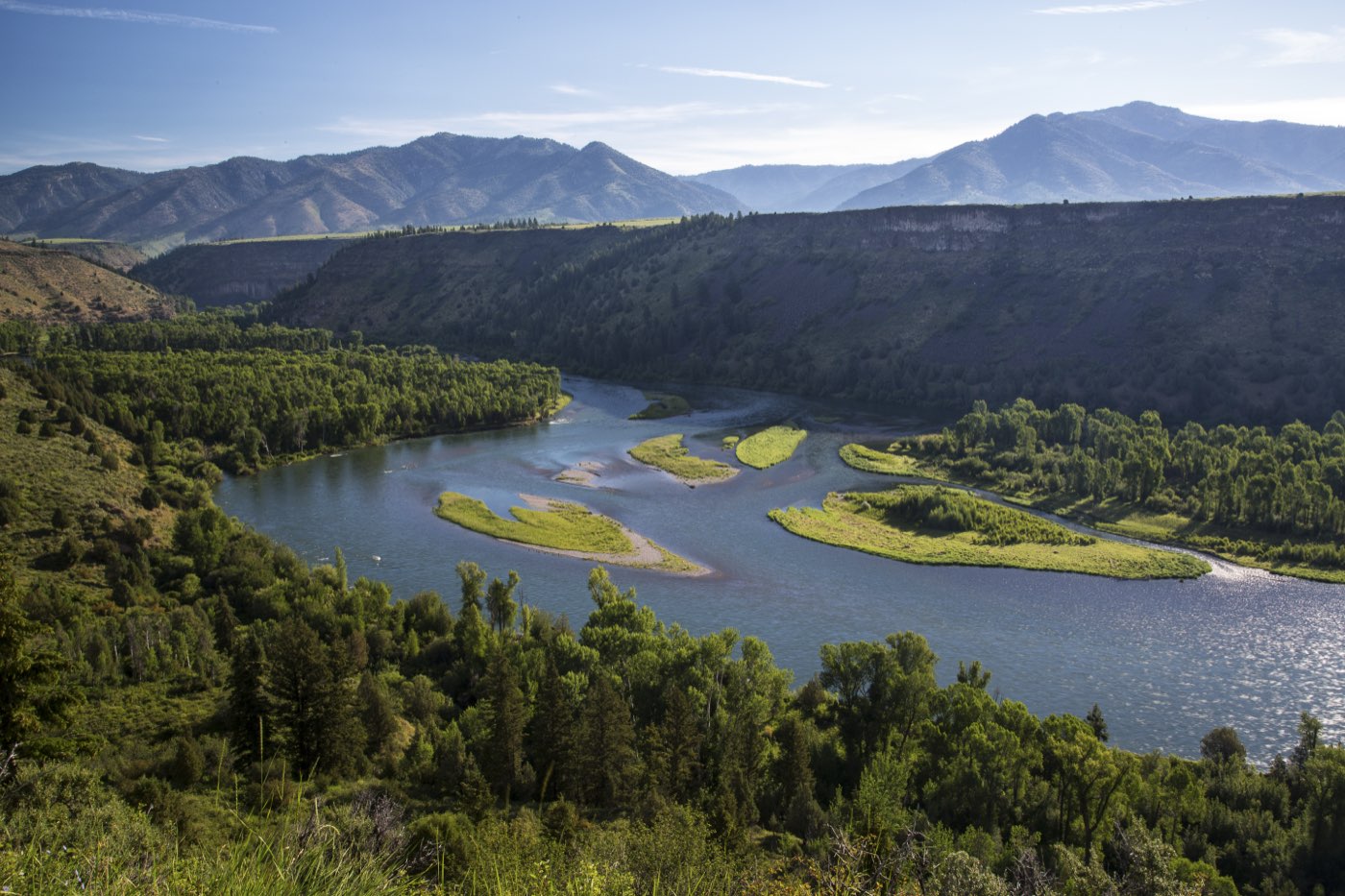
The South Fork of the Snake River drops out of Palisades Reservoir near the Idaho-Wyoming border and runs 64 miles northwest to its confluence with the main Snake near Heise. The full length divides into two distinct fisheries: the Box Canyon, a steep-walled upper stretch with deep fast water and the largest fish in the system, and the lower river below Byington Ford, a broad cottonwood-lined valley where wading is easy and the fish are more numerous but smaller on average.
The South Fork holds three trout species: Snake River fine-spotted cutthroat (the native dominant), rainbow trout (interbreeding with the cutthroat in most reaches), and brown trout concentrated in the middle and lower sections. The fine-spotted cutthroat are what makes this river distinct — they rise to dry flies aggressively throughout the summer and show less wariness than the brown trout that dominate most tailwaters of comparable quality. The fine-spotted subspecies is easy to distinguish from Yellowstone cutthroat at the net — smaller and more numerous spots — with the same willingness to eat a dry fly.
When to fish
Spring (April – June): Runoff from the Snake River Range pushes the South Fork high and turbid through May and into June in heavy snowpack years. Pre-runoff fishing in April produces for the large browns and cutthroat stacked below Palisades Dam. Watch the USGS gauge at Irwin — above 10,000 cfs the river colors up and fishing deteriorates until the water drops and clears. Off-color spring water is streamer water: large articulated patterns fished slow can move the biggest browns of the year. The Bureau of Reclamation publishes Palisades release schedules; check them alongside the Irwin gauge before committing to a spring trip, since releases — not weather — set the conditions here.
Summer (July – August): The prime window. Flows settle to 2,000–5,000 cfs by early July on most years, the river clears, and caddis hatches begin in earnest. The golden stonefly emergence runs from late June into July; a size-8 Chubby Chernobyl or foam golden stone along the canyon walls produces. By late July, PMD hatches (size 16–18) come off morning and evening on the flat-water sections and drive dry-fly fishing that continues through August. The South Fork's cutthroat are willing risers — the evening PMD hatch here is more consistent than on most western rivers of comparable length.
Fall (September – October): The second-best window. Brown trout shift into pre-spawn mode, which increases aggression and concentrates fish in identifiable lies. Streamer fishing in the Box Canyon in October targets these fish effectively; the canyon is lightly pressured in fall and fishes well. Flows drop as irrigation demand eases, and Baetis hatches in October bring large fish up in the slow tailouts. Wet wading is over by mid-September (the water comes from the bottom of Palisades Reservoir and stays cold year-round).
Winter (November – March): Cold, low, and nearly empty of anglers. Midges and early Baetis take fish in the slow water, and the tailwater stays open and fishable through winter for anyone willing to layer for it.
What to fish
Dry flies: Golden stonefly patterns (size 6–10) late June through early July; Elk Hair Caddis (size 14–18) through summer evenings; PMD and PMD Cripple (size 16–18) evenings July through August; Parachute Adams as a searching pattern throughout.
Nymphs: Heavy stonefly nymphs (Rubber Legs, size 4–8) in the Box Canyon; Hare's Ear (size 12–16) and Pheasant Tail (size 14–18) throughout the river; Zebra Midge (size 18–22) in slower tailouts.
Streamers: October for brown trout. A Woolly Bugger (size 4–8) in black or olive covers most situations in the Box Canyon.
The Box Canyon
The Box Canyon runs from Palisades Dam to Byington Ford, approximately 18 river miles. The walls close to 100–200 feet in places; the gradient increases and the water runs deep, fast, and cold. Most Box Canyon fishing happens from a drift boat — the canyon walls limit wading access to specific pullouts, and the fish stack in deep pocket water that requires a boat to reach consistently.
Box Canyon floats launch at Palisades or the put-in below the dam and take out at Byington or Conant Valley. Half-day floats through Box Canyon outfitters in Swan Valley run $400–600 for two anglers. The water in the canyon is class I–II with a few class III sections at higher flows; an experienced guide matters here more than on the lower river.
The lower river (Byington to Heise)
Below Byington Ford the South Fork opens into the broad Snake River Plain. The canyon walls recede, the gradient eases, and wade fishing becomes the primary mode. The lower river holds smaller fish on average — 10–14 inch cutthroat are common, with 16–18 inch fish less frequent — but access from US-26 pullouts is easy and the evening PMD hatches produce consistent rising fish through midsummer.
Dry-dropper fishing with a size-10 caddis dry and a size-16 Pheasant Tail or Hare's Ear dropper covers most situations on the lower river from July through August. Wade to mid-channel, work the bank seams first, then the mid-channel structure behind boulders.
Access
The South Fork below Palisades Dam is navigable water; Idaho law provides fishing access from the ordinary high-water mark down. Primary access points:
- Palisades put-in: Below the dam, concrete ramp. Box Canyon launch.
- Byington Ford: Gravel ramp, primitive camping. Standard Box Canyon take-out and lower river put-in.
- Conant Valley / Lorenzo accesses: Pull-offs along US-26 for wade access to the lower river.
- Twin Bridges: The most popular wade access on the lower river, with fishable structure on both banks. Heavily pressured on summer weekends.
- Cottonwood Creek: Productive wade access for the lower river.
- Snake River Landing (Heise): Lower river boat ramp near the Heise Hot Springs area.
BLM and state-managed fishing access sites run the length of the river corridor. If you float, know your takeout before you launch — the canyon section requires a longer float than most day trips.
Regulations
Check current Idaho Department of Fish and Game regulations before fishing. Per IDFG 2026 regulations:
- A valid Idaho fishing license is required. Licenses available online from IDFG or at fly shops in Swan Valley, St. Anthony, and Idaho Falls.
- Catch-and-release regulations for wild Snake River cutthroat trout apply in specified reaches — verify the current zone maps from IDFG for the water you plan to fish. IDFG adjusts cutthroat rules periodically as it manages the population, including slot limits on specific sections in recent years.
- Wild rainbow trout regulations vary by section; check the current rules booklet.
- The section below Heise runs under different regulations than the upper canyon. Do not assume the rule from last year's trip still applies.
- The South Fork has been subject to emergency drought restrictions in recent summers. Check IDFG's current emergency order status before planning an afternoon session.
Where to base
- Swan Valley, ID: Closest town to the Box Canyon; small and limited services. Teton Valley Lodge is the primary full-service lodging and guide operation in the canyon.
- Idaho Falls, ID: 45 minutes from the lower river; full services, hotel options, airport.
- Jackson Hole, WY: 90 minutes from the canyon via US-26; adds travel time but puts you within range of the Henry's Fork and the upper Snake as well.
Guides and shops
A guide on the first float is worth the money — the South Fork has productive-looking water throughout, and experienced guides know which sections actually hold fish in each season. Local shops update conditions faster than any online source for the South Fork:
- South Fork Lodge (Swan Valley) — primary guide operation for Box Canyon floats.
- Teton Valley Lodge (Swan Valley) — full-service lodge and guide program for the canyon section.
- Henry's Fork Anglers (Last Chance) — covers South Fork and Henry's Fork combined trips.
Box Canyon float guide rates run $500–700 for two anglers for a half day in 2026.
What to bring
- A 9ft 5wt for most conditions; a 9ft 6wt handles the larger stonefly patterns and fall streamer work in the Box Canyon more comfortably. A RIO Gold WF5F loads well for the steady 40–60 foot casting a drift boat day requires.
- Studded or felt wading boots — the lower river's cobble bottom is slick at normal summer flows, and the canyon's large rounded rock in fast water is worse. A Simms G3 Guide Stockingfoot Waders with quality felt or studded soles gives you the grip the uneven bottom demands.
- A landing net with reach. Fishpond Nomad Mid-Length Net handles cutthroat that run hard in open water.
- A dry bag for electronics during Box Canyon floats — the canyon walls trap wind and the water moves unpredictably at higher flows.
- A midlayer or fleece for Box Canyon mornings; the cold reservoir discharge keeps canyon air temperatures in the 50s even in August.