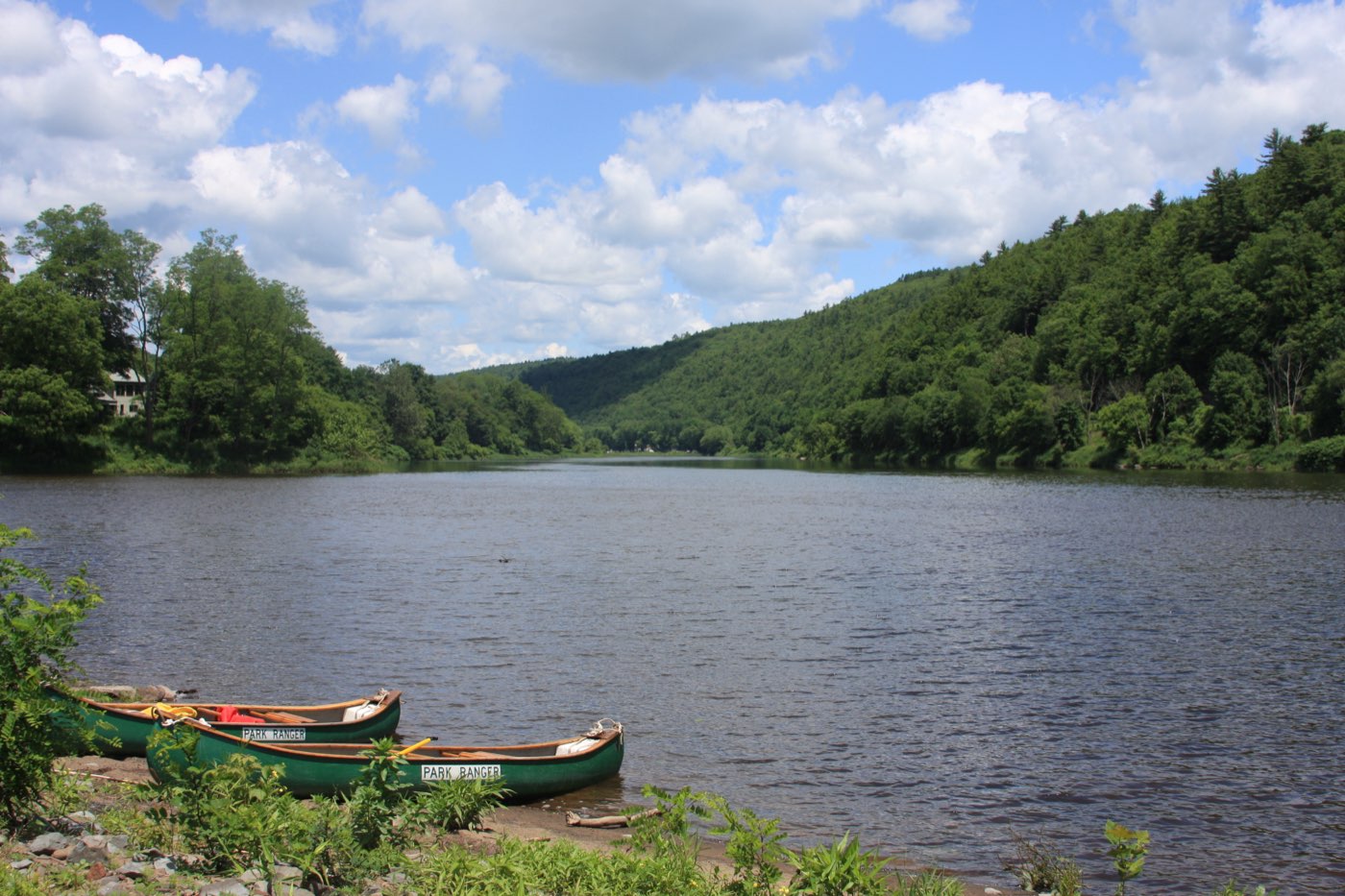
The Upper Delaware forms the New York–Pennsylvania border for roughly 75 miles, from the confluence of the East and West Branches near Hancock downstream to Port Jervis. It is tailwater in character — cold water releases from Cannonsville Reservoir (West Branch) and Pepacton Reservoir (East Branch) keep the main stem cold through summer when most eastern rivers become unfishable. The Upper Delaware holds wild brown trout and wild rainbow trout. No stocked fish.
The rainbow trout in the Delaware are the reason to make the trip. These fish have reproduced naturally since the 1950s and fight with velocity that spring creeks and soft-current rivers never produce — a 14-inch Delaware rainbow runs downstream faster than a 20-inch Catskill limestone creek brown. They average 10–16 inches with fish to 22 inches present throughout the river. The brown trout run larger — fish over 20 inches come to net regularly, and genuine 24-plus-inch browns hold in the deep pools below Hancock.
The branches fish differently from the main stem. The West Branch at Hale Eddy is tighter, more technical water with excellent Hendrickson and Sulphur fishing in a smaller river; the East Branch holds native brook trout in its headwaters above Pepacton Reservoir.
When to fish
April – mid-May: The classic hatch window. Hendricksons (size 12–14) begin in mid-April on warm afternoons — typically the first week of consistent temperatures above 55°F. The Hendrickson hatch is the most reliable dry-fly event of the year on the Delaware, with rising fish in pools and flats from 1–4pm on good days. Quill Gordons overlap in the colder, faster water.
Late May – June: Sulphur season (size 14–16, evening hatches) and the Green Drake hatch (size 8–10) — the largest dry-fly emergence on the Delaware and the event that draws anglers from three states. Green Drake emergence runs approximately two weeks, typically the last week of May through the first week of June; specific timing varies by year and river section. Evening Coffin Fly (the spinner form of the Green Drake) falls can produce dramatic rises in the flat pools. Sulphur spinner falls continue after dark — tracking a size 16 fly at 60 feet at dusk is part of the assignment. Light Cahills (size 14–16) carry the afternoon fishing through June once the drakes taper off.
July – August: Summer low water. The New York City Delaware Basin reservoirs release water to maintain minimum flows in the main stem, but August flows can drop to 1,200–1,500 cfs below Hancock in drought years. Fish concentrate in the deeper pools and become more selective. Trico spinner falls (size 20–24) from 8–10am, scattered caddis in the evenings, and nymphing through the afternoon are the summer toolkit. The Trico fall is the river's hardest test — thousands of naturals on flat water with fish rising everywhere and refusing most imitations. Tippet diameter and hook gap matter more here than anywhere else on the river.
September – October: Isonychia — the slate drake, size 12–14 — hatches in September evenings and produces some of the best large-fish dry-fly action of the season; the after-dark spinner falls are worth sitting out for. Fall BWO hatches (size 18–20) on overcast days produce the most consistent dry-fly fishing of the fall season and can continue into November. Brown trout put on weight before winter and become more aggressive to streamers through October.
What to fish
Dry flies: Hendrickson and Red Quill (size 12–14) in April; Sulphur (size 14–16) evening hatches in May and June; Green Drake (size 8–10) late May; Light Cahill (size 14–16) June and July afternoons; Elk Hair Caddis (size 14–16) through summer; Trico Spinner (size 20–24) summer mornings; Isonychia (size 12–14) September evenings; BWO Comparadun (size 18–20) September–October.
Nymphs: Pheasant Tail (size 14–18) is the foundational nymph on this river; Hare's Ear (size 12–16) in deeper pools; Zebra Midge and thread midges (size 18–22) when surface activity is absent.
Streamers: October for aggressive brown trout. A black Woolly Bugger (size 4–6) or larger articulated pattern on a 6- to 8-foot sink tip fished through the outside bends of the wide pools.
How to fish it
The Upper Delaware runs 150–300 feet wide at normal flows, making full wade-across crossings impractical. The river is primarily a drift boat fishery in the upper section; wade anglers fish edges, pools, and tributary mouths from accessible gravel bars.
Floating: A drift from Hancock to Callicoon (~20 river miles) takes a full day at moderate flow. Day floats typically cover 8–15 miles depending on conditions and how much time the guide spends on rising fish. Rates run $450–700 for one or two anglers per day through Hancock-area outfitters. Book for Green Drake week by February — that window books out 3–4 months ahead.
Wading: The pools between Callicoon and Narrowsburg are more accessible for wade anglers — the river shallows on gravel bars and fish concentrate in predictable pool structure. Fish rising in the flat pools during evening hatches can be approached from the gravel bar side without wading above knee depth on most shoals.
Reading Delaware risers: Delaware trout rise from fixed lanes during a hatch. A fish in the Delaware will not move more than 2–3 feet laterally to take a fly outside its feeding lane. Identify the lane before the first cast. Presentation accuracy matters more than fly selection once you have matched form, size, and color. The pools are wide and the fish sit far from the bank — casts of 60–80 feet are common, and the bigger pools ask for more. If you cannot cast accurately at distance, this river will humble you quickly.
Access
The Upper Delaware flows through New York and Pennsylvania and is part of the National Wild and Scenic Rivers System. The river is publicly navigable; wade anglers can fish the riverbed and banks below the ordinary high-water mark on both sides. You cannot cross private riparian land to reach the water, though — use the designated access sites. Primary access points along the upper section:
- Balls Eddy, PA / Hale Eddy, NY: West Branch access above Hancock; the standard entry points for the lower West Branch water.
- Hancock, NY (Route 97): Town access, several pull-offs near the Branch confluence. Most outfitter launches are above or just below Hancock.
- Lordville, NY / Equinunk, PA: Informal river access pullouts approximately 10 miles below Hancock.
- Buckingham, PA / Hankins, NY: Access sites on the main stem between Lordville and Callicoon.
- Callicoon, NY: Town gravel bar access from the NY side; concrete ramp near the bridge.
- Narrowsburg, NY: Good wade access from the gravel bars at the upstream end of the town pool.
Regulations
The Upper Delaware flows through two states with separate regulations. Per 2026 New York DEC and Pennsylvania Fish and Boat Commission regulations:
- New York: A valid New York fishing license is required to fish from the New York bank or while wading on the New York side. From a boat on the main stem, either a New York or Pennsylvania license is valid.
- Pennsylvania: A valid Pennsylvania license is required to fish from the Pennsylvania bank or while wading on the PA side.
- Catch-and-release regulations and season dates differ between New York and Pennsylvania, and between river sections — check the current year's regulations for the specific water you plan to fish. Both DEC and PFBC publish digital regulation booklets.
- The lower West Branch has a catch-and-release section, and New York maintains special regulations on portions of the main stem protecting wild fish. Verify section boundaries before you fish — these rules change more often than most anglers expect.
- The Upper Delaware is within the National Wild and Scenic Rivers designation; camping is restricted to designated sites.
Pick up both states' regulation booklets at a Delaware-area fly shop on arrival. The shops update local interpretations faster than the state websites do.
Where to base
- Hancock, NY: Small town at the Branch confluence; closest to the upper section. Delaware River Club (Starlight, PA, across the river) is the long-established guide lodge for the uppermost section.
- Callicoon, NY: Mid-river with restaurants, lodging, and gravel bar access to productive pools. A more comfortable base than Hancock for multi-day trips.
- Narrowsburg, NY: Slightly downstream from Callicoon; good wade access from town and an improving lodging scene.
Guides and shops
- Delaware River Club (Starlight, PA) — the primary full-service guide operation for the upper section; full-day and half-day floats plus an on-site lodge.
- Al Caucci's Delaware River Outfitters — tied to the tradition of Delaware-specific hatch study; excellent local hatch information.
- Catskill Flies (Livingston Manor) — covers the upper Delaware and surrounding Catskill tributaries from a single location.
The Delaware conditions hotline operated by cooperating agencies and guides publishes flow, clarity, and temperature data updated several times daily in-season. Call or check the website before driving in from any distance. The Delaware River Basin Commission controls the release schedules from Cannonsville and Pepacton that drive main-stem temperature and fishability — DRBC publishes release data and temperature readings that serious Delaware anglers monitor alongside the hotline.
What to bring
- A 9ft 5wt for dry-fly and nymph work; a 7wt or 8wt with a sink-tip line if you plan to chase fall brown trout with streamers. A floating line with a longer front taper — a RIO Gold WF5F handles it well — helps with the 60-foot-plus presentations the wide pools demand.
- Long leaders for flat pools — 12ft to 14ft leaders with 5X or 6X tippet for Green Drake and Sulphur work on glass-calm pool water, down to 7X during flat-water spinner falls on the most educated fish. Fluorocarbon tippet is worth using in low, clear conditions. Fish see everything at this distance in clear water.
- Fishpond Nomad Mid-Length Net — Delaware rainbows run upstream and downstream before the net; a mid-length handle gives reach without abandoning your footing.
- Both states' fishing licenses if you plan to wade both banks. The licensing distinction matters.
- Polarized lenses. The Delaware runs clear; you can read holding fish in pool structure from a gravel bar before you step into the water and before you spook them.