Quick reference
| Field | Value |
|---|---|
| State / region | Maryland, Catoctin Mountain area (Frederick County) |
| Species | Brown trout, rainbow trout; brook trout mainly in tributaries and headwaters |
| Best months | Mid-April–early May for peak hatches; spring and fall generally |
| Water type | Small freestone with a short tailwater reach below Hunting Creek Lake |
| Difficulty | Intermediate to advanced — small, clear, heavily fished water with tight casting lanes |
| Wading | Possible throughout but tricky in the canyon; slick rocks, plunge pools, and bedrock ledges demand care |
Why fish here
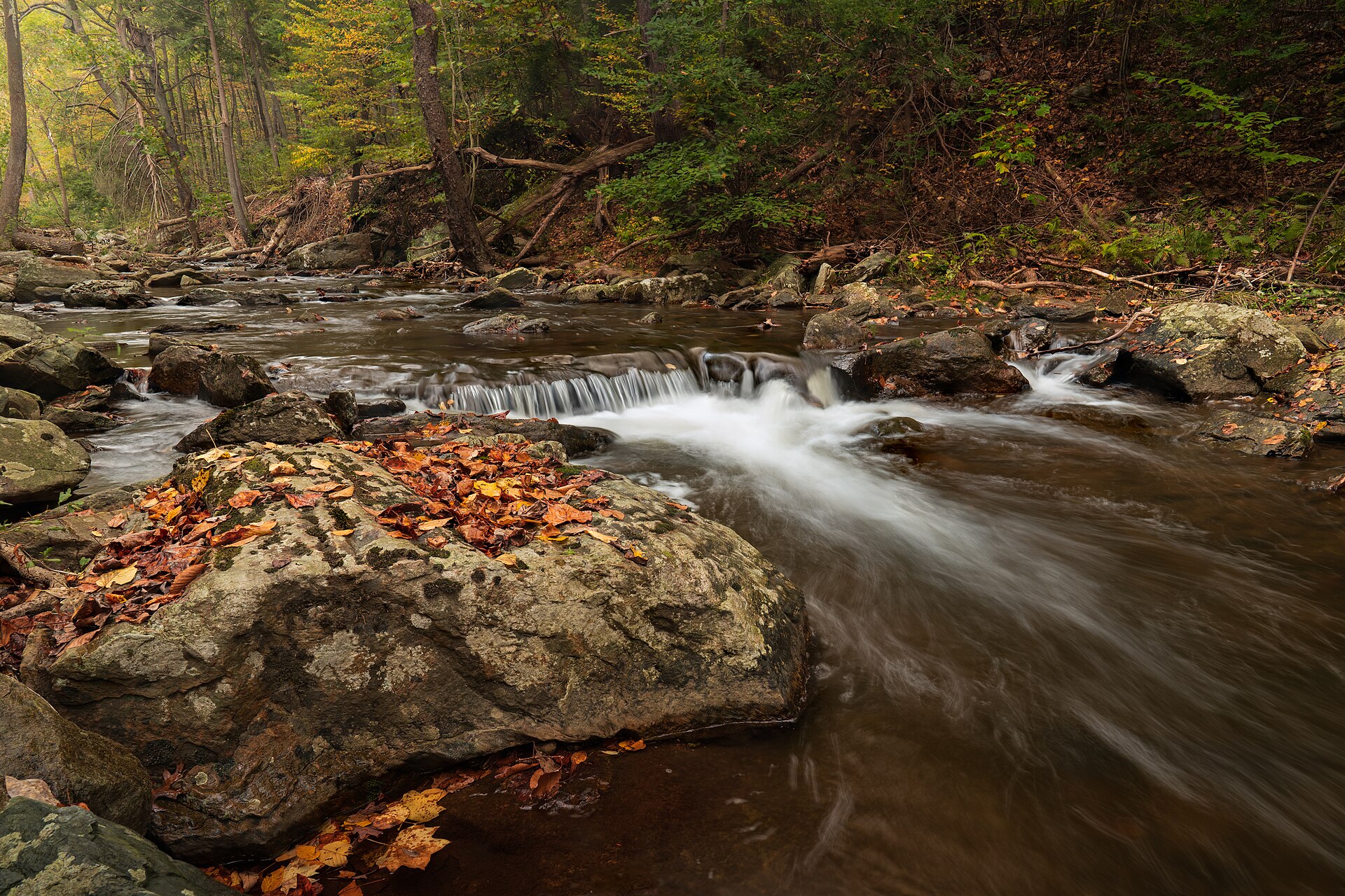
Big Hunting Creek carries more history per mile than any other trout water in Maryland. Flowing through Cunningham Falls State Park and Catoctin Mountain Park in Frederick County, it was the state's first catch-and-release, fly-fishing-only stream, and it remains managed under those rules today — all water in both parks, tributaries included. The result is a compact mountain fishery where wild and holdover brown and rainbow trout hold in classic plunge pools and pocket water under a hemlock and hardwood canopy, protected by regulation and parkland on all sides.
The fish are not large, but density is good for a small mountain stream, and the fishing is honest technical work: clear water, pressured trout, and a hatch progression that runs the full Eastern calendar — early black stoneflies in late winter, Quill Gordons and Blue Quills through early spring, Hendricksons, March Browns, Green Drakes, and Light Cahills into May, then Sulphurs, caddis, and a summer of terrestrials falling from the canopy. Trout here respond to careful presentations and matched flies, and punish the alternative.
The location seals the case. The creek sits within easy reach of both Washington, DC and Baltimore, offers a year-round season, and packs roadside access, canyon scenery, and special-regulation water into a few miles. For a technical small-stream angler in the mid-Atlantic, it is the obvious day trip.
The river, section by section
Lower Canyon (Route 77 corridor)
Access: Roadside pull-offs and designated parking along MD Route 77 within Cunningham Falls State Park and Catoctin Mountain Park, wherever the creek parallels or crosses the road; signed park fishing pull-outs and small lots mark the standard entries. Character: Steep gradient with deep plunge pools, short runs, and pocket water under hemlock and hardwood canopy. Narrow, boulder-bedded, with frequent bedrock ledges and tight casting lanes. Wading is possible but tricky — slick rocks, variable depth, plunge pools. Species mix: Primarily brown trout with some rainbows; brook trout occur mostly in tributaries and nearby Owens Creek, with occasional fish in the creek. Populations are maintained by natural reproduction, supplemented by stocking in connected waters and the lake. Crowding: The most popular reach — busy on weekends and holidays, especially during spring hatches and fall foliage season. Weekdays, early mornings, and poor weather thin it out. Notable hatches: Early black stoneflies in late winter; BWOs and Quill Gordons in March; Blue Quills, Hendricksons, and March Browns in April; Green Drakes and Light Cahills in May; Sulphurs and tan/olive caddis into early summer; ants, beetles, and green inchworms late spring through summer.
The canyon is the signature water. Most anglers fish it the way it asks to be fished: short sections worked carefully, pool by pool, rather than long distances covered fast. The plunge pools hold the reach's better browns, and the tight lanes put a premium on short, accurate casts — often a bow-and-arrow cast or a flip under overhanging limbs rather than a full stroke. The slick boulder substrate is the real hazard; felt or aggressive rubber soles and a staff make the difference.
Upper creek (above Camp Peniel Bridge to below the dam)
Access: Along the park road above Camp Peniel Bridge up to the road below the Hunting Creek Lake dam; parking in designated park lots and roadside pull-offs where the creek runs close to the road, with signed trailheads and fishing access points in both parks. Character: Lower gradient than the canyon — longer pools, glides, and riffles with fewer steep plunges. Slightly more open, moderate width, gentler pocket water; easier wading and traditional pool-hopping. Mixed cobble and small boulders, undercut banks, woody debris. Species mix: Brown and rainbow trout as the primary targets, with brookies in colder tributaries and headwater pockets. Fish run smaller but often more numerous than in the canyon pools, with good numbers through the better riffle-run-pool sequences. Crowding: Moderate — regular anglers but less intensity than the canyon, especially away from major parking. Spring weekends and pleasant summer days still draw people. Notable hatches: The same calendar as the canyon: BWOs and Quill Gordons in March, Blue Quills, Hendricksons, and March Browns in April, Green Drakes and Light Cahills into May, Sulphurs and caddis from late spring, terrestrials through summer.
The upper creek is where the fishing gets more forgiving without leaving the special-regulation water. Open banks and gentler gradient allow real casts, and the higher fish counts make it the better teaching water and the better numbers water. A sensible day pairs the two reaches: hatch-matching over canyon pools in the morning, then pool-hopping the upper creek when the crowds fill in below.
Hunting Creek Lake and the tailwater below the dam
Access: The concrete boat launch and parking lot at Hunting Creek Lake in Cunningham Falls State Park, with shoreline access from designated parking and paths; the short tailwater below the dam is reached from the road and nearby park parking just downstream. Character: The lake is a small impoundment fished from shore or small craft — kayaks, canoes, and small boats off the concrete ramp. The tailwater reach below the dam carries more stable flows and cooler summer water through short runs and pools before the creek resumes its freestone character. Tailwater wading is limited but workable at low flows. Species mix: The lake holds rainbow trout, largemouth bass, sunfish, channel catfish, and black crappie. The tailwater mirrors the creek — browns and rainbows, with some stocked fish moving between lake and creek. Crowding: The lake draws families and general anglers, so the launch and shoreline get crowded in warm months and on weekends. The tailwater sees less pressure than the canyon, though summer anglers seek out its cooler water. Notable hatches: The lake fishes on stillwater forage, but trout take the creek's mayflies and caddis along with midges and terrestrials near the outflow. Streamers, nymphs, and generic attractors are the standard choices in both lake and tailwater.
The tailwater's value is thermal. When summer heat pushes the open freestone reaches toward marginal temperatures, the short run below the dam stays cooler and keeps fishing. It is a small piece of water, but on an August morning it can be the best piece.
Hatches and seasons
| Months | Hatches | Flies |
|---|---|---|
| Feb–Mar | Early black stoneflies, Blue-Winged Olives, Quill Gordons, midges | Black stonefly nymphs and adults #16–18, BWO dries #18–20, Quill Gordon dries #14–16, Pheasant Tail and general mayfly nymphs #14–18 |
| Apr–May | Blue Quills, Hendricksons, March Browns, Green Drakes, Light Cahills, caddis | Blue Quill dries #16–18, Hendrickson dries and emergers #12–14, March Brown parachutes #12–14, Green Drake patterns #12–14, Light Cahill dries #16–18, Elk Hair Caddis tan/olive #14–18, nymphs #14–16 |
| Jun–Aug | Sulphurs, tan and olive caddis, terrestrials (ants, beetles, inchworms), assorted summer mayflies | Sulphur comparaduns and parachutes #16–18, Elk Hair Caddis #14–18, Parachute Adams #14–18, Royal Wulff/Coachman/Trude #12–16, ants and beetles #14–18, green inchworm imitations #12–16 |
| Sep–Nov | Blue-Winged Olives, fall caddis, midges, early-fall terrestrial leftovers | BWO dries and emergers #18–20, small caddis #16–18, Griffith's Gnat and midge patterns #18–22, small attractor dries #16–18 |
| Dec–Jan | Sparse mayflies and caddis, midges, baitfish forage | Woolly Bugger and sculpin patterns #6–10, generic nymphs #14–18, midges #18–22, small streamers #6–10 |
Recommended flies (by season)
| Season | Top patterns | Why |
|---|---|---|
| Spring | Quill Gordon, Blue Quill, Hendrickson, March Brown, Green Drake, Light Cahill dries; Pheasant Tail and Hare's Ear nymphs; tan/olive Elk Hair Caddis; Parachute Adams | Peak hatch season — multiple classic Eastern mayflies and caddis emerging with trout feeding actively in riffles and tailouts; matching size and stage matters in the clear, pressured water |
| Summer | Sulphur dries; tan/olive caddis; Parachute Adams, Royal Wulff, Coachman, Trude; ants, beetles, and green inchworm imitations; small streamers | Low flows make trout selective and push feeding to evening Sulphur and caddis windows plus terrestrials dropping from the canopy; attractors excel in tight shady canyon water and small streamers move fish from the deep plunge pools |
| Fall | BWO dries and emergers; small caddis; Parachute Adams; Griffith's Gnat and midge patterns; small nymphs | Cooling water and lighter pressure bring steady BWO and caddis feeding in softer edges and pools; smaller, more technical flies handle educated fish in the heavily fished canyon runs |
| Winter | Woolly Buggers; sculpin patterns; Pheasant Tail and Hare's Ear nymphs; midges | Insect activity is minimal, so low-and-slow presentations with streamers and nymphs through the deepest pools and slow runs find the lethargic fish |
Gear notes
A 7½- to 8-foot 4-weight with a floating line suits the small, brushy water and its need for delicate presentation. Standard trout tapers with a 7½–9-foot leader to 5X–6X cover the dry-fly and nymph fishing, with 4X for streamers in the deeper pools. The regulations shape the kit: conventional fly tackle only — fly rod, fly reel, fly line, leader up to 18 feet — with single barbless hooks (or barbs pinched). Felt-soled or high-traction boots and a wading staff are worthwhile on the slick, bouldery canyon bottom; lightweight waders or wet-wading gear are enough in summer.
Logistics
- Regulations: Maryland Department of Natural Resources (DNR) manages all waters of Big Hunting Creek and its tributaries within Cunningham Falls State Park and Catoctin Mountain Park as a special catch-and-return, fly-fishing-only trout area. Anglers 16 and older need a Maryland fishing license and trout stamp, and may not possess trout while fishing — everything goes back immediately. Only artificial flies and streamers tied conventionally on a single hook are legal; spinning, spincast, and casting reels, natural or scented baits, and molded lures (spinners, spoons, plugs) are prohibited, and hooks must be barbless or have barbs pinched down. Regulations change annually — verify current DNR rules before fishing.
- Access points:
- MD Route 77 roadside pull-offs (Cunningham Falls State Park) — multiple signed pull-offs and small lots giving direct access to the canyon and adjacent reaches; the primary entries for the lower and middle stream
- Hunting Creek Lake boat launch parking lot — concrete ramp for kayaks, canoes, and small boats, plus shoreline access to the lake and the tailwater below the dam
- Camp Peniel Bridge area — the practical landmark dividing upper and lower sections, with parking in nearby park lots and roadside areas
- Nearest towns: Thurmont, Frederick, Emmitsburg
- Flows: Big Hunting Creek has no active USGS gauge — its old gauge stopped reporting years ago. Judge conditions on the ground: the creek runs high and off-color after heavy rain and clears within a day or two.
When NOT to fish here
The small watershed rises fast. During and immediately after heavy rain, the creek turns high and turbid, and the canyon's plunge pools and tight banks become unsafe to wade — wait it out. Midsummer afternoons in heat waves warm the water beyond comfortable trout fishing, particularly outside the coolest park reaches; shift to shaded canyon water, early mornings, or the tailwater below the dam. And pleasant spring weekends and holidays bring the crowds — anglers after solitude should fish weekdays, pick the less obvious pull-offs, or head for the upper reaches.
Where to fish next
- Fly Fishing in Maryland — the full state guide
- Gunpowder Falls — Maryland's other marquee special-regulation trout water, with its own catch-and-release sections
- Owens Creek — the neighboring Catoctin stream, and the better bet for brook trout