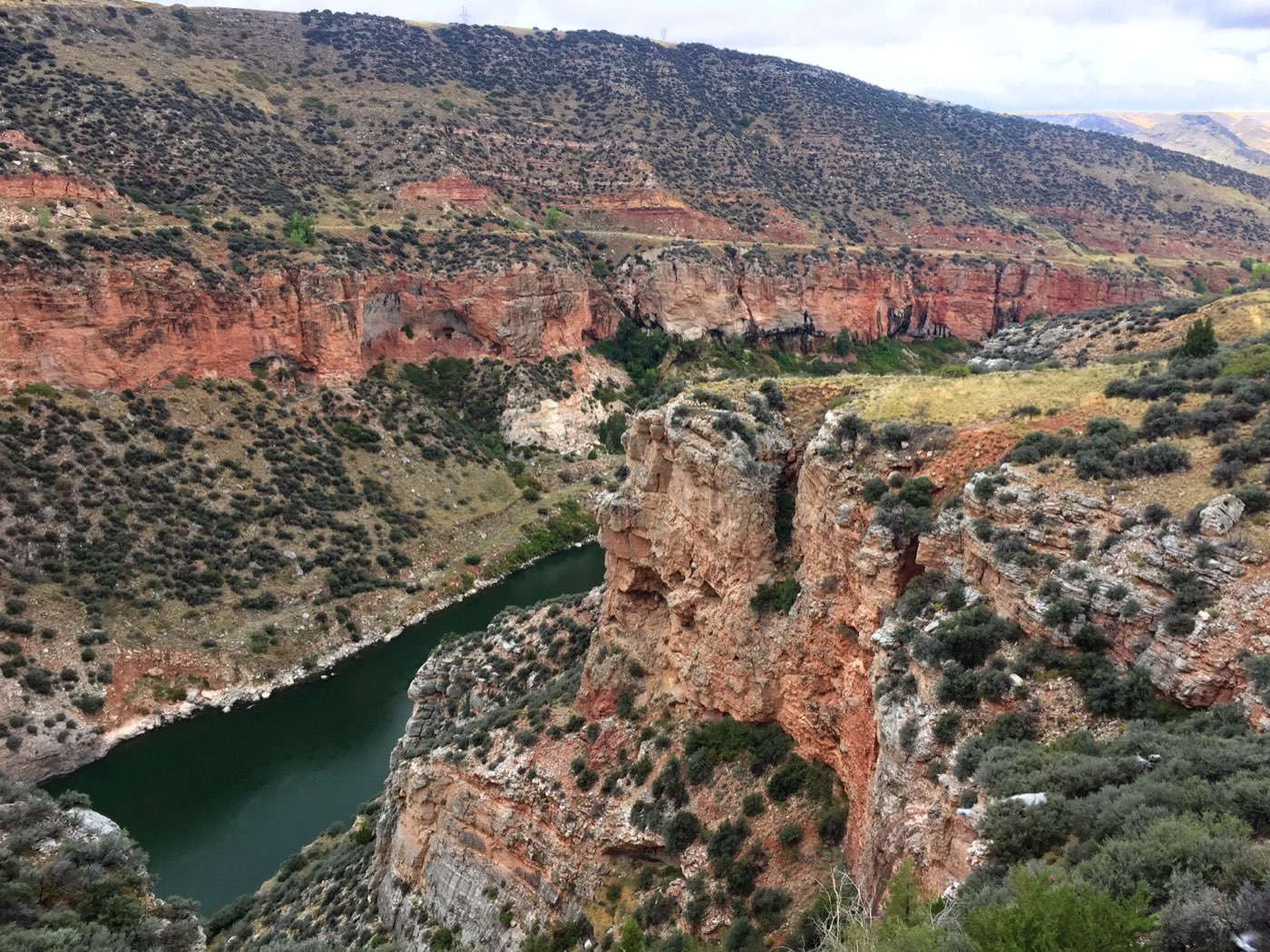
The Bighorn River exits Yellowtail Dam cold and rich at 3,000–10,000 cfs and runs 13 miles of designated catch-and-release water to Three Mile Access before the regulations shift. This tailwater section—the Bighorn below Yellowtail Dam to Bighorn, Montana—holds a combination of conditions that produces very large trout: dam-controlled flows that stay cold year-round, exceptional invertebrate density from the nutrient-rich reservoir releases, and a fishery that has been managed for trophy trout since the 1980s.
The Bighorn doesn't have the name recognition of the Madison or the technical mystique of the Missouri among casual fly anglers. It has something more useful: a high probability of catching a 20-inch fish on any given day if you know what you're doing. Montana Fish, Wildlife & Parks surveys have documented average trout sizes in the C&R section that exceed most tailwaters in the country. Browns dominate the top end of the size range; rainbows are more numerous.
The trade-off is access. Much of the river corridor in the C&R section runs through the Crow Indian Reservation. Fishing the Bighorn requires a Crow tribal fishing permit in addition to a Montana state license. Outfitters based in Fort Smith have longstanding relationships with tribal management and handle the permit logistics for guided trips. Wade anglers fishing independently must purchase tribal permits and understand the boundary constraints.
When to fish
March – May: The best dry fly fishing window of the year. Midge hatches carry the early season; Baetis (BWO) hatches build through April and peak in May. The fish are actively feeding on the surface during afternoon hatches, and spring crowds haven't arrived yet.
June – July: PMD and caddis hatches add variety. Flows can increase with upstream irrigation demands in early summer, which shifts the fish's position and makes reading water more important. The Bighorn's PMD hatch is consistent but less celebrated than the Missouri's; the fish still key on it.
August: Trico spinner falls in the morning, terrestrials and caddis through the afternoon. The big fish move into feeding lanes for spinner falls at first light. Late-August water temps in the lower river bear watching—still well within the trout's range given the dam-controlled flow, but worth monitoring.
September – October: Fall streamer season. Brown trout pre-spawn aggression plus falling water temps create the best streamer fishing of the year. An articulated pattern swung through a deep run in October on the Bighorn produces the largest fish available. Fall BWO hatches also come off reliably on overcast afternoons.
Winter: Open year-round. The Bighorn is one of Montana's best winter tailwaters because the dam-controlled flows keep temperatures from swinging. Midge hatches are the primary food source; the fishing is slower but the fish are still there.
What to fish
The Bighorn is a hatch-matching river. Attractor patterns work in fast water but the feeding lanes in the flat runs require presentation and matching:
- Midge dries and clusters (20–26): Griffith's Gnat, Palomino Midge — year-round, especially spring and winter
- BWO dries (18–22): Comparadun, CDC Dun, Parachute BWO — spring and fall afternoons
- PMD dries (16–18): Sparkle Dun, PMD Cripple — June–July evenings
- Trico spinners (20–22): black-and-white spinner patterns — August mornings, pre-8am
- Midge nymphs (20–24): Mercury Midge, Zebra Midge, WD-40
- PMD nymphs (16–18): Frenchie, Hot Spot Pheasant Tail
- Streamers (4–6): articulated patterns in white/chartreuse, Kreelex, Double Bunny — October
How to fish it
The Bighorn is primarily a float fishery. The 13-mile C&R section from the dam to Three Mile Access is long enough that wading one productive stretch all day is a legitimate strategy, but the fish distribution rewards covering water. Drift boats and rafts let you move efficiently between the flat runs and bends where the largest trout hold.
Float approach: The standard float puts in at Afterbay Dam (the lower dam, about a mile below Yellowtail) and takes out at Three Mile or Bighorn Access. Most guided days run the full 13 miles in 6–8 hours, fishing from the boat in riffles and along bank structure, pulling over to wade the productive flat runs. Guide boats on the Bighorn are well-equipped for this format—anchor drops in the right spots, and the guide will position you for the fish.
Reading the water: The Bighorn doesn't look like a difficult river from the bank. Flows are controlled, gradients are moderate, and the runs look uniform. The fish aren't uniform. Browns and larger rainbows hold along the seams where faster current meets slower water—the downstream edge of boulders, inside bends, the transition from a riffle into a flat pool. During midge and BWO hatches, fish stack in feeding lanes on the surface of the slower flat water. These fish are selective and spooky; approach from downstream, make a long drag-free drift, and use 5X–6X tippet.
Streamer technique: In October, fishing articulated streamers on a sink-tip from a drift boat is the most effective method for the river's biggest browns. Work the streamers along undercut banks and deep outside bends. Swing them through runs, vary the retrieve speed, and be ready for aggressive strikes. The fish are in pre-spawn mode and will chase.
Wading: The Afterbay area near the put-in and the reaches around Three Mile Access are the most accessible wading sections. The riverbed is mixed gravel and silt—wading studs and a wading staff help in the slicker sections. For wade-only anglers, the Afterbay area fishes well during morning hatches without requiring a boat.
Bring Simms G3 Guide Stockingfoot Waders for the long wade sections; the Bighorn's gravel runs are manageable but the silt pockets require stable footing. A Fishpond Nomad Mid-Length Net handles the 20–24-inch fish you'll encounter in the C&R section.
Access
The Bighorn has three primary public access sites managed by Montana Fish, Wildlife & Parks along the C&R section:
- Afterbay Dam Access — the standard float put-in below Yellowtail Dam; day-use parking, launch ramp. Coordinates: ~45.342°N, 107.944°W (Fort Smith, MT 59035)
- Three Mile Access — 3 miles below the dam; wade access and alternate take-out. Coordinates: ~45.313°N, 107.948°W
- Bighorn Access (13-Mile) — the primary lower take-out at the end of the C&R section; paved ramp, parking. Coordinates: ~45.228°N, 107.994°W
Beyond Three Mile Access, the regulations change and the river flows through more private land. The C&R section above is the primary destination for most anglers.
Fort Smith itself (population under 100) has a few outfitter lodges and the Quill Gordon Fly Fishers shop, which serves as the operational hub for guided trips on this stretch.
Regulations
The Bighorn below Yellowtail Dam has a designated catch-and-release section from the dam to approximately 13 miles downstream. Within this section:
- Artificial lures and flies only
- All trout must be released immediately — no possession
- The Crow tribal fishing permit is required in addition to a Montana fishing license. Purchase tribal permits through the Crow Tribe's permit system or through your outfitter prior to fishing. Fishing without a tribal permit on reservation waters is a violation of tribal law, not just state regulation.
- Check current Montana FWP regulations for the most recent season-specific rules, as section boundaries and special restrictions can change.
Where to base
Fort Smith, MT — The only option if you want to walk to the river. Fort Smith is 43 miles south of Hardin via US-313. Accommodations are limited to outfitter lodges (most require booking well in advance for peak season), a few small motels, and RV camping at Bighorn Canyon National Recreation Area. The Quill Gordon lodge books early for October; plan at least a year ahead.
Hardin, MT — 43 miles north on US-313/BIA-313. More lodging options, restaurants, and services than Fort Smith. A reasonable base if you're comfortable with the drive each morning, especially mid-week when Fort Smith campsite availability is low.
Billings, MT — 80 miles from Fort Smith. Full city amenities, commercial airport (BIL), multiple hotels. Some anglers fly into Billings and stay there while guiding out to the Bighorn each day—the drive is straightforward on dry Montana roads.
Guides and shops
Quill Gordon Fly Fishers — The original Bighorn guide operation, based in Fort Smith. They have the deepest local knowledge and private access relationships along key sections. Book 6–12 months out for fall. quillgordonflyfishers.com
Bighorn Angler — Fort Smith-based, full guide services, lodge accommodations, and tribal permit handling for guided guests. bighornanglermt.com
Billings fly shops — Several Billings-based shops run guided trips to the Bighorn and handle permit logistics. Worth calling if Fort Smith operations are booked.
What to bring
- Montana fishing license (purchase at FWP.mt.gov)
- Crow tribal fishing permit — sort this before you arrive; don't assume you can purchase it in Fort Smith on the morning of your trip
- Leaders tapering to 5X–6X for the flat runs; 4X for streamers
- Midge box with sizes 20–26, including emergers and clusters
- PMD and BWO dries in 16–22 with cripple and CDC variants
- Trico spinners if you're fishing August
- Articulated streamer box if you're fishing October
- Strike indicators and split shot for indicator rigs in the deeper runs
- Polarized glasses — the Bighorn's clear water makes sight-fishing possible on good days; you'll spot large fish holding in the feeding lanes
Closest gauge
Monitor conditions at USGS gauge 06294700 — Bighorn River near St. Xavier. The dam controls most flow variability, but checking the gauge before your trip confirms no operational releases are changing conditions. Typical fishing flows run 1,500–3,500 cfs. Above 5,000 cfs, reading water becomes harder and wading is inadvisable.
Where to fish next
- Missouri River, Montana — the other great Montana tailwater; different character, easier independent access, similar dry-fly precision
- Madison River, Montana — freestone alternative if you want faster water and less selective fish after the Bighorn's technical demands
- Yellowstone River, Montana — big-river float fishing, different species mix, worth building into a Montana trip