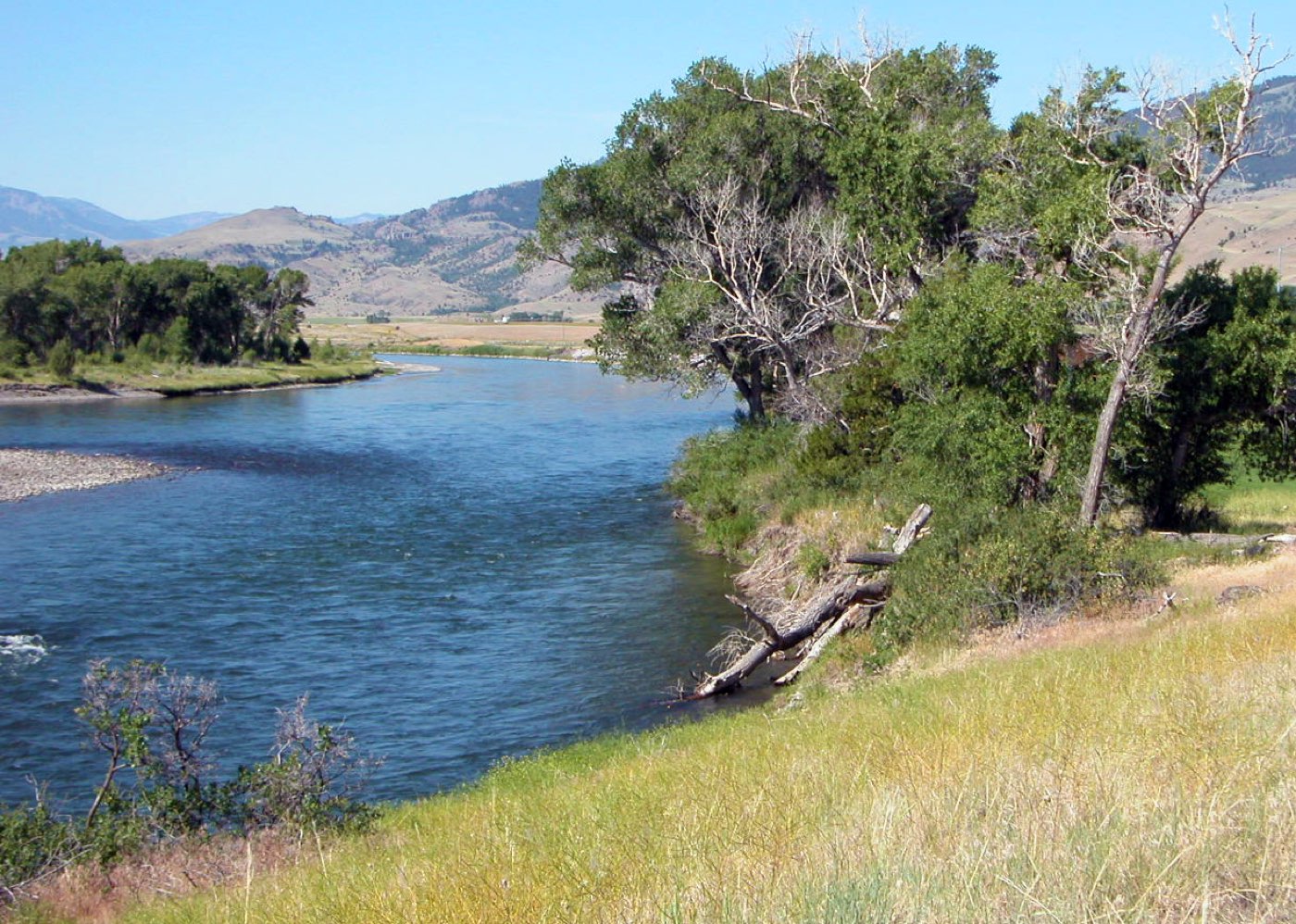
The Yellowstone River runs 692 miles from Yellowstone Lake to its confluence with the Missouri near Culbertson, Montana — the longest undammed river in the contiguous United States. The stretch fly anglers fish is shorter and more specific: the Paradise Valley section, from Gardiner (at the northern boundary of Yellowstone National Park) downstream to Livingston, roughly 50 miles of freestone and spring-fed water that holds wild rainbow and brown trout in water that stays cold enough to fish through summer.
The river here runs wider than the Madison — 150 to 300 feet in most places — and holds fish distributed across the full channel rather than concentrated in bank seams. Browns and rainbows average 14–18 inches, and fish over 20 inches are legitimate in the right water — deep runs, outside bends, and the canyon section below Gardiner. Wade fishing is productive but the productive water spreads widely; a float trip covers more fish per day.
One clarification before anything else: the Yellowstone inside Yellowstone National Park and the Yellowstone below Gardiner are different fisheries — different regulations, different fish populations, different character. This guide covers the Montana water; the park section gets its own treatment below.
When to fish
April – mid-May: The underrated window. Pre-runoff midge and BWO hatches produce consistent dry-fly fishing with fewer crowds than summer. The river runs clear and cold; nymphing and dry-dropper work well from the bank.
Mid-May – June: Runoff from snowmelt in the Absaroka Range pushes flows high and often turbid, sometimes exceeding 10,000 cfs. Fishing deteriorates sharply in high water. The salmon fly hatch moves upriver from the lower drainage in late May, peaking in the canyon area — timing varies by year and often collides with runoff, so check conditions reports before chasing it. Most anglers wait it out or fish spring creeks in the valley (Armstrong, Nelson's, DePuy's) while the main stem colors up.
July – August: The primary summer window. Flows drop, the river clears, and hopper-dropper fishing takes over from mid-July through August. Fish early mornings for caddis and PMDs before the valley heats; fish evenings for spinner falls and continued hopper action. Check water temperatures in the afternoon — the Yellowstone can approach 65°F on hot August days in the lower reaches. The Montana FWP Hoot Owl restriction (no fishing 2pm–midnight) applies when temps hit 73°F for three consecutive days.
September – October: The best overall fishing of the year. Flows stabilize in the 1,500–3,000 cfs range, brown trout begin staging pre-spawn, and streamer fishing becomes as productive as dry-fly fishing was in summer. BWO hatches on overcast afternoons produce consistent rising fish — the October baetis hatch is the sleeper, when size 18–22 imitations on 5X or 6X tippet can bring large browns to selective surface feeding in low light. Fewer anglers, harder weather, heavier fish.
November – March: Open year-round on most reaches below Gardiner. Midge hatches year-round; BWOs on warmer afternoons above 40°F. A winter trip with no crowds and fish midging in slow pools is worth doing at least once.
What to fish
Dry flies: Hopper patterns (size 8–12, tan or golden) from mid-July through August along grassy banks; Elk Hair Caddis (size 14–18) in the evenings; Parachute Adams (size 14–18) during BWO and PMD hatches in spring and fall.
Nymphs: Pheasant Tail (size 14–18), Hare's Ear (size 12–16), Zebra Midge (size 18–22), Pat's Rubber Legs (size 4–8) in fast water.
Streamers: September and October are the best streamer months. A Sparkle Minnow, Kreelex, or black Woolly Bugger (size 4–8) on a sink-tip fished through the outside bends of the river's sweeping curves produces aggressive brown trout in fall. Articulated streamers earn their keep here too — pre-spawn browns are territorial and will move from depth to chase a well-presented fly. The evening bite in the deep runs and outside bends below Gardiner is the best streamer fishing on the river.
Tippet: 4X for streamers and hoppers, 5X for caddis and mayflies, 6X for midge and BWO presentations.
How to fish it
Wading: The Paradise Valley's cobble bottom is accessible from the bank at most FAS sites. The fish distribute widely across the channel; wade out 30–50 feet into mid-channel structure to reach the better lies rather than fishing the bank seam from shore. Felt or studded boots are necessary — the bottom is irregular and slick. The popular access sites are heavily fished in summer; early mornings in the shoulder seasons give you the best wading without competition.
Floating: The primary floats run from the Park boundary at Corwin Springs down to Livingston and beyond, approximately 60 river miles total. Day floats typically cover 8–12 miles. Float access also opens water that is largely off-limits to wading anglers because of the private-land corridor along much of the valley. Most outfitters in Livingston run the Carter's Bridge to Livingston section in summer; book six weeks ahead in September. Full-day float for two anglers: $650–800 plus tip and lunch.
The Yellowstone is not a technical river. Its browns and cutthroat don't demand spring-creek presentation precision; the challenges are physical — reading fast water at scale, managing long drifts at distance, and staying stable in strong current. The river rewards anglers who wade confidently and cast long in the wind, and it is not forgiving of sloppy wading.
The river inside the park
The Yellowstone above the upper falls holds one of the most intact native Yellowstone cutthroat populations in the West — wild, lightly fished, and managed to stay that way. The accessible fishable water runs from Yellowstone Lake downstream to the Grand Canyon of the Yellowstone, and again below Tower Fall. The stretch above Fishing Bridge is restricted to protect spawning fish, and the Yellowstone Lake tributaries are closed entirely to support cutthroat recovery from lake trout predation.
Fish average 12–16 inches; 20-plus-inch cutthroat exist but are not the norm. The value is the population itself — native fish in water as close to pre-settlement condition as you will find. The Fishing Bridge area is the main access point, and the wading is as good as it gets: flat water, gravel bottom, visible fish.
Park cutthroat are not selective. Elk Hair Caddis, Royal Wulff, and Parachute Adams in sizes 12–16 cover the season. A Orvis Helios 4 9ft 5wt in 4-weight suits the light presentations and smaller water; a 5-weight handles the larger fish in the lower park section.
Park regulations differ from Montana's: an NPS fishing permit is required, barbless hooks are mandatory park-wide, and several sections carry individual rules or closures that change with the cutthroat recovery program. Read the current park regulation summary annually.
Access
Montana's stream access law provides fishing access below the ordinary high-water mark on all navigable streams. The Yellowstone is navigable throughout the Paradise Valley. Montana FWP Fishing Access Sites along US-89 give wade anglers entry at intervals of 3–8 miles. Key sites from south to north: Corwin Springs FAS, Carbella FAS, McLeod FAS, Carter's Bridge FAS, Grey Owl FAS, and Pine Creek FAS. Pull the current FAS map from the Montana FWP site before any trip — facilities and boundaries update annually.
Regulations
Read current Montana FWP regulations before fishing — the Yellowstone has zone-specific rules that change annually. Per Montana FWP 2026 regulations:
- Non-resident anglers require a valid Montana fishing license and conservation license (both available online from Montana FWP and at valley fly shops).
- Catch-and-release and slot limits vary by river section; confirm the applicable zone boundaries for the specific water you plan to fish.
- Hoot Owl restrictions apply when water temperatures hit 73°F for three consecutive days — no fishing 2pm–midnight. Beyond Hoot Owl, Montana FWP issues full emergency closures during drought and low water, most often in August and September; the FWP website posts them before any signage appears riverside. Check before any late-season trip.
- Inside the park, Montana licenses do not apply — you need the NPS permit and barbless hooks described in the park section above.
- Whirling disease is present in the Yellowstone system. Do not transport water, mud, weed, or live fish from this drainage.
The Montana FWP regulations booklet is free at every fly shop in the valley. Pick one up on arrival rather than relying on last year's version.
Where to base
- Livingston, MT: Center of the Paradise Valley fishery. Fly shops: Dan Bailey's Fly Shop (open since 1949) and Sweetwater Travel. Lodging from budget motels to the Murray Hotel.
- Gardiner, MT: North Yellowstone Park entrance; smaller, best for anglers combining river fishing with a park day.
- Bozeman, MT: 25 miles west of Livingston; airport access and broader lodging.
Guides and shops
The valley fly shops update conditions faster than any online source. Primary operations:
- Dan Bailey's (Livingston) — oldest shop in the valley; walk-in friendly, guide bookings for the Paradise Valley section.
- Sweetwater Travel (Livingston) — strong float guide program for the main river.
- Parks' Fly Shop (Gardiner) — best for the upper river and Park section near the border.
- Blue Ribbon Flies (West Yellowstone) — for anglers extending the trip to the upper Madison.
Guide trips for two anglers run $650–800 for a full day in 2026; book 4–6 weeks out for September.
What to bring
- A 9ft 5wt for dry-fly and nymph work; a 9ft 6wt handles the larger hopper patterns of summer and fall streamers more comfortably.
- Studded or felt boots — Simms G3 Guide Stockingfoot Waders handles cold mornings and all-day wading in cobble.
- A mid-length landing net. Fishpond Nomad Mid-Length Net. The Yellowstone's browns and rainbows run fast in open water and require reach.
- A stream thermometer. Hoot Owl restrictions trigger at 73°F; the thermometer tells you when to leave.
- Layers. The Paradise Valley sits at 5,200 ft elevation; mornings in July run 35–45°F and afternoons reach 85°F. The weather changes faster than weather apps update.