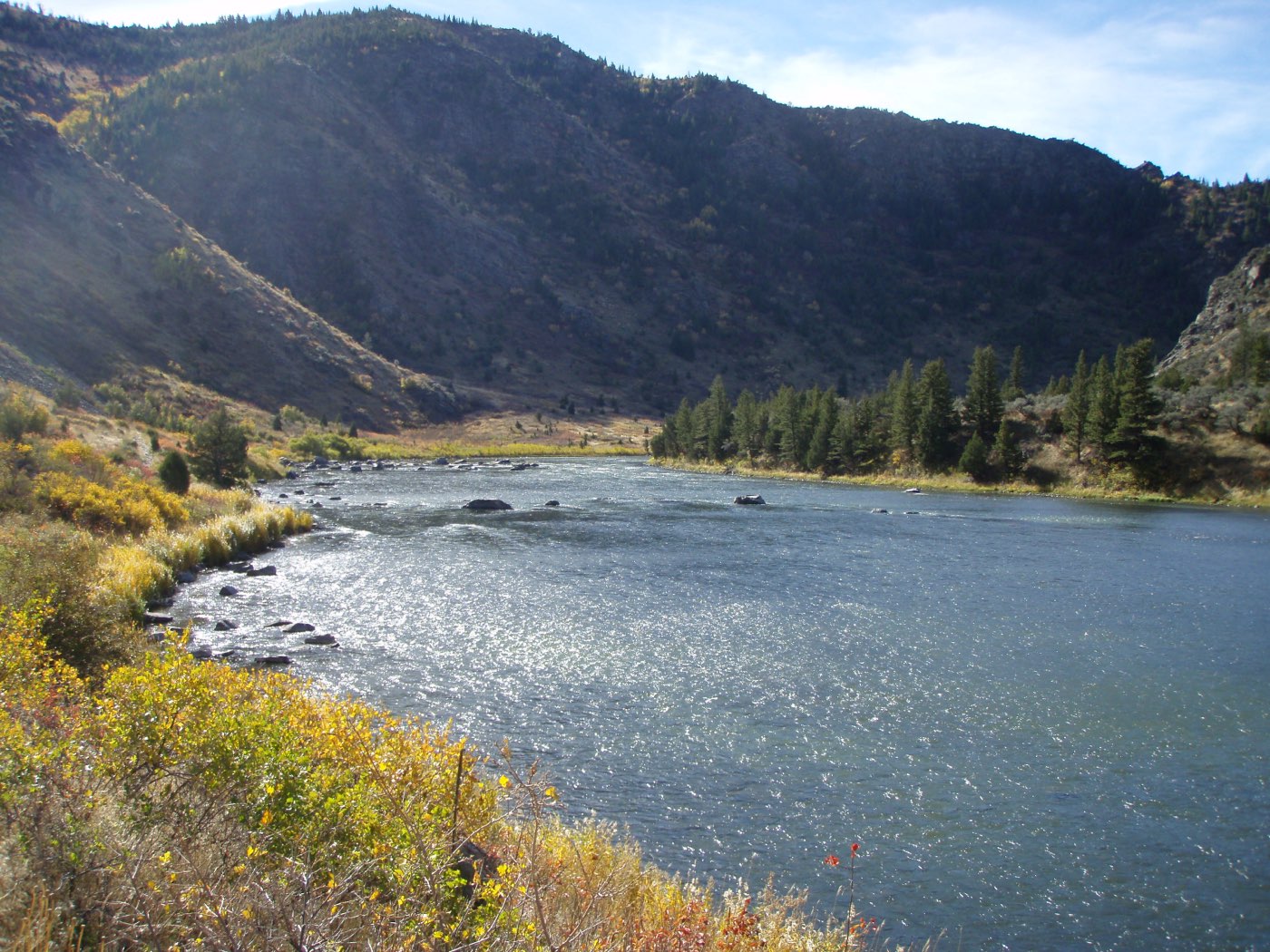
The Madison River runs 183 miles from the confluence of the Firehole and Gibbon in Yellowstone National Park to Three Forks, Montana, where it joins the Jefferson and Gallatin to form the Missouri. Fly anglers fish three distinct sections, each requiring different tactics:
- The Park stretch — Madison Junction to West Yellowstone. Slow meadow water with cruising rainbows and browns; tough fishing, technical presentations.
- Hebgen-to-Quake to the Lower Madison — the famous 50-mile riffle, freestone water with constant flow, the section most anglers mean when they say "the Madison."
- The Lower Madison — Bear Trap Canyon to Three Forks. Tailwater with predictable hatches; warmer water that limits summer afternoon fishing.
This guide focuses on the 50-mile riffle (sections 2–3 above), which is the section that justifies the river's reputation.
The fish
Wild brown and rainbow trout, no stocking. The browns average 14–18 inches, and a legitimate 20-inch fish is possible throughout the river — not just in the trophy water. Rainbows run slightly smaller and fight harder. The Bear Trap Canyon section below Ennis Lake holds the largest concentration of big fish on the river, protected by catch-and-release, artificials-only regulations.
When to fish
May – mid-June (runoff): Hebgen Lake moderates spring flows, so the Madison doesn't blow out the way an unimpounded freestone does — but it colors up and rises, and dry-fly fishing gets difficult. Czech nymphing the soft-water edges and streamer fishing produce best until the river clears.
June 20 – early July: Salmonfly hatch on the Madison from Lyons Bridge upstream toward Quake Lake. The hatch initiates when water temperature hits 50°F at a given point, then moves upstream at roughly 2–5 miles per day — figure 3–5 fishable days per reach, so call the local shops the week before your trip rather than guessing. Cast big foam patterns; a Fishpond Thunderhead Submersible Sling fits the fly volume needed. Crowded, but the fishing justifies the crowds. Caddis and pale morning duns overlap.
Mid-July through August: Hopper fishing along grassy banks below Ennis Lake and in the lower river. Trico spinner falls in early-morning slow water. Evening caddis are reliable from the Quake Lake outflow downstream — Elk Hair Caddis in tan and olive, 14–16. Tricky afternoon fishing — water temps push 70°F by 2pm in the lower river; fish early and late, be off the water by early afternoon on hot days, and check temps with a stream thermometer.
September – October: Fall blue-winged olives, October caddis, brown trout pre-spawn aggression. Streamer water comes alive — September and October streamer fishing here is some of the best in Montana, with large browns chasing flies along the banks in the morning and evening. Fewer anglers, harder weather, the best dry-fly fishing of the year if you catch a clear afternoon. Browns move onto gravel in October — if you see spawning fish in the riffles, give them a wide berth and move on.
Winter (December – March): Open year-round below Hebgen. Midges, BWOs on warm days, slow nymph fishing. The stretch near Quake Lake fishes best — thermal influence keeps water temps from crashing. Standard rig: a Zebra Midge or RS2 on 6X fluorocarbon under a small indicator. Crowds are minimal. Dress for it.
What to fish
Carry these in the listed sizes. Trim or expand based on the hatch:
- Salmonfly dries (size 4–8): Chubby Chernobyl, Rogue Stone, Madison Stone — June only
- Caddis dries (14–18): Elk Hair Caddis, X-Caddis, Iris Caddis
- Mayfly dries (16–20): Parachute Adams (see our pattern guide), PMD Sparkle Dun, BWO Comparadun
- Hoppers (8–12): Morrish Hopper, Chubby Chernobyl in tan
- Nymphs (12–18): Pheasant Tail, Hare's Ear, Pat's Rubber Legs (4–8 for stones), Zebra Midge
- Streamers (4–8): Sex Dungeon, Sparkle Minnow, Kreelex
Tippet: 4X for streamers and stones, 5X for hoppers, 5X–6X for caddis and mayflies.
How to fish it
The 50-mile riffle is the longest sustained riffle in the Lower 48. The water runs 2–5 ft deep across most of it, with constant cobble bottom and broken surface. Reading water in this kind of consistent flow is harder than reading a pool-and-run river — the fish are everywhere and nowhere. Two techniques produce:
Wading the buckets. Cover water on foot, looking for slight depth changes (deeper buckets), bank cuts, and submerged rocks. Cast across and slightly upstream, dead-drift, mend mid-drift. The boring water actually holds fish — many anglers wade past prime water looking for "obvious" structure.
Drift boat hopper-dropper. Indicator and a 12–18 inch dropper off a hopper. Cast tight to the bank from a moving boat. Most outfitters in Ennis, Cameron, and West Yellowstone run this; a half-day float runs $400–600.
For wading anglers, high-stick nymphing works in the pocket water around boulder gardens between the West Fork and Lyons Bridge.
Access
Public access is excellent. Montana FWP Fishing Access Sites cover the entire 50-mile riffle at intervals of every 2–5 miles. Pull the official FAS map from the Montana FWP site before any trip — boundaries shift, and a few sites switch between primitive and improved status year to year. Notable accesses, top to bottom:
- Quake Lake to $3 Bridge — roadside pullouts along US-287 the whole way; heavily waded water, so go early
- Raynolds Pass / $3 Bridge — the most popular access on the river; easy parking, good wading, crowded on summer weekends; also the upstream boundary of the wade-only catch-and-release rainbow zone
- West Fork — central salmonfly water in late June; primitive boat ramp
- Lyons Bridge — concrete ramp; the most-used put-in for the upper float through Cameron
- Varney Bridge — concrete ramp; standard take-out for the Lyons-to-Varney float (about 9 miles, half-day at moderate flow)
- Eight Mile Ford / Ennis — primitive ramps along the Ennis stretch; town fly shops cluster here. The town reach itself wades easily, fishes well in the evening, and sees lighter pressure than the middle river
- Valley Garden / McAtee Bridge — boat take-out for the Varney-to-McAtee float (~6 miles); good wade access downstream
- Bear Trap Canyon — the trophy section below Ennis Lake; a 1.5-mile trail in, catch-and-release, artificials only. Worth the hike for solitude and the river's biggest fish
- Greycliff / Cobblestone (Lower Madison) — below Bear Trap, tailwater stretch with concrete ramps
Wade vs. float. The wade-only catch-and-release section between Quake Lake and Lyons Bridge has no boat fishing — drift through it without anchoring or casting. Below Lyons Bridge through the lower river, anglers can fish from boats. Most outfitters in Cameron, Ennis, and West Yellowstone run the Lyons-to-Varney or Varney-to-McAtee floats; a half-day runs $400–600.
Public land + stream access. The river corridor is mostly BLM, MFWP, and USFS land. Where it runs through private property, Montana's stream access law (76-13-101 et seq.) lets the public wade and fish below the ordinary high-water mark — but you cannot cross private upland to reach the river without permission. Use FAS sites for ingress, then wade up or down.
Regulations
Read the current Montana FWP regulations before fishing — they change yearly and the Madison has more zone-specific rules than most rivers in the state.
The fixed elements:
- License required. Non-resident anglers need a Montana fishing license plus a conservation license; both are sold on Montana FWP's site or at any Madison Valley fly shop.
- Single barbless hook, no bait, throughout the upper river to Ennis Lake.
- Catch-and-release on rainbow trout in defined zones, including the wade-only stretch above Lyons Bridge. Brown trout and other species have separate, varying limits.
- Bear Trap Canyon is catch-and-release, artificial lures and flies only — the special regulation is what sustains the big-fish population there.
- The Park stretch above Hebgen falls under Yellowstone National Park rules, not Montana FWP: a park fishing permit is required and all native cutthroat are catch-and-release.
- Hoot Owl restrictions kick in when water temps hit 73°F for three consecutive days — no fishing 2pm–midnight. Triggered every August in recent years on the lower river. Check the FWP drought-response page before driving in for an afternoon session. Agricultural water releases also move late-season flows around — the Madison Valley Ranchlands Group publishes the release schedules, and local shops track them.
- Section closures. Portions close for spawning protection (rainbow in spring, brown in fall). Specific dates and miles change; the regulations booklet is the source of truth.
The Montana FWP regulations booklet is free at every fly shop in the valley. Pick one up.
Where to base
- West Yellowstone, MT — best for the upper river and Park access. Slide Inn, Madison Crossing Lodge.
- Ennis, MT — center of the lower river fishery, most outfitters and fly shops. The Trout Shop, The Tackle Shop.
- Bozeman, MT — 1 hour to the Lower Madison, cheaper lodging, broader food/lodging options.
Guides and shops
Use the local fly shops as the entry point. They book guides, sell daily licenses, and update flow and hatch info that's a week ahead of anything online. Brief picks, not a directory:
- The Tackle Shop (Ennis) — oldest shop in the valley; deep guide bench, walk-in friendly.
- The Trout Shop (Ennis) — strong wade-trip programs and reliable rentals.
- Madison River Fishing Company (Ennis) — publishes a weekly conditions report that is accurate and worth reading before any trip.
- Galloup's Slide Inn (Cameron) — Kelly Galloup's shop and lodge; streamer culture, intermediate-to-advanced clientele.
- Madison River Outfitters (West Yellowstone) — best for the Park stretch and upper river floats.
- Blue Ribbon Flies (West Yellowstone) — fly tying horsepower; the place to match a tricky hatch.
Outside the valley, Yellowstone Angler (Livingston) and Montana Troutfitters (Bozeman) both book Madison trips and cover Yellowstone-area logistics in one stop.
A guide trip on the Madison costs $650–800 for a full day for two anglers in 2026, plus tip and lunch. Book 60+ days out for late-June salmonfly week — that window books out by April most years.
What to bring
- Stockingfoot waders + studded boots: cobble is slick. Simms G3 Guide Stockingfoot Waders for cold mornings.
- A 9ft 5wt for everything except salmonflies and heavy streamer work (a 9ft 6wt makes the big foam casts easier and loads better with runoff-season rigs). A RIO Gold WF5F covers the general-purpose fishing; add a sink-tip line for fall streamers.
- A landing net — wading the riffle without one means losing fish at your feet. Fishpond Nomad Mid-Length Net.
- Layers. The Madison Valley sits at 5,000–6,000 ft elevation; mornings are 35°F in July, afternoons 80°F.
- A stream thermometer. Hoot Owl restrictions (no fishing 2pm–midnight) trigger when water temps hit 73°F. The river will be closed to afternoon fishing in most Augusts.