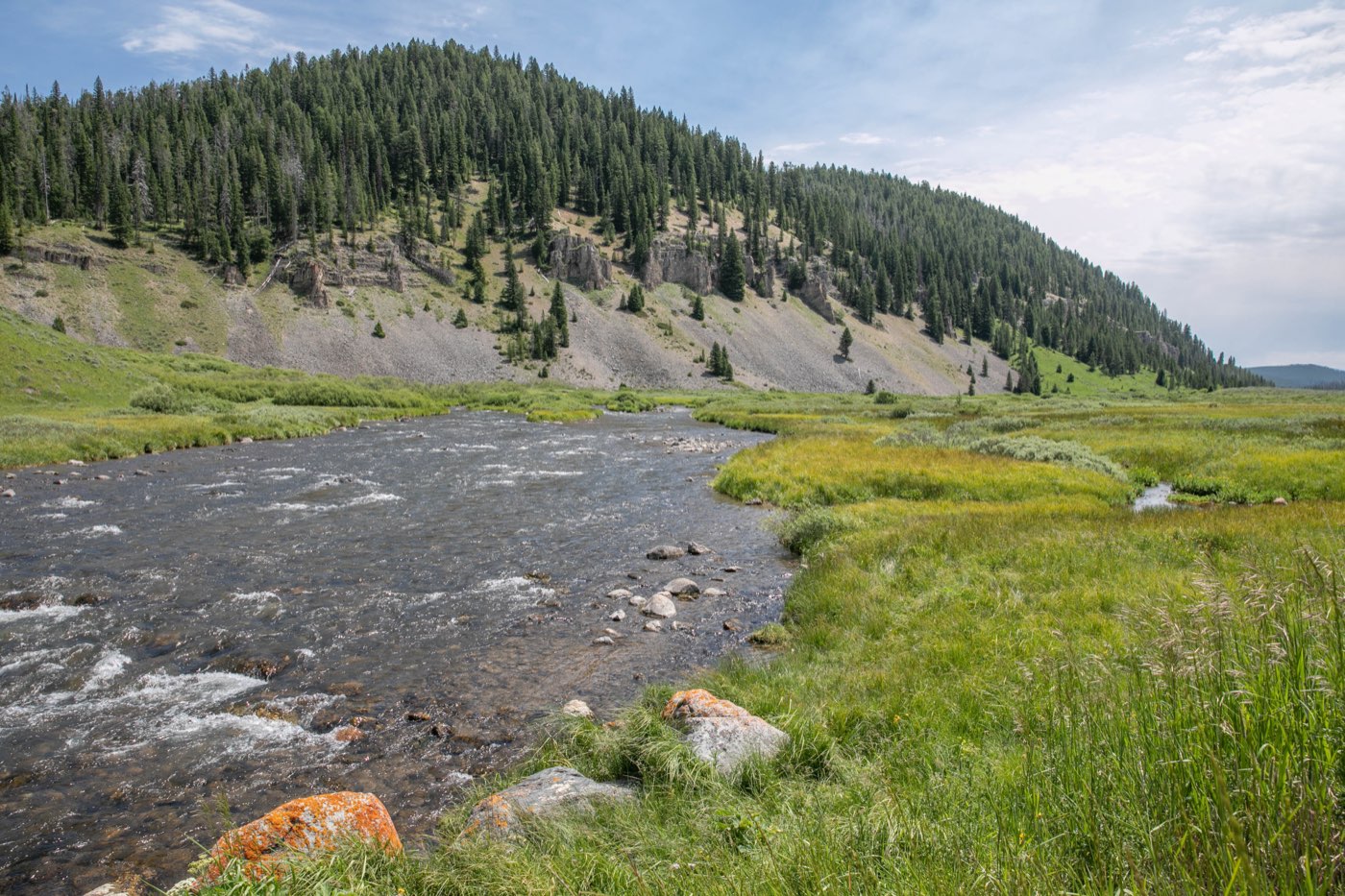
The Gallatin runs 120 miles from its headwaters in Yellowstone National Park north through a steep limestone canyon to Three Forks, where it joins the Jefferson and Madison to form the Missouri. The canyon stretch—US-191 from Big Sky north to Gallatin Gateway—is what most anglers mean when they say the Gallatin. The highway follows the river the entire way, meaning roadside access to 50 miles of fishable freestone water with no shuttle required.
This is not the Missouri. The Gallatin is smaller, faster, and more physical—a wade-primary river with boulder gardens, pocket water, and tight casting lanes. The trout aren't as large on average and aren't as numerous per mile as the tailwater fisheries to the east. What the Gallatin offers instead: wild fish in wild water, a lower technical bar for newcomers relative to the Missouri's hatch-matching demands, and proximity to Bozeman and Big Sky that puts it within reach of anglers who aren't planning a dedicated fly fishing trip.
When to fish
March – April: Runoff starts building in April and peaks in May. Early spring offers the last low-clear-water window before runoff; the river fishes well in March for anglers willing to work nymphs through cold water. Baetis (BWO) hatches come off on warm afternoons.
Late June – July: The canyon clears after peak runoff and the best dry fly fishing of the year starts. Golden stoneflies hatch in late June and early July; fish big foam attractors and stimulators tight to the bank. Caddis (size 14–16) follow through the summer and produce reliable evening rises.
August: Hopper season along grassy banks in the lower canyon and upper meadow sections. Water temps in the lower river can push into the mid-60s by August afternoons; fish mornings and evenings, or move upstream where the water runs colder.
September – October: Fall brings cooling temps, blue-winged olive hatches on overcast afternoons, and pre-spawn brown trout aggression in the lower canyon. Less crowded than summer; some of the best fishing of the year for anglers who can tolerate variable weather.
Winter: The canyon closes to fishing between certain sections during winter spawning protection periods. Check Montana FWP regulations—closed sections and dates change. The accessible sections fish on midges.
What to fish
The Gallatin's character—fast freestone water, pocket water, pocket water, more pocket water—favors prospecting and attractor patterns over precise hatch-matching. That said, the hatches matter in the evenings:
- Golden stonefly dries (6–10): Stimulator, Chubby Chernobyl in gold — late June to mid-July
- Caddis dries (14–16): Elk Hair Caddis, X-Caddis — July through September evenings
- Hopper attractors (8–12): Morrish Hopper, Chubby in tan — August along grassy banks
- BWO dries (18–22): Comparadun, Parachute Adams — spring and fall, overcast afternoons
- Nymphs (14–18): Frenchie, Perdigon, Hare's Ear, Pheasant Tail
- Stonefly nymphs (6–10): Pat's Rubber Legs, Kaufmann Stone — year-round in deeper pockets
Tippet: 4X for attractors and stonflies, 5X for caddis and smaller dries. The Gallatin's broken water surface is forgiving on tippet diameter relative to the Missouri's flat runs.
How to fish it
Wading the canyon. The Gallatin is a wading river. The canyon stretch has almost no float traffic—the gradient is too steep and the boulder gardens too frequent for drift boats. This makes it unusual among Montana blue-ribbon rivers: you get the water to yourself in a way that's rare on the Madison or Missouri.
The standard approach is drive-and-wade. Pull off US-191 at any of the designated pullouts, work upstream or downstream from the road, cover water. The fish hold in the pocket water behind boulders, in the heads and tails of pools, and along undercut banks. High-stick nymphing through the pockets produces all day; switch to dries when you see rises or at hatch time.
Reading the canyon water. Look for the transition zones—where fast riffle water dumps into the head of a pool, where current slackens behind a boulder, where a bank cut creates a slow edge against fast mid-current. The Gallatin doesn't have the uniform depth of the Missouri. The productive lies are specific and usually obvious once you've trained your eye to look for them.
The Yellowstone Park section. Above the park boundary, the upper Gallatin runs through open meadows with cutthroat and brook trout under Yellowstone's regulations: NPS fishing permit required (available at park entrances), catch-and-release for native cutthroat, specific gear restrictions. Check current NPS rules before fishing inside the park. The meadow character is completely different from the canyon—slower, more technical, tighter presentation.
Access
US-191 is the access road for the canyon stretch. Designated pullouts line the highway; parking is primitive (gravel shoulder) at most. Key reference points, upstream to downstream:
- Taylor Fork confluence — 45.173°N, 111.163°W — transition from open valley to upper canyon; good access to both the mainstem and the Taylor Fork tributary
- Greek Creek FAS — 45.340°N, 111.129°W — managed FAS with pit toilet; one of the better parking areas in the mid-canyon
- Storm Castle / Portal Creek area — 45.479°N, 111.081°W — mid-canyon access with good pocket water upstream and downstream
- Moose Creek Flat — 45.520°N, 111.064°W — wider valley section; good wade access and a slightly different character than the tight canyon water
- Gallatin Gateway — 45.627°N, 111.120°W — lower canyon exit; transition to valley water where private land starts
Montana's stream access law applies through the canyon. Most land adjacent to US-191 is Gallatin National Forest, so there are few access restrictions. The exceptions are at the upper end near private ranches and at the lower end where the river exits the canyon near Gallatin Gateway—stay below the high-water mark.
Regulations
The canyon stretch (below the Yellowstone Park boundary to Gallatin Gateway) is governed by Montana FWP regulations. Key points:
- Non-resident license required — Montana fishing license plus conservation license, sold at Bozeman fly shops or on the Montana FWP website.
- Season: Generally open the third Saturday in May through November 30 for the canyon stretch, with some sections having extended or year-round seasons. Verify current dates in the FWP regulation booklet.
- No bait in most canyon sections. Artificial lures and flies only — confirm the specific section before fishing.
- Catch-and-release on cutthroat trout — the upper canyon and park-adjacent sections protect native fish; verify the boundary for the section you're fishing.
- Inside Yellowstone National Park: NPS fishing permit required, different regulations apply. Available at park entrance stations.
The Montana FWP regulations booklet is free at every Bozeman fly shop. Pick one up before the trip.
Where to base
- Bozeman, MT — the natural hub; 45–60 minutes from the mid-canyon, full hotel and restaurant infrastructure, both major fly shops.
- Big Sky, MT — inside the canyon, closer to the mid and upper water; ski-resort lodging and restaurants. More expensive than Bozeman; better if you're combining skiing and fishing in shoulder seasons.
- West Yellowstone, MT — 90 minutes from the lower canyon; better as a hub for the Madison and Yellowstone rivers than the Gallatin.
Guides and shops
Both Bozeman shops know this river well and guide it regularly:
- Gallatin Riverguides (Bozeman) — the primary operation on the Gallatin; half-day and full-day wade trips in the canyon, float trips on the lower river in spring.
- East Slope Outdoors (Bozeman) — smaller shop, strong local knowledge, good for walk-in trip planning and fly selection advice.
- Montana Troutfitters (Bozeman) — also books Gallatin wade trips; strong guide bench and useful for combining a Gallatin day with a Missouri or Yellowstone float.
Guide rates for a half-day wade trip: $350–450 for two anglers in 2026. A full day runs $550–650. The Gallatin is one of the more accessible guided experiences in Montana for newer fly anglers specifically because the wade format and prospecting-friendly water reduce the technical pressure.
What to bring
- Wading boots with felt or rubber studs: the Gallatin's limestone boulders are slippery. Simms G3 Guide Stockingfoot Waders or a lighter wading shoe works; you'll cover more ground here than on a flat Missouri wade.
- A 9ft 5wt handles all situations. A shorter rod (8–8.5ft) is easier to manage in the tighter canyon sections but not necessary.
- A landing net — Fishpond Nomad Mid-Length Net — particularly useful when landing fish in fast water without a good gravel bar nearby.
- Layers. The canyon runs east-west in sections; morning shadow makes it feel 15°F colder than the afternoon.
- Polarized glasses. Spotting fish in the pocket water is the difference between fishing where trout are and fishing where they aren't.
Closest gauge
USGS 06043500 — Gallatin River at Gallatin Gateway, MT — the downstream gauge for canyon conditions. Good wade flows: 400–900 cfs. Above 1,200 cfs the canyon water gets pushy and fast; below 300 cfs in late summer, water temps in the lower canyon become a concern.
Where to fish next
- Madison River, Montana — the natural comparison; bigger water, more float-oriented, the benchmark Montana freestone experience
- Missouri River, Montana — the tailwater counterpart; if the Gallatin's prospecting style leaves you wanting more technical hatch-matching, the Missouri is the next step
Last updated: May 2026. Affiliate disclosure: Cast & Tie earns a commission on purchases made through links on this page at no additional cost to you.